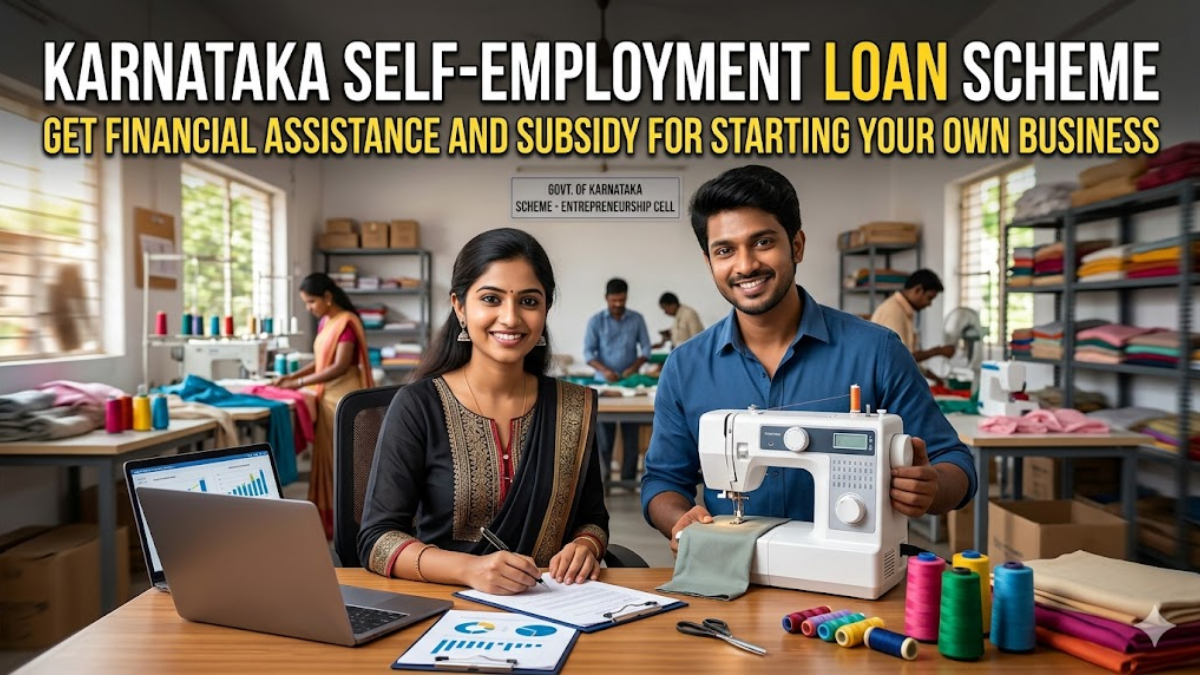
Finding stable employment has become increasingly challenging for many educated young people. As a result, self-employment and entrepreneurship are becoming attractive alternatives. Whether you are planning to start a small retail shop, dairy farming unit, sheep rearing business, or another income-generating activity, access to capital is often the biggest obstacle.

To encourage self-reliance and economic development among disadvantaged communities, the Government of Karnataka offers financial assistance through various development corporations. Under certain self-employment programs, eligible beneficiaries can receive subsidized loans with low interest rates, helping them establish or expand their businesses.
This guide explains the key features of the scheme, eligibility requirements, subsidy benefits, documents needed, and the application process.
Purpose of the Scheme
The primary objective of the self-employment loan program is to support individuals from economically weaker sections by providing financial assistance for income-generating activities. Instead of depending solely on employment opportunities, beneficiaries are encouraged to create sustainable livelihoods through entrepreneurship and small-scale business ventures.
The scheme aims to:
- Promote self-employment among eligible citizens.
- Improve economic conditions of disadvantaged communities.
- Support small business development.
- Reduce unemployment.
- Encourage entrepreneurship in rural and urban areas.
Major Benefits of the Loan Scheme
One of the most attractive aspects of the program is the combination of government subsidy and low-interest financing.
1. Subsidy Support
Eligible applicants may receive a subsidy of up to 50% of the approved project cost, subject to scheme guidelines and limits.
A subsidy is a financial contribution provided by the government that generally does not need to be repaid. This significantly reduces the financial burden on the beneficiary.
2. Affordable Interest Rate
The remaining amount is usually provided as a loan at a concessional interest rate, often much lower than commercial lending rates. In many cases, the interest rate is around 4% per annum.
This allows entrepreneurs to manage repayments more comfortably while focusing on business growth.
3. Support for Various Business Activities
The scheme may support several types of self-employment projects, including:
- Dairy farming
- Sheep and goat rearing
- Poultry farming
- Small retail shops
- Service-based businesses
- Agricultural allied activities
- Micro-enterprises
- Rural entrepreneurship projects
4. Online Application Facility
Applicants can generally submit applications through the appropriate government portals, making the process more accessible and transparent.
Who Can Apply?
The scheme is intended for specific categories of beneficiaries. Applicants must satisfy the eligibility conditions prescribed by the concerned development corporation.
Community Eligibility
The program is generally designed for individuals belonging to:
- Scheduled Castes (SC)
- Scheduled Tribes (ST)
- Minority communities
Applicants should verify the latest eligibility criteria with the concerned authority before applying.
Age Requirement
Applicants are generally expected to be between:
21 years and 60 years of age
The age limits may vary slightly depending on the corporation or specific scheme guidelines.
Residency Requirement
Applicants should be permanent residents of Karnataka and must be able to provide valid proof of residence.
Income Criteria
Family income should fall within the limits prescribed by the government. Income certificates issued by the competent authority are typically required to establish eligibility.
Understanding the Subsidy with an Example
Many applicants are confused about how the subsidy and loan components work together. The following example makes it easier to understand.
Suppose an individual proposes a business project costing ₹1,00,000.
If the scheme provides a subsidy of 50%, the government contributes:
- Subsidy: ₹50,000
The remaining amount is financed through a loan:
- Loan: ₹50,000
The beneficiary generally repays only the loan portion according to the prescribed repayment schedule and interest rate.
This arrangement substantially lowers the financial risk associated with starting a new business.
In larger projects, the subsidy amount may increase according to approved project costs and applicable scheme limits. Certain programs may provide assistance that reaches several lakhs of rupees, depending on eligibility and project viability.
Types of Projects That May Be Considered
The scheme often supports practical and income-generating ventures that can create sustainable livelihoods.
Dairy Farming
Dairy farming remains one of the most popular self-employment options. Assistance may be used for:
- Purchase of milch animals
- Construction of sheds
- Feed and equipment
- Dairy infrastructure
Sheep and Goat Rearing
Livestock-based businesses can provide regular income through breeding and sales. Funding may help cover:
- Purchase of animals
- Veterinary expenses
- Housing facilities
- Feed requirements
Small Retail Shops
Individuals interested in starting a shop may utilize the assistance for:
- Initial inventory
- Furniture and fixtures
- Rental deposits
- Working capital
Service Businesses
Financial assistance may also support activities such as:
- Repair centers
- Tailoring units
- Beauty parlors
- Mobile service shops
- Other small enterprises
Documents Required for Application
Applicants should keep all required documents ready before beginning the application process.
Aadhaar Card
A valid Aadhaar card is generally mandatory. It is advisable to ensure that the mobile number linked to Aadhaar is active.
Caste Certificate
Applicants claiming eligibility under SC, ST, or other designated categories must provide a valid caste certificate.
Income Certificate
An income certificate issued by the competent authority is typically required to verify family income.
Ration Card
A ration card may be required as supporting documentation. Beneficiaries holding eligible ration cards may receive priority under certain schemes.
Bank Account Details
Applicants should provide:
- Bank passbook copy
- Account number
- IFSC code
The financial assistance is generally transferred directly to the beneficiary’s bank account.
Passport-Size Photograph
Recent passport-size photographs may be required for the application.
Project Report
A project report is one of the most important documents.
The report should explain:
- Nature of the business
- Estimated project cost
- Expected income
- Required investment
- Business objectives
A well-prepared project report can improve the chances of approval.
Step-by-Step Application Process
The exact process may vary depending on the implementing agency, but the following steps provide a general overview.
Step 1: Visit the Official Portal
Access the designated government portal or the website of the concerned development corporation.
Step 2: Select the Appropriate Scheme
Identify the self-employment loan scheme that matches your category and business proposal.
Step 3: Register and Log In
Create an account if required and complete the registration process.
Step 4: Fill in Personal Details
Provide information such as:
- Name
- Address
- Age
- Community category
- Contact details
Step 5: Enter Business Information
Describe the proposed business activity and provide project-related information.
Step 6: Upload Documents
Upload scanned copies of all required documents in the prescribed format.
Step 7: Review and Submit
Carefully verify all details before submitting the application.
Step 8: Save the Acknowledgement
After submission, download or print the acknowledgement receipt for future reference.
What Happens After Submission?
Once the application is submitted, it generally goes through several stages of verification.
Document Verification
Authorities verify the authenticity of submitted documents.
Field Inspection
In some cases, officials may conduct field inspections to assess the feasibility of the proposed business.
Approval Process
Applications meeting all requirements are forwarded for sanction and approval.
Release of Funds
After approval, the sanctioned amount is usually credited to the beneficiary’s bank account according to scheme rules.
Estimated Processing Time
Processing times may differ depending on the number of applications received and administrative procedures.
Generally, applicants may expect:
- Initial scrutiny and verification
- Field-level assessment
- Approval and sanction
- Fund release
The complete process can take several months, so applicants should regularly monitor the status of their application.
Tips to Improve Approval Chances
Keep Documents Updated
Ensure that caste certificates, income certificates, and other supporting documents are valid and current.
Prepare a Strong Project Report
A clear and realistic business proposal demonstrates seriousness and feasibility.
Provide Accurate Information
Incorrect or incomplete information may result in delays or rejection.
Attend Any Required Training
For activities such as dairy farming, livestock rearing, or specialized businesses, training certificates may strengthen the application.
Maintain a Functional Bank Account
Ensure that your bank account is active and capable of receiving direct benefit transfers.
Frequently Asked Questions
Can I apply if I have previously received benefits under another government subsidy scheme?
Eligibility depends on the rules of the specific program. Many schemes restrict multiple subsidies for the same beneficiary. Applicants should check the latest guidelines before applying.
Is the subsidy amount repayable?
Generally, a subsidy is financial assistance provided by the government and does not require repayment, subject to compliance with scheme conditions.
What is the typical interest rate on the loan component?
The interest rate may vary depending on the implementing authority and scheme guidelines. Applicants should verify the latest rate at the time of application.
Can rural residents apply?
Yes. Many self-employment schemes are specifically designed to support rural entrepreneurs and small-scale business owners.
Is online application mandatory?
Many schemes now encourage online applications through government portals, though procedures may differ depending on the implementing agency.
Conclusion
The Karnataka Self-Employment Loan Scheme offers an excellent opportunity for eligible individuals to establish their own businesses with government support. By combining subsidy assistance and affordable loans, the program helps reduce financial barriers that often prevent aspiring entrepreneurs from turning their ideas into reality.
Whether you plan to start a dairy farm, livestock enterprise, retail shop, or service business, this initiative can provide valuable financial backing. Interested applicants should carefully review the latest eligibility criteria, prepare the required documents, and submit their applications through the appropriate government channels.
With proper planning, dedication, and responsible use of financial assistance, beneficiaries can build sustainable livelihoods and contribute to the economic growth of their communities.