Introduction
India is rapidly moving toward a cleaner and more sustainable energy future. To achieve energy security, reduce electricity costs for households, and promote renewable energy, the Government of India launched the PM Surya Ghar Muft Bijli Yojana. This ambitious scheme aims to encourage residential households to install rooftop solar panels and generate their own electricity.
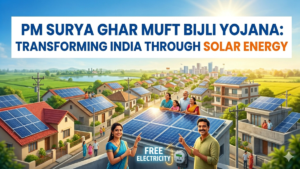
Announced by the Central Government in 2024, the PM Surya Ghar Muft Bijli Yojana is one of the largest residential solar energy programs in the world. The scheme seeks to provide substantial financial assistance to households for installing rooftop solar systems, helping families reduce their electricity bills while contributing to environmental protection.
This initiative represents a major step toward India’s goal of increasing renewable energy capacity and achieving sustainable development. By enabling citizens to become producers of clean energy, the scheme promotes both economic savings and environmental responsibility.
What is PM Surya Ghar Muft Bijli Yojana?
PM Surya Ghar Muft Bijli Yojana is a government-sponsored program designed to support the installation of rooftop solar panels in residential homes across India. The scheme provides financial subsidies to eligible households, making solar energy more affordable and accessible.
The primary objective of the program is to help households generate their own electricity through solar power. This reduces dependence on conventional electricity sources and lowers monthly power bills. Under the scheme, households can install rooftop solar systems and receive government subsidies based on the system capacity.
The government aims to benefit millions of households through this initiative and promote widespread adoption of renewable energy technologies.
Objectives of the Scheme
The PM Surya Ghar Muft Bijli Yojana has several important objectives:
1. Promote Renewable Energy
The scheme encourages the use of solar energy, a clean and renewable source of power. This helps reduce dependence on fossil fuels and supports India’s green energy goals.
2. Reduce Electricity Bills
Households can significantly lower their electricity expenses by generating electricity from solar panels installed on their rooftops.
3. Increase Energy Independence
The program empowers citizens to produce their own electricity, reducing dependence on the traditional power grid.
4. Protect the Environment
Solar energy produces no harmful emissions during operation. Increased use of solar power contributes to reduced carbon emissions and environmental conservation.
5. Generate Employment
The installation, maintenance, manufacturing, and distribution of solar equipment create employment opportunities in various sectors.
6. Strengthen India’s Energy Security
By increasing domestic renewable energy production, India can reduce reliance on imported fuels and strengthen national energy security.
Key Features of PM Surya Ghar Muft Bijli Yojana
The scheme includes several attractive features designed to encourage public participation.
Financial Subsidy
The government provides direct financial assistance for installing rooftop solar systems. The subsidy amount depends on the capacity of the solar system installed.
Easy Application Process
Citizens can apply through the official online portal, making the process transparent and convenient.
Direct Benefit Transfer
Subsidy amounts are transferred directly to the beneficiary’s bank account after successful installation and verification.
Net Metering Facility
Beneficiaries can export excess electricity generated by their solar panels to the grid. This allows them to receive credits or compensation for surplus power generation.
Nationwide Coverage
The scheme is available across India, benefiting households in urban, semi-urban, and rural areas.
Eligibility Criteria
To avail benefits under the PM Surya Ghar Muft Bijli Yojana, applicants generally need to meet the following conditions:
Residential Ownership
The applicant must be a resident of India and own a house suitable for rooftop solar installation.
Electricity Connection
The household should have a valid electricity connection in the applicant’s name.
Rooftop Availability
The property must have adequate rooftop space capable of supporting solar panel installation.
Single Benefit Rule
A household can generally avail the subsidy benefit once under the scheme.
Applicants should verify the latest eligibility requirements through official government guidelines before applying.
Subsidy Structure
One of the most attractive aspects of the scheme is the financial support provided by the government.
The subsidy amount varies according to the capacity of the rooftop solar system installed. Smaller systems receive support suitable for average household consumption, while larger systems may qualify for higher subsidy amounts.
The subsidy significantly reduces the initial investment required for solar installation, making renewable energy affordable for middle-income and lower-income families.
By lowering installation costs, the government aims to accelerate the adoption of rooftop solar systems throughout the country.
How Rooftop Solar Systems Work
Understanding the basic functioning of rooftop solar systems helps citizens appreciate the benefits of the scheme.
Solar Panels
Solar panels capture sunlight and convert it into direct current (DC) electricity.
Inverter
An inverter converts DC electricity into alternating current (AC), which is used by household appliances.
Consumption
The generated electricity powers lights, fans, televisions, refrigerators, air conditioners, and other household devices.
Net Meter
A net meter records both electricity consumption and excess electricity supplied to the grid.
Grid Interaction
When solar generation exceeds household requirements, surplus power is exported to the electricity grid. When solar production is insufficient, electricity is drawn from the grid.
This arrangement ensures a reliable power supply throughout the day and night.
Benefits for Households
Lower Electricity Bills
Perhaps the most immediate benefit is a substantial reduction in monthly electricity expenses.
Long-Term Savings
Solar systems generally operate efficiently for many years, providing long-term financial benefits after installation.
Increased Property Value
Homes equipped with solar power systems often enjoy increased market value due to lower operating costs.
Reliable Energy Source
Solar energy offers a dependable source of electricity, particularly during periods of high energy demand.
Government Support
Subsidies reduce the financial burden associated with installing solar systems.
Environmental Benefits
The PM Surya Ghar Muft Bijli Yojana contributes significantly to environmental sustainability.
Reduction in Carbon Emissions
Solar energy generation produces no greenhouse gas emissions during operation.
Cleaner Air
Increased use of renewable energy reduces pollution caused by conventional power generation.
Conservation of Natural Resources
Solar energy reduces dependence on coal, oil, and natural gas, helping conserve finite natural resources.
Climate Change Mitigation
Greater adoption of renewable energy helps combat global climate change by reducing carbon footprints.
Economic Impact
The scheme is expected to have a positive impact on India’s economy.
Job Creation
The solar industry requires skilled workers for manufacturing, installation, maintenance, logistics, and customer support.
Growth of Domestic Manufacturing
Increased demand for solar panels and related equipment encourages domestic manufacturing and industrial growth.
Reduced Energy Imports
Higher domestic energy production can decrease reliance on imported fuels, saving foreign exchange.
Increased Investment
The renewable energy sector attracts investments from private companies, financial institutions, and international organizations.
Role in India’s Renewable Energy Mission
India has set ambitious renewable energy targets to achieve sustainable development and energy security.
The PM Surya Ghar Muft Bijli Yojana supports these goals by encouraging decentralized electricity generation. Instead of relying solely on large power plants, households become active participants in energy production.
This decentralized approach strengthens the overall energy infrastructure and promotes widespread renewable energy adoption.
Challenges and Solutions
While the scheme offers numerous benefits, certain challenges may arise.
Initial Awareness
Many citizens may not fully understand rooftop solar technology.
Solution: Government awareness campaigns and community outreach programs can educate the public.
Rooftop Limitations
Some houses may lack sufficient rooftop space.
Solution: Innovative installation methods and community solar projects can address this issue.
Technical Maintenance
Solar systems require periodic maintenance for optimal performance.
Solution: Professional service providers and maintenance contracts can ensure long-term efficiency.
Financing Concerns
Even after subsidies, some households may find the initial investment challenging.
Solution: Banks and financial institutions can provide affordable loans and financing options.
Application Process
The application process is designed to be simple and transparent.
Step 1: Registration
Applicants register on the designated government portal.
Step 2: Verification
Details related to electricity connections and property ownership are verified.
Step 3: Vendor Selection
Applicants choose an approved vendor for installation.
Step 4: Installation
The rooftop solar system is installed according to technical standards.
Step 5: Inspection
Authorities inspect and verify the installation.
Step 6: Subsidy Disbursement
The subsidy amount is transferred directly to the beneficiary’s bank account.
Future Prospects
The PM Surya Ghar Muft Bijli Yojana has the potential to transform India’s residential energy landscape. As technology becomes more affordable and awareness increases, rooftop solar adoption is expected to grow rapidly.
Future advancements in battery storage, smart grids, and energy management systems will further enhance the effectiveness of residential solar power systems.
The scheme may also inspire additional renewable energy initiatives, helping India move toward a cleaner and more sustainable future.
Conclusion
The PM Surya Ghar Muft Bijli Yojana is a landmark initiative that combines economic benefits, environmental sustainability, and energy independence. By providing financial support for rooftop solar installations, the Government of India is empowering households to generate their own clean electricity while reducing monthly power expenses.
The scheme not only benefits individual families but also contributes to national goals such as renewable energy expansion, carbon emission reduction, employment generation, and energy security. As more households participate, the program will play a vital role in transforming India’s energy sector and building a greener future for generations to come.
Through widespread adoption of rooftop solar systems, PM Surya Ghar Muft Bijli Yojana stands as a powerful example of how government policy can drive sustainable development while improving the quality of life for millions of citizens across the country.