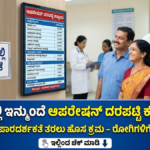
Medical treatment can be expensive, particularly when a patient requires surgery, intensive care, diagnostic tests, or an extended hospital stay. For many families, understanding the total cost of treatment before admission is just as important as choosing the right hospital and doctor.

In Karnataka, discussions and reported measures concerning transparency in private hospital billing have drawn attention to an important issue: patients should be able to understand the charges associated with medical services before making treatment decisions.
The concept of a hospital operation price list is intended to help patients obtain clearer information about surgical procedures, consultation fees, room charges, diagnostic services, and other hospital expenses. Better access to pricing information can make it easier for families to compare available options, prepare their budgets, and ask questions about their medical bills.
However, patients should distinguish between a hospital displaying its charges, an official government direction requiring disclosure, and a legally prescribed maximum price. These are different arrangements. The exact requirements applicable to hospitals in Karnataka should be checked against the relevant official government notification.
In this article, we explain how hospital price lists work, what information patients should look for, how transparent billing can help families, and what to do when a medical bill is unclear.
1. Why Is a Hospital Operation Price List Important?
When a doctor recommends surgery, patients and their families often have several concerns. They want to understand the medical procedure, the expected recovery period, the risks involved, and the total financial commitment.
Unfortunately, the cost of an operation is not always limited to the surgeon’s fee. Depending on the procedure and the patient’s condition, the final bill may include anaesthesia, medicines, diagnostic investigations, hospital accommodation, nursing care, medical equipment, and follow-up services.
Without a clear explanation of these expenses, families may find it difficult to estimate how much money they will need.
A properly prepared hospital price list can provide an initial reference for common procedures and services. It can also help patients identify which charges are included in a quoted package and which may be billed separately.
The purpose is not simply to display numbers on a noticeboard. It is to make medical billing easier to understand and to encourage hospitals to explain their charges clearly.
For patients who are comparing private hospitals, this information may help them make more informed financial decisions without compromising the quality or urgency of medical care.
2. What Is the Purpose of Greater Billing Transparency?
Transparent pricing is an important part of building trust between healthcare providers and patients.
When hospitals explain their charges clearly, patients can discuss treatment options with a better understanding of the financial implications. Families may also find it easier to arrange insurance documents, savings, or other payment resources before planned treatment.
The main objectives of greater price transparency include:
- Clearer treatment estimates: Helping patients understand the expected cost before undergoing planned procedures.
- Better financial planning: Allowing families to prepare for hospital expenses in advance.
- Improved billing accountability: Making it easier to question charges that appear unclear or unexpected.
- Informed hospital comparisons: Helping patients compare the quoted costs of similar services at different facilities.
- Better communication: Encouraging hospitals to explain the services and materials included in a treatment package.
- Greater patient confidence: Reducing uncertainty about the financial side of medical treatment.
Price transparency can be particularly helpful for planned operations, where patients generally have more time to obtain estimates and compare available options.
In an emergency, however, immediate medical attention remains the priority. Families should not delay urgent treatment solely to compare prices.
3. Which Charges May Be Included in a Hospital Price List?
The services covered by a hospital’s published price list can vary depending on its facilities, the procedures it performs, and the applicable rules.
Patients should look for clear information about the following categories.
A. Surgical procedure charges
This category may include prices or estimated package costs for common operations performed at the hospital.
Examples include:
- Cataract surgery
- Hernia repair
- Appendix removal
- Gallbladder surgery
- Caesarean delivery
- Orthopaedic procedures
- Selected laparoscopic operations
- Other major and minor surgical procedures
These examples are illustrative only. Not every hospital performs all these procedures, and there is no single universal price that applies to every patient.
The cost may depend on the complexity of the operation, the equipment required, the surgeon’s assessment, and whether the procedure is routine or complicated.
B. Surgeon and specialist fees
A hospital bill may include professional fees for the surgeon, anaesthesiologist, consulting specialists, and other medical professionals involved in the patient’s care.
Patients should ask whether these fees are included in a quoted surgical package or charged separately.
If multiple specialists are required because of the patient’s medical condition, additional professional fees may apply.
C. Hospital room charges
Room charges can form a significant portion of the overall hospital bill, particularly when a patient requires several days of admission.
Depending on the facility, accommodation options may include general wards, shared rooms, private rooms, and other categories.
The price may vary according to the type of accommodation, hospital location, and services provided.
Patients should also ask whether nursing services, meals, monitoring, and other routine services are included in the room charge.
D. Intensive Care Unit charges
Some patients need intensive monitoring after surgery or because of a serious medical condition.
ICU charges may be different from standard room charges and can depend on the level of care, monitoring equipment, staffing, medicines, and duration of admission.
The need for intensive care cannot always be predicted accurately before treatment. Therefore, an initial estimate may not include every possible expense if the patient’s condition changes.
E. Diagnostic tests and scans
Before or after surgery, doctors may recommend blood tests, imaging, heart examinations, or other investigations.
Depending on the procedure, these may include laboratory tests, X-rays, ultrasound examinations, CT scans, MRI scans, and other diagnostic services.
Patients should ask which tests are included in the treatment estimate and which may be charged separately.
F. Medicines and medical consumables
Hospital bills may include medicines, injections, dressings, disposable supplies, surgical materials, and other items used during treatment.
The exact requirements can differ from one patient to another. Some procedures require specialised implants or medical devices, which can significantly affect the overall cost.
Patients may request an itemised bill showing the relevant charges and quantities.
G. Emergency and additional services
Emergency care, blood-related services, rehabilitation, physiotherapy, and other support services may also contribute to the final bill when medically necessary.
Their availability and pricing depend on the hospital and the patient’s treatment requirements.
4. How Can a Price List Help Patients Before Surgery?
For patients undergoing planned surgery, an advance estimate can provide a clearer picture of the likely financial commitment.
Consider a family whose doctor recommends a surgical procedure. The family may initially receive a single total amount without knowing whether it includes the surgeon’s fees, room accommodation, medicines, and post-operative care.
By requesting a written estimate and reviewing the hospital’s applicable price list, the family can ask more specific questions.
For example:
- What is the estimated total cost of the operation?
- Which services are included in the quoted package?
- Are medicines and medical supplies included?
- Will diagnostic tests be billed separately?
- What happens if the patient requires an additional hospital stay?
- Are there separate charges for ICU care?
- What expenses might arise if complications occur?
These questions help patients understand the difference between an advertised starting price and a realistic estimate for their individual circumstances.
A price list does not guarantee that every patient will pay the same amount. It provides a reference that should be considered alongside the doctor’s treatment plan and the hospital’s explanation of additional charges.
5. Can Transparent Pricing Help Prevent Unexpected Bills?
Clear billing information can reduce confusion, but it cannot eliminate every unexpected medical expense.
A patient’s condition may change during treatment. An operation may require additional equipment, an extended hospital stay, extra investigations, or specialist intervention.
These circumstances can affect the final cost.
Nevertheless, itemised estimates and bills can help families identify the reasons for differences between the expected amount and the amount charged.
Patients should request clarification when a bill contains unfamiliar entries, duplicate-looking charges, unexplained quantities, or services they do not recognise.
If an additional procedure becomes necessary, families can ask the treating team to explain the medical reason and the expected financial implications whenever the circumstances permit.
In emergencies, the need for immediate treatment may limit the opportunity for advance discussion. The hospital can still be asked to explain the charges and provide appropriate billing documentation.
The important principle is that patients should be able to understand what they are being charged for and whom to contact if they need an explanation.
6. What Responsibilities Do Hospitals Have?
Hospitals have an important role in ensuring that patients receive understandable information about the services they provide and the associated costs.
Depending on the applicable legal requirements, registration conditions, government directions, and contractual arrangements, a hospital may have specific obligations concerning the disclosure or display of charges.
Good billing practices generally include:
Displaying relevant pricing information: Making applicable charges accessible to patients and their families.
Providing estimates: Explaining the anticipated cost of planned procedures and identifying important exclusions.
Clarifying package details: Specifying whether professional fees, accommodation, medicines, tests, and other services are included.
Issuing itemised bills: Providing sufficient detail for patients to understand the services and materials charged.
Explaining additional expenses: Clarifying why costs have changed when the treatment requirements differ from the original estimate.
Communicating payment conditions: Explaining deposits, insurance processing, package limitations, and other relevant financial arrangements.
The precise legal duties applicable to an individual hospital should be verified through the relevant official rules. A general recommendation for transparent billing should not be confused with a confirmed statutory requirement or a government-fixed price ceiling.
7. Are Operation Prices the Same in Every Hospital?
No. Medical costs can vary considerably between hospitals.
Differences may arise because of the hospital’s location, infrastructure, specialist services, available technology, accommodation categories, and the complexity of the treatment.
Even two patients undergoing the same type of operation may have different bills because their medical conditions and treatment needs are not identical.
For example, a straightforward procedure may require a shorter hospital stay than the same procedure performed on a patient with additional medical complications.
Similarly, the cost of an operation using a specialised implant may differ from that of a procedure that does not require one.
When comparing estimates, patients should ensure that they are comparing similar services and the same set of inclusions.
A lower initial quotation may exclude items that another hospital has already included in its package. Therefore, the lowest advertised price is not necessarily the lowest final cost.
Patients should also consider the treating doctor’s qualifications, the hospital’s facilities, infection-control standards, emergency support, and the suitability of the recommended treatment.
Financial considerations matter, but the decision should also account for clinical quality and patient safety.
8. What Should Patients Check Before Hospital Admission?
Before agreeing to a planned operation, patients can take several practical steps to understand the financial arrangements.
Step 1: Obtain a written estimate.
Ask the hospital for an estimate based on the recommended procedure and the patient’s medical condition.
Step 2: Request a breakdown of charges.
Check the surgeon’s fees, anaesthesia, room charges, tests, medicines, equipment, and other relevant expenses.
Step 3: Understand the package conditions.
Ask what is included, what is excluded, and whether the package applies only under specific conditions.
Step 4: Ask about possible additional costs.
Clarify how charges may change if the patient needs ICU care, additional tests, or a longer admission.
Step 5: Check insurance coverage.
If the patient has health insurance, confirm the policy’s coverage, exclusions, applicable limits, and approval requirements with the insurer or relevant hospital insurance desk.
Step 6: Keep the documents.
Retain the estimate, consent documents, bills, payment receipts, test reports, and relevant communication with the hospital.
Step 7: Review the final bill.
Before discharge, ask for clarification of unfamiliar entries and check whether the bill corresponds with the services recorded during the hospital stay.
These steps can help patients and their families prepare for treatment and address billing questions more effectively.
9. What Can Patients Do If They Find a Billing Discrepancy?
If a patient believes that a hospital has charged an incorrect amount, the first step is to request a detailed explanation from the hospital’s billing department.
The patient can identify the specific entry in question and ask for supporting information, such as the service description, quantity, applicable rate, or relevant treatment record.
If the issue remains unresolved, the patient may consider approaching the hospital’s grievance or patient-relations department.
Depending on the nature of the complaint, the relevant state health authority, applicable healthcare regulatory body, insurance grievance mechanism, or consumer dispute-resolution channel may also be appropriate.
The correct route depends on the facts of the case and the rules that apply to the particular hospital and service.
Patients should keep copies of the bill, receipts, estimate, and any written responses received. These records may be helpful when seeking clarification or submitting a formal complaint.
A disagreement about a bill does not automatically establish wrongdoing. However, patients are entitled to ask questions and seek an explanation of charges they do not understand.
10. What About Government-Fixed Operation Rates?
One important distinction deserves attention: a requirement to disclose hospital charges is not necessarily the same as a government decision fixing the maximum amount a hospital may charge for every operation.
A hospital price list may simply show the rates applicable at that facility. In other circumstances, specific schemes, insurance arrangements, government programmes, or official regulations may prescribe rates for particular treatments or eligible patients.
The scope of any such arrangement depends on the applicable notification or scheme conditions.
Therefore, claims that all private hospitals in Karnataka must charge an identical amount for every operation should not be accepted without checking the relevant official documentation.
Likewise, claims that a new rule automatically prevents all overbilling require evidence of the exact measure, its implementation date, and its enforcement provisions.
For the latest confirmed requirements, patients should consult official Karnataka government health department announcements and relevant hospital-registration or healthcare regulatory guidance.
11. Will This Bring Relief to Patients and Their Families?
Greater access to reliable pricing information can be beneficial for families dealing with medical expenses.
It can help them prepare a budget, ask informed questions, compare suitable treatment options, and better understand the relationship between the original estimate and the final bill.
It may also encourage healthcare providers to improve communication about their billing practices.
However, the actual benefit depends on how clearly the information is presented, whether the estimates are meaningful, and how effectively applicable rules are implemented.
A price list alone cannot resolve every concern related to healthcare affordability. Insurance coverage, access to public hospitals, the availability of qualified specialists, and the cost of essential medicines also influence the financial burden on patients.
For this reason, transparency should be viewed as one important part of a broader effort to make healthcare more understandable and accessible.
12. How to Check the Operation Price List
Patients looking for information about surgical charges should begin with the hospital where treatment is being considered.
Ask the hospital for its current price list and a written estimate for the recommended procedure. If the hospital refers to a government-fixed rate, request the name of the applicable scheme, order, or notification and check whether the patient and procedure qualify.
For official updates concerning Karnataka, consult the relevant state government health department website or other authorised government source.
Do not rely solely on social media posts, forwarded messages, or unofficial links when deciding whether a particular operation has a legally fixed price.
This link is provided as a reference from the original article. Its contents should be checked before treating it as an official or comprehensive government price list.
Conclusion: Clearer Medical Bills Can Help Patients Make Informed Decisions
Understanding the cost of surgery is an important part of planning medical treatment. A clearly presented hospital price list, combined with a written estimate and an itemised bill, can help patients understand expected expenses and raise questions about charges that need clarification.
For families in Karnataka, the most practical approach is to ask hospitals for current pricing information, confirm which services are included, review insurance coverage, and keep copies of all relevant documents.
At the same time, it is essential to verify the exact legal status of any reported government measure before assuming that a universal operation-rate cap or a new mandatory pricing rule applies to every hospital.
The key message for patients is simple: understand the proposed treatment, ask for a clear cost estimate, verify the applicable rules, and make informed healthcare decisions without delaying urgent medical care.