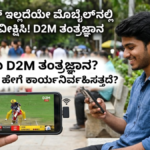
Direct-to-Mobile (D2M) technology is an emerging broadcasting solution that could change how people watch television and access digital information on their smartphones. Instead of depending entirely on mobile data or Wi-Fi, this technology is designed to deliver selected video, audio and data services directly to compatible mobile devices through broadcast signals.
In India, where millions of people use smartphones to access news, entertainment, sports and educational content, D2M could provide another way to receive digital broadcasts. It may be particularly useful for people with limited mobile data, unreliable internet connections or restricted access to conventional streaming services.
However, D2M is still developing, and its practical availability depends on several factors, including device compatibility, broadcasting infrastructure, technical standards and commercial rollout.
In this article, we explain what D2M technology means, how it works, its potential benefits, the challenges involved and what smartphone users in India should know before expecting to watch television without an internet connection.
What Is Direct-to-Mobile (D2M) Technology?
Direct-to-Mobile, commonly abbreviated as D2M, is a broadcasting technology designed to deliver multimedia content directly to compatible mobile devices without requiring a conventional internet connection for the broadcast itself.
Traditional online streaming platforms send video through an internet connection. When someone watches a live television programme using a streaming application, the content typically travels through a network connection to the user’s device.
D2M follows a different approach. It uses broadcasting infrastructure to transmit content that supported devices can receive directly.
Imagine wanting to watch a live news bulletin while travelling or checking a sports match when your mobile data allowance has run out. With an operational D2M service, a compatible smartphone could potentially receive the broadcast without using mobile data to stream that programme.
The technology may support several types of content, including:
- Live television channels and news programmes.
- Sports broadcasts and entertainment.
- Educational programmes and learning resources.
- Public information and awareness campaigns.
- Selected emergency communications and alerts, depending on the system implemented.
D2M should not be confused with ordinary mobile internet, Bluetooth or conventional Wi-Fi. Its main purpose is to distribute broadcast content directly to suitable receiving devices.
How Does D2M Technology Work?
D2M technology relies on a broadcasting system that sends content to multiple receivers. Rather than creating a separate internet stream for every viewer, a broadcaster can transmit the same programme for many compatible devices to receive.
Although the precise implementation depends on the technology and service being deployed, the general process involves four stages.
1. Content Is Prepared for Broadcasting
The process begins when a broadcaster prepares a programme or other digital material. This might include a live news bulletin, a sporting event, an educational lesson or a public information message.
The content is encoded and processed so that it can be transmitted through the appropriate broadcasting system.
2. Broadcasting Infrastructure Transmits the Signal
The prepared content is sent through suitable transmission equipment using the relevant radio-frequency spectrum and broadcasting standards.
Unlike ordinary mobile streaming, this delivery method does not depend on sending an individual video stream over the internet to every viewer.
3. A Compatible Device Receives the Broadcast
A smartphone or other supported device must have the necessary receiving capability to detect and process the relevant broadcast signal.
This requirement is important because not every smartphone automatically supports D2M. Compatibility depends on the receiving hardware, software and technical standards used by the service.
4. The Device Displays the Content
After receiving and processing the signal, the device can display the supported programme on its screen or play the corresponding audio.
If the service is available in the user’s location and the device is compatible, the viewer may be able to watch the broadcast without consuming mobile data for that content.
One of the main advantages of this approach is that a single broadcast can serve a large audience simultaneously.
What Are the Main Benefits of D2M Technology?
D2M could offer several advantages if suitable services become widely available. Its value would depend on the coverage provided, the programmes offered and the number of compatible devices in use.
1. Watch Live TV Without Using Mobile Data
One of the most attractive features of D2M is the possibility of receiving supported television broadcasts without using a mobile data allowance.
Many people rely on limited data plans for daily communication, work, study and entertainment. Watching live video can consume a substantial portion of that allowance, depending on video quality and viewing time.
With an available D2M broadcast, users could potentially watch supported programmes without paying for mobile data to carry the broadcast.
However, this does not automatically mean that every D2M service will be free. Pricing will depend on the provider, the content and the service model.
2. An Alternative Way to Access News and Entertainment
Smartphone users commonly depend on websites and streaming applications to watch live programmes.
D2M could provide another option by delivering selected television channels directly to compatible devices. This could be useful for people who prefer watching news, live events or other scheduled programmes on their phones.
It may also reduce dependence on internet-based streaming when the desired content is available through a broadcast service.
3. Potential Benefits for Rural and Remote Communities
Reliable internet access is not equally available everywhere. Some communities experience weak mobile coverage, expensive data services or limited broadband infrastructure.
Broadcast-based delivery could help make selected programmes available in locations where internet streaming is difficult, provided that appropriate broadcast coverage exists.
This could create additional opportunities to distribute public information, educational material and entertainment to a wider audience.
Nevertheless, D2M is not automatically available in every remote location. Its effectiveness would depend on transmitter coverage, signal conditions and compatible receiving devices.
4. Opportunities for Digital Education
Educational broadcasting is another potential application of D2M technology.
Schools, educational organisations and public institutions could use broadcasting networks to distribute lessons, demonstrations, instructional videos and other learning resources to large groups of users.
For students who have limited access to affordable internet services, receiving selected educational programmes without mobile data could be beneficial.
The actual educational opportunities would depend on the content made available and whether students have suitable receiving devices.
5. Public Awareness and Emergency Communication
Broadcasting networks can distribute the same message to many receivers at once. This makes them potentially useful for public information campaigns and certain emergency communication applications.
D2M could help deliver relevant announcements, safety information or disaster-related updates through supported systems.
However, emergency alert functionality should not be assumed to be included in every D2M implementation. It would require appropriate technical arrangements, coverage and coordination with the relevant authorities.
Is D2M Technology Available in India?
India has been exploring Direct-to-Mobile broadcasting through initiatives involving organisations such as Prasar Bharati and IIT Kanpur.
Development and testing activities have examined how broadcast-based delivery could work alongside the country’s existing telecommunications and broadcasting infrastructure.
Developments reported during 2026 have also highlighted cooperation and research involving organisations such as IIT Kanpur and BSNL, including work related to next-generation telecommunications technologies and D2M.
These activities indicate continued interest in the technology and its potential applications.
However, research, demonstrations, pilot projects and commercial availability are different stages of development. The existence of a trial or institutional partnership does not mean that a service is available to every consumer.
Before expecting to watch D2M television, users should confirm the following:
- Whether an operational service has launched in their area.
- Which broadcasting standards the service supports.
- Which smartphones or receiving devices are compatible.
- Whether any additional receiver or accessory is required.
- Which channels and programmes are available.
- Whether the service is free or subject to specific terms.
For the latest information, consult official announcements from the relevant broadcasting authorities, service providers and device manufacturers.
Will D2M Work on Existing 4G and 5G Smartphones?
Not necessarily. A smartphone’s ability to connect to a 4G or 5G mobile network does not automatically mean that it can receive D2M broadcasts.
Mobile connectivity and broadcast reception are different capabilities. A phone needs the appropriate hardware and software support for the particular D2M system being used.
Some devices may require dedicated receiving components, while compatibility with other implementations will depend on the standards and design choices adopted by manufacturers.
Before purchasing a smartphone specifically for D2M, check the official specifications and confirm that the device supports the intended service.
Be cautious about advertisements claiming that a simple application or software update will make every existing smartphone compatible. Such a claim should be supported by reliable information from the manufacturer or service provider.
If your current phone does not support the necessary receiving technology, installing an ordinary television application will not, by itself, provide the missing broadcast hardware.
D2M Technology vs Internet Streaming
Although both technologies can deliver video to mobile devices, they use different methods.
| Feature | D2M Broadcasting | Internet Streaming |
|---|---|---|
| Content delivery | Broadcast signal | Internet connection |
| Mobile data for viewing | Not required for the D2M broadcast itself | Usually required on mobile networks |
| Device requirements | Compatible broadcast receiver | Internet-capable device and suitable application or browser |
| Audience delivery | One broadcast can reach many receivers | Content is generally delivered through individual network streams |
| Live television | Possible where supported | Widely available through streaming services |
| On-demand videos | Depends on the service | Commonly available |
| Personalised recommendations | Depends on implementation | Commonly supported by streaming platforms |
| Interactive features | May need an internet connection | Often supported through internet connectivity |
| Coverage requirements | Suitable broadcast signal | Internet network access |
D2M and internet streaming do not necessarily compete with each other. They could serve different purposes within the same digital ecosystem.
For example, a viewer might use D2M to watch a supported live television channel and switch to internet streaming for a film, a personalised video or an on-demand programme.
The best option would depend on the type of content, device compatibility, signal availability and the user’s preferences.
What Are the Challenges of D2M Technology?
Despite its potential, D2M faces several practical challenges before it can become a widely used consumer service.
Smartphone Compatibility
One major challenge is ensuring that enough devices can receive the relevant broadcasts.
If many existing smartphones lack compatible receiver hardware, adoption could require new devices, suitable external receivers or other supported solutions.
Manufacturers and technology developers would need to address compatibility in a practical and affordable way.
Broadcasting Infrastructure and Coverage
A broadcast service needs appropriate transmission facilities and sufficient coverage to reach its intended audience.
Building or adapting infrastructure requires technical planning, investment and coordination. Signal reception can also vary according to location, buildings, terrain and the characteristics of the receiving device.
Technical Standards and Industry Cooperation
Successful deployment requires coordination among broadcasters, telecommunications companies, equipment manufacturers, regulators and other stakeholders.
Common technical standards and reliable operating arrangements can help ensure that compatible devices receive the service correctly.
Content Availability and Business Models
Even when the technology works, consumers need programmes worth watching.
Broadcasters and service providers must determine which channels and other content will be offered, how the service will be funded and whether users will have to pay for particular features.
The availability of compatible devices alone does not guarantee a useful or attractive service.
Limitations Compared With Internet Services
Broadcasting is particularly suitable for distributing the same content to a large audience.
However, activities such as personalised recommendations, live online interactions, account-based services and many on-demand features may still require internet connectivity.
D2M should therefore be viewed as a possible addition to existing digital services rather than a complete substitute for mobile internet.
Does D2M Require a SIM Card?
Receiving a D2M broadcast does not inherently require a SIM card or an active mobile-data subscription.
The technology is designed to receive content through a broadcast signal rather than relying on a conventional mobile internet connection for that broadcast.
However, the precise requirements depend on the service and device. Some features, including internet-based applications or additional interactive functions, may still need connectivity.
Users should check the requirements of the particular D2M service before assuming that it can operate entirely independently of mobile networks.
Is D2M Technology Free to Use?
D2M can potentially support free-to-air television broadcasts, but it is important to distinguish the technology from the commercial service built around it.
A broadcast may be free to receive, while other content or features could be offered under different pricing arrangements.
Costs may also arise from purchasing a compatible smartphone or receiver.
Consequently, users should verify the terms of the service rather than assuming that every D2M channel, feature or device will be free.
Frequently Asked Questions About D2M Technology
1. What is the full form of D2M?
D2M stands for Direct-to-Mobile. It describes technology designed to deliver broadcast content directly to compatible mobile devices.
2. Can I watch live TV on my phone without internet using D2M?
Potentially, yes. You need a compatible device, an available broadcast signal and an operational service offering the programme you want to watch.
3. Does D2M consume mobile data?
The D2M broadcast itself is designed to be received without using mobile data to stream that content. Other internet-based features may still consume data.
4. Will D2M work on every Android smartphone?
No. Compatibility depends on the receiving hardware, software and broadcast standard. An Android operating system alone does not guarantee D2M support.
5. Can D2M replace Wi-Fi and mobile internet?
No. It could provide an alternative for selected broadcasts, but internet connectivity remains useful for browsing, messaging, video calls, on-demand content and interactive services.
6. Can D2M be useful for students?
It could support the distribution of educational programmes and learning materials to compatible devices, particularly where internet access is limited. The benefits depend on the content and service coverage available.
7. How can I check whether D2M is available in my area?
Look for official announcements from broadcasting authorities and service providers. Confirm local coverage, supported devices and the launch status before purchasing any equipment.
Conclusion
Direct-to-Mobile technology could become a valuable addition to India’s broadcasting and digital communication landscape. By delivering selected multimedia content through broadcast signals, it offers the possibility of watching supported live television programmes without using mobile data for the broadcast itself.
Potential applications include news, entertainment, sports, education and public information. The ability to distribute the same content to many compatible devices could also make broadcasting useful in situations where internet access is limited or large audiences need to receive the same programme.
However, the technology’s practical benefits will depend on compatible smartphones, reliable coverage, suitable infrastructure, accessible content and the availability of operational services.
For consumers, the most important step is to verify the facts before making purchasing decisions. Not every 4G or 5G phone automatically supports D2M, and the existence of trials or development partnerships does not guarantee nationwide availability.
As India continues to explore new ways to distribute digital content, D2M may provide another option alongside conventional television and internet streaming. Its long-term success will depend on how effectively the technology moves from development into affordable, reliable services that people can actually use.