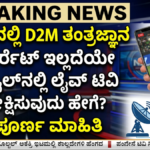
Imagine watching live television, breaking news, educational programmes, and selected sports broadcasts on your smartphone without using your mobile data. This is the idea behind Direct-to-Mobile (D2M) technology, an emerging broadcasting approach that could offer another way for people in India to access digital content.
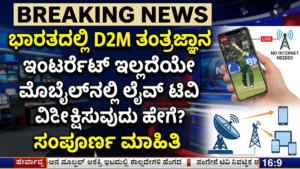
Today, most smartphone users depend on mobile internet or Wi-Fi to stream videos. While online streaming offers convenience and a wide selection of content, it can consume significant amounts of data, especially when watching high-quality videos for extended periods.
D2M technology aims to address part of this challenge by delivering supported multimedia content directly to compatible mobile devices through broadcast signals. Instead of sending a separate internet stream to every viewer, broadcasters can transmit the same programme to many devices within a coverage area.
But how does D2M work? Can it operate without a SIM card? Will existing smartphones support it? And when will people across India be able to use this technology?
This guide explains the concept, possible benefits, technical requirements, challenges, and future prospects of D2M broadcasting in India.
1. What Is D2M Technology?
Direct-to-Mobile, commonly called D2M, is a broadcasting technology designed to deliver multimedia content directly to compatible mobile devices without requiring a conventional internet connection for the broadcast itself.
The concept combines aspects of digital broadcasting with the portability of smartphones. Instead of relying exclusively on cellular data networks, a compatible device receives supported content through an appropriate broadcast receiver.
The technology could be used to distribute various types of content, including:
- Live television programmes and selected entertainment channels.
- News bulletins and public information.
- Educational videos and learning materials.
- Cultural programmes and special broadcasts.
- Emergency alerts and public awareness messages, where supported.
The main objective is to make selected digital content accessible through a different delivery method.
However, D2M is not simply a software feature that can be activated on every smartphone. Compatible receiving hardware, supported broadcasting standards, suitable signal coverage, and an operational service are all important.
2. How Does D2M Broadcasting Work?
To understand D2M, it helps to compare broadcasting with conventional online video streaming.
When you watch a video through an internet-based application, the content is delivered through an internet connection. Your device requests data from the service, and the video is transmitted through the relevant network infrastructure.
D2M uses a broadcasting approach instead.
A broadcaster transmits content using compatible broadcasting equipment and an appropriate transmission network. Devices equipped with the required receiver can capture the signal and display the available programme.
The process generally involves three main stages.
First, content preparation: A broadcaster prepares television programmes, audio, video, or other supported information for transmission.
Second, signal transmission: The prepared content is distributed through the relevant broadcast infrastructure using the applicable technology and spectrum arrangements.
Third, reception on a mobile device: A compatible smartphone or receiver captures the broadcast signal and processes the content for viewing.
The advantage is that the same broadcast can reach many receivers simultaneously within the signal’s coverage area. Viewers do not each need a separate mobile-data stream to receive the same programme.
Actual performance depends on signal strength, transmission infrastructure, receiver capabilities, and the broadcasting system being used.
3. How Is D2M Different From YouTube and OTT Streaming?
Most popular video platforms rely on internet connectivity to deliver content. D2M is designed to provide an alternative distribution method for supported broadcasts.
Here are the main differences.
Internet streaming: Services such as YouTube and other over-the-top (OTT) platforms generally deliver video through an internet connection. Mobile data or Wi-Fi is normally required to stream content.
D2M broadcasting: Supported content is transmitted through a broadcast signal and received by compatible devices. Mobile internet is not inherently required to receive that broadcast.
Content selection: Online streaming offers extensive libraries of videos, films, recorded programmes, and live streams. A D2M service offers only the channels and content made available through its broadcasting system.
Individual delivery versus shared transmission: Internet streaming commonly delivers separate streams to individual viewers. Broadcasting can distribute the same content to many receivers at once.
Device requirements: Online streaming generally works on supported devices with an internet connection. D2M reception requires compatible broadcast-receiving hardware and access to the appropriate signal.
Neither technology replaces the other completely. Internet streaming remains useful for on-demand entertainment, personalised recommendations, interactive services, and a wide range of online content. D2M could complement these services by distributing selected broadcasts more efficiently.
4. Why Is D2M Technology Important for India?
India has a large and diverse mobile-user population. Smartphones are used for education, entertainment, communication, news, and access to public services.
However, internet access, data affordability, and network quality can vary between locations and households. Some people may also want to reduce their mobile-data consumption when watching frequently broadcast content.
D2M could provide an additional way to distribute selected programmes without requiring every viewer to use cellular data for the same broadcast.
Its potential relevance includes:
- Rural communities where reliable internet access may be limited.
- Students who need access to educational broadcasts.
- Households looking for additional ways to receive television content.
- People who regularly watch live news and scheduled programmes.
- Public agencies distributing information to large audiences.
These are potential applications rather than guaranteed outcomes. Their success will depend on the coverage, affordability, availability, and accessibility of the services eventually introduced.
5. Development of D2M Technology in India
Interest in Direct-to-Mobile broadcasting in India has involved research and discussions around how broadcasting infrastructure could complement telecommunications networks.
Organisations associated with India’s D2M development efforts have included Prasar Bharati, the country’s public service broadcaster, and IIT Kanpur, which has contributed to work related to the technology.
The broader objective is to explore how compatible mobile devices could receive broadcast content directly, creating another distribution channel for television and other multimedia services.
Such work can involve technical demonstrations, receiver development, spectrum considerations, broadcasting standards, and coordination among different industry participants.
It is important to distinguish between research, pilot projects, demonstrations, and full commercial availability. A successful technical trial does not necessarily mean that every smartphone can receive D2M or that nationwide services have already launched.
For the latest confirmed developments, users should consult official announcements from the relevant government departments, broadcasting organisations, and telecommunications authorities.
6. Can You Watch Live TV on Your Existing Smartphone?
This is one of the most important questions for anyone interested in D2M.
Not every smartphone is automatically compatible with D2M technology.
A phone may support 4G, 5G, Wi-Fi, and Bluetooth without having the receiver hardware needed for a particular D2M broadcasting standard.
Compatibility depends on the receiving technology selected for the service, the phone’s internal hardware, software support, and the broadcast signal available in the user’s area.
Before purchasing a smartphone specifically for D2M, check the manufacturer’s official specifications and obtain confirmation that the device supports the intended service.
Do not assume that installing an application will be sufficient to enable reception. An application cannot generally replace missing radio-frequency receiver hardware.
In some implementations, an external receiver or accessory could potentially be used, but availability and requirements would depend on the specific system.
7. Does D2M Work Without Mobile Data or Wi-Fi?
Yes, the central idea of D2M is to receive supported broadcasts without requiring mobile data or Wi-Fi for the broadcast itself.
For example, if a compatible device receives a live television programme through a suitable D2M signal, it would not need to stream that programme through a conventional mobile internet connection.
This could be useful for people who have limited data allowances or want to reserve their internet connection for other activities.
However, several conditions must be met:
- The device must support the relevant broadcast technology.
- A compatible service must be operating.
- The broadcast signal must reach the device.
- The content must be available through that service.
Other functions, such as signing into an account, updating applications, browsing websites, or accessing interactive online features, may still require internet connectivity.
Therefore, D2M should be understood as a way to receive supported broadcasts without internet access, not as a replacement for the internet itself.
8. Can D2M Work Without a SIM Card?
D2M reception does not inherently depend on a SIM card because the broadcast is not delivered through the subscriber’s conventional mobile-data connection.
A compatible receiving device could potentially receive an available broadcast without an active mobile subscription, depending on the implementation.
Nevertheless, the absence of a SIM card does not guarantee that an ordinary smartphone can receive D2M. The appropriate receiver and supporting software remain essential.
Users should also distinguish between receiving a broadcast and accessing services that require an internet connection, account verification, or mobile network connectivity.
9. Will D2M Be Free to Use?
The technology itself does not determine whether all content must be free.
D2M could support free-to-air television and public information broadcasts. Depending on the service model, other content could be subject to subscription fees, access restrictions, or different commercial arrangements.
Potential costs could also arise from purchasing a compatible device or an additional receiving accessory.
For consumers, the important questions will include which channels are available, whether access is free, whether a subscription is required, and whether compatible equipment must be purchased.
Until specific services and their terms are officially announced, it would be incorrect to promise that every D2M channel will be free.
10. Major Benefits of D2M Technology
Reduced Mobile-Data Consumption
Watching supported content through a broadcast signal could reduce the amount of mobile data used for that content. This may be especially useful for people who regularly watch live television on their phones.
Efficient Distribution of Popular Programmes
A broadcast can deliver the same programme to many compatible receivers simultaneously. This may reduce the need to deliver separate internet streams to every viewer watching the same live event.
Educational Opportunities
D2M could support the distribution of lessons, educational videos, and other learning materials to compatible devices. This may be particularly helpful in areas where internet access is expensive or unreliable.
Wider Access to Public Information
Broadcasting can distribute messages to large audiences at the same time. Depending on the system, D2M could offer another channel for public awareness campaigns and important information.
Additional Content Delivery Options
Rather than replacing traditional television or online streaming, D2M could give broadcasters another way to reach mobile audiences.
The actual benefits will depend on deployment quality, programme availability, signal coverage, and device adoption.
11. Can D2M Help During Emergencies?
Broadcasting can be useful when information must reach large numbers of people quickly.
Depending on how the service is designed, D2M infrastructure could potentially support the distribution of emergency-related information, disaster warnings, and public safety messages.
A broadcast-based approach can reach multiple compatible receivers without requiring a separate video stream for every user.
However, D2M should not be assumed to provide a complete emergency-alert solution automatically. Reliable emergency communication requires appropriate alerting systems, coverage planning, device support, and coordination with the responsible authorities.
Until specific emergency features are confirmed for a deployed service, people should continue to rely on officially designated warning systems and emergency communication channels.
12. Challenges Facing D2M Adoption
Although D2M has potential, several challenges must be addressed before it can become a widely used consumer technology.
Smartphone compatibility: Many existing devices may not contain the necessary receiving hardware. Manufacturers and technology providers will need to address device support.
Broadcast coverage: A service must have sufficient transmission infrastructure to reach its intended audience. Reception can vary by location and physical surroundings.
Spectrum and regulation: Broadcasting requires appropriate frequency arrangements and compliance with applicable regulatory requirements.
Investment in infrastructure: Expanding coverage may require equipment, transmission facilities, testing, and ongoing maintenance.
Content partnerships: Broadcasters and service providers must decide which programmes will be distributed and how users can access them.
Public awareness: Consumers need clear information about compatible devices, service availability, costs, and limitations.
Industry coordination: Device manufacturers, broadcasters, technology developers, and relevant authorities must work together to create a consistent experience.
Addressing these challenges will be important in determining how quickly D2M becomes practical for everyday users.
13. How to Check for Official D2M Updates
If you want to know when D2M becomes available in your area, follow announcements from credible official sources.
Useful starting points include:
- Parivahan Sewa is not the relevant service portal for D2M; instead, check Prasar Bharati: https://prasarbharati.gov.in
- Department of Telecommunications: https://dot.gov.in
- Ministry of Information and Broadcasting: https://mib.gov.in
- IIT Kanpur: https://www.iitk.ac.in
These organisations can provide information about broadcasting initiatives, technical development, policy decisions, or related announcements.
Before purchasing a phone or accessory, verify whether a service has actually launched, whether it covers your location, and whether your device is officially supported.
Avoid relying solely on viral social media posts or advertisements claiming that D2M is already available on every smartphone.
14. Frequently Asked Questions About D2M Technology
Q1. What is the full form of D2M?
D2M stands for Direct-to-Mobile, a technology intended to deliver broadcast content directly to compatible mobile devices.
Q2. Can I watch live TV without internet using D2M?
Potentially, yes. You need a compatible receiving device, an available D2M service, and sufficient broadcast signal coverage.
Q3. Does D2M work on all 4G and 5G smartphones?
No. Support for mobile networks does not automatically mean that a phone contains the receiver required for D2M.
Q4. Will D2M use my daily mobile-data allowance?
Receiving a supported broadcast does not inherently require mobile data. Other internet-based activities on the phone may still consume data.
Q5. Is D2M the same as satellite television?
No. D2M is intended to deliver broadcasts directly to compatible mobile devices through the applicable broadcasting system. The reception technology and infrastructure depend on the implementation.
Q6. Can I use D2M in a village?
Potentially, if a compatible service covers the location and your device can receive its signal. Actual availability depends on the broadcasting network.
Q7. Will I need to buy a new smartphone?
Not necessarily. The answer depends on whether your existing device supports the relevant receiving technology or whether an appropriate external receiver is available.
Q8. Is D2M a replacement for 5G?
No. D2M broadcasting and 5G mobile telecommunications have different functions. They could complement each other.
Q9. Is D2M already available throughout India?
Nationwide availability should not be assumed. Check official announcements for confirmed launch information, service coverage, and device compatibility.
Conclusion
Direct-to-Mobile technology represents an interesting development in the way television and multimedia content could reach smartphone users in India.
By delivering supported broadcasts directly to compatible devices, D2M could offer an alternative to internet streaming for selected live programmes, news, educational content, and public information. It may also help reduce mobile-data consumption when people watch content distributed through the broadcast system.
However, its practical usefulness will depend on compatible devices, suitable broadcasting infrastructure, service availability, and the content offered to viewers.
For now, consumers should distinguish between the technology’s potential and the services that are actually available. Check official announcements before assuming that your existing phone supports D2M or purchasing a device specifically for this purpose.
If implemented successfully, D2M could become a useful addition to India’s digital broadcasting ecosystem, working alongside conventional television, mobile networks, and internet-based streaming services.