Learning to drive is an important milestone that brings greater independence and convenience. Whether you want to ride a scooter, operate a motorcycle, or drive a car, obtaining the appropriate driving licence is an essential step towards becoming a responsible road user.
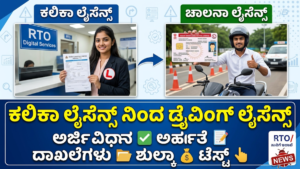
In India, the licensing process generally begins with a Learner’s Licence (LL) and progresses to a Driving Licence (DL) after the applicant gains sufficient practice and passes the required driving test. The procedure is designed to ensure that new drivers understand traffic regulations, basic vehicle operation, and road safety.
This guide explains how to apply for a Learner’s Licence, which documents may be required, how to prepare for the learner’s test, and how to proceed towards a permanent Driving Licence. It also covers eligibility conditions, estimated fees, common mistakes, and useful driving tips.
1. What Is a Learner’s Licence?
A Learner’s Licence is an official authorisation issued by the relevant state or Union Territory transport authority. It allows an eligible applicant to learn to drive a vehicle in the category specified on the licence, subject to applicable supervision and safety requirements.
It serves as the first stage of the licensing process and gives new drivers an opportunity to develop practical skills before attempting the formal driving test.
A Learner’s Licence helps applicants become familiar with traffic signs, road markings, right-of-way rules, speed limits, and responsible driving practices. It is not equivalent to a permanent Driving Licence and does not provide unrestricted permission to drive independently.
2. Different Categories of Driving Licences
Before submitting an application, select the vehicle category that matches the type of vehicle you intend to operate.
Light Motor Vehicle (LMV): This category generally covers private cars and other eligible light motor vehicles. The precise authorisation depends on the vehicle and applicable licensing rules.
Motorcycle With Gear (MCWG): This category is commonly used for motorcycles equipped with gears.
Motorcycle Without Gear (MCWOG): This category generally applies to eligible gearless two-wheelers, including many scooters.
Transport Vehicle: Applicants seeking authorisation to operate eligible commercial or transport vehicles must satisfy the additional requirements applicable to that category.
E-rickshaws and other specialised vehicles: These may be subject to specific vehicle classifications and licensing conditions.
Check the category displayed on the official Parivahan portal or confirm it with your local Regional Transport Office (RTO) before applying.
3. Eligibility Requirements for a Learner’s Licence
The minimum age depends on the vehicle category and the applicable legal conditions.
- Age 16 years: Eligible applicants may apply for a motorcycle licence for a vehicle with an engine capacity not exceeding 50cc, subject to the applicable restrictions and written consent of a parent or guardian.
- Age 18 years: Applicants can generally apply for a licence covering eligible motorcycles and private motor vehicles.
- Transport vehicles: Applicants must meet the prescribed age, training, medical fitness, and other conditions applicable to the specific category.
Applicants must also satisfy the relevant identity, residence, and medical fitness requirements. Certain categories require additional declarations or medical certification.
Remember that meeting the minimum age requirement does not automatically guarantee approval. The transport authority must verify the application and the applicant must complete the required testing process.
4. Documents Required for Applying
Preparing the necessary documents in advance can make the application process easier.
Commonly requested documents and information include:
Proof of age: A birth certificate, passport, school certificate, or another document accepted by the relevant authority.
Proof of address: An Aadhaar document, passport, voter identity card, or other accepted residence proof, depending on the state’s requirements.
Identity details: Applicants may need to provide identity information through an accepted document or an authorised electronic verification process.
Photograph and signature: These may be uploaded electronically or captured during an appointment, depending on the state’s procedure.
Medical documentation: Form 1 is generally used for the applicant’s self-declaration of physical fitness. Form 1A is the medical certificate prescribed for applicants and categories where it is required under the applicable rules.
Applicants below 18 years of age must provide the required parent or guardian consent where applicable.
Document requirements can vary between states and licensing categories. Always consult the official application instructions rather than assuming that every listed document is compulsory for every applicant.
5. How to Apply for a Learner’s Licence Online
The Parivahan Sewa portal provides access to driving licence-related services for participating states and Union Territories.
Follow these general steps:
Step 1: Visit the official portal. Open the Parivahan Sewa website at https://parivahan.gov.in and navigate to the driving licence-related services.
Step 2: Select your state. Choose the state or Union Territory where you are eligible to submit the application.
Step 3: Start the Learner’s Licence application. Select the appropriate service and follow the instructions displayed on the portal.
Step 4: Enter your personal details. Provide your name, date of birth, address, contact information, and other requested details. Ensure that your information matches your supporting documents.
Step 5: Choose the vehicle category. Select the correct category based on the vehicle you intend to drive.
Step 6: Submit the required documents. Upload the requested documents or complete the available electronic verification process.
Step 7: Complete the payment. Pay the applicable government charges using an available payment method. Save the receipt for future reference.
Step 8: Schedule the learner’s test. If an appointment is required, select an available slot and follow the instructions provided by the transport authority.
Step 9: Take the test. Complete the learner’s knowledge test through the authorised online system or at the designated testing centre, as applicable.
Step 10: Check the application status. After passing the test and completing the formalities, follow the portal’s instructions to access or download your Learner’s Licence.
The exact sequence may differ by state. Some applicants may need to visit an RTO for document verification, photographs, biometric procedures, or testing.
6. Applying Through the RTO
Applicants who cannot complete the process online may be able to use the offline services offered by their local transport office.
Begin by checking which forms and documents the RTO requires. Submit the completed application, provide the requested supporting records, and pay the prescribed charges.
The office will inform you about the learner’s test and any appointment requirements. After successfully completing the applicable procedures, you can check when your Learner’s Licence becomes available.
Visiting the RTO without checking the current requirements may lead to unnecessary delays. Confirm the office address, working hours, document checklist, and appointment procedure before travelling.
7. Preparing for the Learner’s Licence Test
The learner’s test evaluates your understanding of essential traffic rules and road safety principles. Its purpose is to establish whether you understand the responsibilities associated with driving.
Questions commonly cover:
- Traffic signs, signals, and road markings.
- Road intersections and right-of-way rules.
- Speed limits and safe following distances.
- Helmet and seatbelt requirements.
- Overtaking and lane discipline.
- Pedestrian crossings and school zones.
- Emergency situations and safe stopping.
- The dangers of alcohol-impaired driving and mobile phone use.
The test format, number of questions, time limit, and passing score can differ according to the applicable testing system.
To prepare effectively, study official traffic sign materials and practise sample questions from reliable sources. Pay particular attention to warning signs, mandatory instructions, and signs indicating restrictions.
Rather than memorising answers alone, understand what each rule means in an actual traffic situation. This knowledge will help you during the test and when you begin practical driving lessons.
8. Learner’s Licence Validity and the Waiting Period
A Learner’s Licence is generally valid for six months from its date of issue.
Under the usual licensing process, an applicant may apply for the permanent Driving Licence test after completing the prescribed minimum waiting period, generally 30 days from the issue of the Learner’s Licence.
However, the applicant must also satisfy the remaining requirements and complete the process before the Learner’s Licence expires.
Use the validity period to practise consistently with an appropriately licensed instructor or accompanying driver, as required by law. Avoid postponing all your preparation until the final weeks.
If your Learner’s Licence expires before you complete the process, check the current rules and available services with the official portal or RTO. Do not assume that an expired licence can be renewed or extended automatically.
9. Important Rules While Learning to Drive
A Learner’s Licence comes with conditions that must be followed during practice.
Display the learner identification sign: The prescribed red letter “L” must be displayed prominently at the front and rear of the vehicle in accordance with applicable rules.
Follow supervision requirements: Practise under the supervision of a person who meets the legal requirements for the vehicle category. For a car, the supervising person must occupy the appropriate seat and be able to assist safely.
Wear the required safety equipment: Motorcycle riders and passengers must follow applicable helmet laws. Car occupants must use seatbelts as required.
Avoid risky situations: Do not practise in heavy traffic or difficult road conditions until you have developed the necessary skills under suitable supervision.
Follow every traffic rule: A learner must obey signals, speed limits, road markings, and other applicable regulations.
Never drive under the influence: Alcohol, intoxicating substances, fatigue, and distractions can seriously affect driving ability.
Learners must also comply with the applicable restrictions on carrying passengers and using particular types of vehicles. Check the rules for your category before beginning practice.
10. Moving from a Learner’s Licence to a Driving Licence
Once you have completed sufficient practice and become eligible, you can begin the permanent Driving Licence application process.
First, visit the Parivahan Sewa portal and choose the relevant state. Select the service for applying for a Driving Licence and provide your Learner’s Licence details.
Complete the requested application information, pay the prescribed charges, and book a driving test appointment if required.
On the scheduled date, arrive at the designated testing location with the required documents and an eligible vehicle, if the testing authority requires you to arrange one.
The examiner will assess your practical driving ability and your compliance with traffic rules. If you pass and all other requirements are satisfied, your application can proceed to licence issuance.
If you do not pass, check the retest procedure and any applicable fees before booking another appointment.
11. What Happens During the Driving Test?
The practical examination depends on the vehicle category and the testing system used by the relevant transport authority.
For two-wheelers, the examiner may assess balance, steering control, acceleration, braking, turning, and the ability to manoeuvre safely through the prescribed test course.
For cars, the assessment may include vehicle control, starting and stopping, steering, reversing, turning, manoeuvring through a designated course, and observing traffic conditions.
Depending on the location and procedure, the test may also evaluate lane discipline, mirror use, signalling, parking, and compliance with road instructions.
Common mistakes include failing to check mirrors, using indicators incorrectly, losing control of the vehicle, ignoring instructions, touching boundary markers, and failing to observe traffic signs.
Practise the actual skills rather than concentrating exclusively on memorising a test route. Safe driving habits matter both during the examination and after receiving your licence.
12. Learner’s Licence and Driving Licence Fees
Government charges are prescribed under the applicable rules, but the total amount payable may vary depending on the service, licence category, state, and any additional procedures.
The commonly listed central fee schedule includes:
- Learner’s Licence issuance: ₹150.
- Learner’s Licence test or repeat test: ₹50.
- Driving test or repeat test: ₹300 per vehicle class.
- Driving Licence issuance: ₹200.
Additional charges may apply for other services, such as certain appointments, endorsements, or licence-related procedures. The displayed amount on the official portal should be treated as the final reference for your application.
These figures are not an all-inclusive estimate of every possible expense. Driving school fees, lessons, vehicle arrangements, and other optional services may increase the overall cost.
13. Should You Use a Driving School?
A driving school can be useful if you have little driving experience or want structured preparation for the practical examination.
Professional instructors can help you understand vehicle controls, practise manoeuvres, improve road awareness, and develop safer driving habits. Some schools also assist with application forms and appointment procedures.
Before enrolling, compare the course duration, instructor experience, practical lesson hours, vehicle availability, and total fees. Ask whether the package includes only lessons or also covers other services.
Remember that paying a driving school does not guarantee a licence. Applicants must satisfy the legal requirements and pass the relevant examinations.
14. Common Application Mistakes to Avoid
Several avoidable errors can delay the licensing process.
Selecting the wrong category: Review your intended vehicle type before submitting the form.
Entering incorrect personal details: Check your name, date of birth, and address carefully.
Uploading unsuitable documents: Ensure that files are readable, complete, and in the accepted format.
Ignoring the test appointment: Follow the instructions for the selected date and location.
Waiting too long to practise: Begin regular lessons early enough to build confidence before the practical test.
Missing the validity deadline: Keep track of the issue date and the final date for completing the process.
Using unofficial agents without verification: Make payments through authorised channels and never share sensitive credentials with unknown individuals.
Careful preparation can reduce unnecessary visits, additional costs, and administrative delays.
15. Frequently Asked Questions
Q1. How long is a Learner’s Licence valid in India?
It is generally valid for six months from the date of issue.
Q2. When can I apply for a permanent Driving Licence?
Under the usual process, you can apply for the driving test after the prescribed minimum waiting period, generally 30 days after your Learner’s Licence is issued, subject to eligibility and applicable rules.
Q3. Can I apply for a Learner’s Licence online?
Yes. The Parivahan Sewa portal provides online application services in participating states, although some steps may require an RTO visit.
Q4. Is Aadhaar compulsory for every applicant?
Aadhaar may be used for identity verification, but acceptable documents and authentication requirements depend on the applicable rules and service. Check the instructions for your state.
Q5. What happens if I fail the learner’s test?
You can check the official procedure for taking the test again. Any waiting period or repeat-test charge will depend on the applicable rules.
Q6. Can I drive alone with a Learner’s Licence?
A Learner’s Licence does not provide unrestricted permission to drive independently. You must follow the supervision and other conditions applicable to your vehicle category.
Q7. Where can I check my application status?
Visit the official Parivahan Sewa portal and use the relevant application-status service.
Conclusion
Obtaining a Driving Licence in India involves more than completing a form or passing an examination. The process helps new drivers understand traffic laws, develop practical skills, and recognise their responsibilities towards other road users.
Start by checking your eligibility and preparing the correct documents. Apply through the authorised portal or your local RTO, prepare carefully for the learner’s test, and use the validity period to practise under the required supervision.
When you become eligible, complete the Driving Licence application and demonstrate your driving ability during the practical test.
Most importantly, continue following safe driving practices even after receiving your licence. Patience, awareness, regular practice, and respect for traffic rules will help you become a more confident and responsible driver