Higher education can open doors to better career opportunities, but the cost of professional courses can place a significant financial burden on students and their families. College tuition fees, accommodation, books, examination charges and other educational expenses often make it difficult for talented students from financially disadvantaged backgrounds to continue their studies without support.
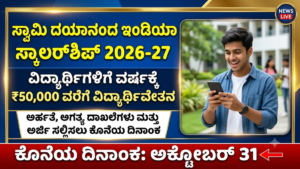
To help address this challenge, the Swami Dayanand Education Foundation (SDEF) offers merit-cum-means scholarships to eligible students pursuing professional undergraduate courses in India.
The Swami Dayanand India Scholarship 2026–27 provides selected students with financial assistance of up to ₹50,000 per academic year. The programme is intended for academically strong students who need financial support to pursue their higher education.
Applications for the 2026–27 programme are open, and the announced last date is 31 October 2026. Students who meet the eligibility requirements should review the official guidelines, prepare the necessary documents and submit their applications before the deadline.
This article explains the scholarship amount, eligible courses, academic requirements, family income limit, documents required, selection procedure and online application steps.
1. Swami Dayanand India Scholarship 2026–27: Overview
The Swami Dayanand India Scholarship is administered by the Swami Dayanand Education Foundation, an organisation that supports deserving students through educational scholarships.
The programme considers both academic merit and financial need. Its objective is to help talented students continue their professional education when family finances could otherwise become an obstacle.
Here are the important details of the scholarship:
- Scholarship name: Swami Dayanand India Scholarship 2026–27
- Scholarship provider: Swami Dayanand Education Foundation (SDEF)
- Academic year: 2026–27
- Maximum annual assistance: ₹50,000
- Potential total assistance: Up to ₹2,00,000 over four academic years, subject to renewal and programme conditions
- Eligible applicants: Students entering the first year of an approved full-time professional undergraduate programme
- Minimum Class 12 marks: 80% or equivalent CGPA
- Maximum annual family income: ₹12 lakh
- Application mode: Online through the official scholarship application portal
- Application deadline: 31 October 2026
- Expected notification period: Mid-November 2026, according to the published schedule
- Expected funding commencement: January 2027, according to the published schedule
The scholarship is competitive. Meeting the minimum eligibility requirements does not guarantee that an applicant will receive financial assistance.
Students should refer to the official foundation website for the latest instructions and any changes to the application schedule.
2. Who Can Apply for the Swami Dayanand Scholarship?
The scholarship is intended for students who have demonstrated strong academic performance and require financial assistance to pursue professional education.
Applicants must satisfy the prescribed academic, financial and admission requirements.
Academic performance
Students must have secured at least 80% marks in their Class 12 board examination, or an equivalent CGPA accepted under the scholarship guidelines.
Applicants should have their Class 12 marksheet ready because it is an important part of the eligibility verification process.
First-year admission requirement
The scholarship is intended for students entering the first year of an eligible full-time undergraduate professional degree programme during the 2026–27 academic year.
Students who are already studying in the second year or a later year of their undergraduate course are not eligible for the fresh scholarship application.
Applicants should ensure that their admission details correspond to the academic year specified in the application.
Family income limit
The applicant’s total annual family income from all sources must not exceed ₹12,00,000.
Students may be asked to submit supporting evidence to establish the family’s financial circumstances. Depending on the situation, this may include an income certificate, salary documentation, income tax returns, pension records or other documents accepted by the foundation.
Applicants from agricultural families should also be prepared to provide information about agricultural landholdings and the supporting documents requested by SDEF.
Full-time professional course
The applicant must be enrolled in an eligible full-time undergraduate professional programme at a recognised institution in India.
Part-time courses and programmes outside the foundation’s approved categories do not qualify under the India Scholarship programme.
Entrance examination requirements
Certain courses have additional entrance examination conditions. Depending on the programme, applicants may need to satisfy the prescribed rank or score requirement.
The published criteria include the following requirements for specified entrance examinations:
- JEE Main: All India Rank of 50,000 or better.
- JEE Advanced: All India Rank of 40,000 or better.
- NEET UG: All India Rank of 50,000 or better.
- NATA: A minimum score of 100 marks.
Applicants should confirm which examination requirement applies to their particular course before submitting the application.
3. Which Courses Are Eligible?
The Swami Dayanand India Scholarship supports students pursuing selected professional undergraduate degrees.
The eligible programme categories include:
Engineering and technology
- Bachelor of Engineering (B.E.)
- Bachelor of Technology (B.Tech.)
Medical education
- Bachelor of Medicine and Bachelor of Surgery (MBBS)
Dental education
- Bachelor of Dental Surgery (BDS)
Nursing
- Bachelor of Science in Nursing (B.Sc Nursing)
- Other approved nursing degree programmes covered by the guidelines
Pharmacy
- Bachelor of Pharmacy (B.Pharm.)
- Doctor of Pharmacy (Pharm.D)
Architecture
- Bachelor of Architecture (B.Arch.)
Veterinary science
- Bachelor of Veterinary Science and Animal Husbandry (BVSc & AH)
The foundation’s approved programme list and course-specific admission conditions should be checked before applying. Not every undergraduate degree is automatically covered by this scholarship.
Students enrolled in courses such as B.A., B.Com., B.Sc. general programmes, BBA or BCA should not assume that they qualify under the professional India Scholarship category. SDEF operates a separate Shiksha Shakti Scholarship programme for eligible female students pursuing approved non-technical undergraduate courses.
4. How Much Financial Assistance Can Students Receive?
Selected students can receive financial support of up to ₹50,000 for each academic year.
The actual scholarship amount depends on the award offered to the individual student and the foundation’s applicable conditions.
For students who remain eligible throughout a four-year undergraduate programme, the potential maximum assistance can be calculated as follows:
| Academic year | Maximum potential assistance |
|---|---|
| First year | ₹50,000 |
| Second year | ₹50,000 |
| Third year | ₹50,000 |
| Fourth year | ₹50,000 |
| Total over four years | ₹2,00,000 |
These figures represent the maximum potential support, not a guaranteed payment to every applicant.
Renewal is subject to the foundation’s requirements, satisfactory academic progress and continued eligibility. Students must follow the renewal procedure each year rather than assuming that the award will continue automatically.
How is the scholarship money paid?
According to the foundation’s published programme information, scholarship funds are transferred directly to the student’s college or university account and applied towards approved educational expenses.
Applicants should therefore read the payment conditions carefully and ask their institution or the foundation if they need clarification about how the award will be credited.
The scholarship can help reduce education-related expenses, but students should not assume that it will cover all tuition fees, accommodation costs or other personal expenses.
5. Documents Required for the Scholarship Application
Preparing the required documents in advance can make the online application process easier.
Students should keep clear digital copies of the documents listed below.
Essential documents
1. Recent passport-size photograph
A recent photograph of the applicant is required for identification and application records.
2. Aadhaar card
Applicants should keep their Aadhaar details ready for identity verification.
3. Class 10 marksheet
The Class 10 marksheet may be required as part of the applicant’s educational records.
4. Class 12 marksheet
This is particularly important because the scholarship requires a minimum of 80% marks or an accepted equivalent CGPA.
5. Entrance examination scorecard
Applicants should provide the relevant JEE, NEET, NATA or other applicable entrance examination scorecard, according to their course and the published requirements.
6. College admission letter
The admission letter helps establish that the student has secured admission to an eligible programme for the 2026–27 academic year.
7. College identity card
A college ID may be requested to verify the applicant’s enrolment.
8. Latest college fee receipt
Students should provide the most recent fee payment receipt or other acceptable proof of college fees.
9. Family income documents
An income certificate, salary certificate, salary slips, income tax return, pension documentation or other accepted evidence may be needed to establish the household’s financial circumstances.
10. Electricity, water or gas bill
A recent utility bill may be required as supporting documentation for the residence.
11. SDEF Scholar Pledge Form
The foundation requires applicants to complete and sign the prescribed Scholar Pledge and upload a scanned copy with the application.
Additional documents, where applicable
Some applicants may need to provide:
- Agricultural land records or other landholding documents.
- Educational loan documentation.
- Income tax returns.
- Salary or pension records.
- Three photographs of the applicant’s residence.
- Any additional documents requested by the foundation during verification.
The precise requirements can depend on the applicant’s circumstances. Use the official checklist rather than relying solely on a general list published elsewhere.
6. Who Is Not Eligible?
Students should check the exclusion criteria before spending time on the application.
The following applicants generally do not qualify for the fresh India Scholarship programme:
Students who took a gap year after Class 12: Applicants who took a drop or gap year after completing Class 12 are excluded under the published eligibility conditions.
Students already in the second year or later: The fresh application is intended for eligible first-year undergraduate students entering an approved course during 2026–27.
Students with less than 80% in Class 12: Applicants who do not meet the minimum academic requirement are not eligible unless the foundation’s published rules explicitly provide an applicable alternative.
Applicants whose family income exceeds ₹12 lakh annually: The programme’s stated income ceiling must be satisfied.
Students enrolled in non-eligible courses: Applicants must study an approved professional undergraduate programme.
Students who fail the applicable entrance examination criteria: Where a particular course has a prescribed entrance examination requirement, the applicant must satisfy it.
Applicants with incomplete or inaccurate documentation: Missing records, false information or forged documents can result in rejection or disqualification.
Students should also remember that eligibility is only the first stage. Final selection depends on the foundation’s assessment of the complete application.
7. How Are Scholarship Recipients Selected?
The Swami Dayanand Education Foundation follows a merit-cum-means approach. This means that academic achievement and financial need are both considered during the selection process.
The process may include several stages.
Initial eligibility screening
Applications are checked to determine whether candidates meet the academic, income, course and admission requirements.
Document verification
The foundation reviews the supporting records submitted by applicants. Additional documentation may be requested if clarification is needed.
Assessment of academic merit and financial need
The selection team evaluates the student’s educational performance alongside the family’s financial circumstances and other relevant factors.
Preference may be given to first-generation college students and other applicants in circumstances identified in the programme guidelines. However, such preferences do not guarantee selection.
Further assessment
Shortlisted students may be required to participate in an online assessment, an interview or additional verification, depending on the foundation’s instructions.
Applicants should monitor their registered email address, including the spam or junk folder, for communications about subsequent stages.
The foundation’s published schedule indicates that notifications are expected around mid-November 2026, with funding expected to begin in January 2027. These are expected programme milestones and may be subject to change.
8. How to Apply Online for the Swami Dayanand Scholarship 2026–27
Students can apply through the official Swami Dayanand Education Foundation website.
Follow these steps to complete the application.
Step 1: Visit the official website
Open the official scholarship page:
https://www.swamidayanand.org/india-scholarships-2026-27
Check the eligibility requirements, important dates and instructions before proceeding.
Step 2: Open the fresh scholarship application
Choose the application option intended for new applicants. Make sure you are applying for the India Scholarship 2026–27 rather than a different SDEF scholarship or a renewal programme.
Step 3: Read the eligibility conditions
Review the academic marks requirement, family income limit, eligible courses and entrance examination criteria.
Proceed only if you meet the stated conditions.
Step 4: Complete the SDEF Scholar Pledge
Download the prescribed Scholar Pledge Form, complete it and sign it. Save a clear scanned copy because it must be uploaded during the application process.
Step 5: Enter your personal details
Fill in the requested information, including your name, contact details, address and other identification details.
Ensure that your information matches the supporting documents.
Step 6: Provide academic and admission information
Enter your Class 10 and Class 12 results, current college details, course information and relevant entrance examination details.
Double-check marks, ranks and other figures before continuing.
Step 7: Enter family income details
Provide accurate information about your family’s income and financial circumstances.
Keep the necessary supporting documents ready in case the foundation requests further verification.
Step 8: Upload the required documents
Upload your photograph, marksheets, Aadhaar details, admission letter, college ID, fee receipt, income evidence, utility bill and signed Scholar Pledge, along with any additional documents applicable to your situation.
Make sure the files are readable and comply with the portal’s format and size requirements.
Step 9: Review your application
Before submitting, check every section for missing information or errors.
Incomplete applications may not be considered, so confirm that all mandatory fields and uploads have been completed.
Step 10: Submit before the deadline
Submit the completed application through the official portal no later than 31 October 2026.
Save the acknowledgement or application reference and retain a copy of the submitted details for future reference.
Applicants should not wait until the final day, as technical issues or missing documents could prevent timely submission.
9. What Is the Last Date to Apply?
The published closing date for the Swami Dayanand India Scholarship 2026–27 is 31 October 2026.
The application schedule lists mid-November 2026 as the expected notification period and January 2027 as the expected start of funding.
Since the deadline is approaching, interested students should review the eligibility criteria and prepare their documents as soon as possible.
Submitting an application before the deadline does not guarantee a scholarship. The application must meet the requirements and pass the foundation’s selection process.
10. Official Website and Contact Information
For accurate information, application instructions and updates, students should use the foundation’s official website.
Official scholarship page:
https://www.swamidayanand.org/india-scholarships-2026-27
Eligibility and document information:
https://www.swamidayanand.org/overview-and-eligibility-india
Email for scholarship enquiries:
scholarships@swamidayanand.org
India office telephone:
+91-120-4146823
Applicants should contact the foundation directly if they have questions about their course eligibility, entrance examination requirements, documents or application status.
Avoid paying agents who promise guaranteed selection. Use the official application portal and provide accurate information throughout the process.
Frequently Asked Questions
1. What is the maximum scholarship amount?
Selected students may receive up to ₹50,000 per academic year. Eligible students may receive renewed assistance for subsequent years, subject to the programme conditions.
2. Who provides the scholarship?
The Swami Dayanand Education Foundation administers the India Scholarship programme.
3. What percentage is required in Class 12?
Applicants must have at least 80% marks or an equivalent CGPA under the published eligibility requirements.
4. What is the annual family income limit?
The stated maximum annual family income is ₹12 lakh from all sources.
5. Can second-year students apply?
The fresh scholarship application is intended for eligible first-year students entering an approved undergraduate professional course in 2026–27. Second-year and later students are not eligible for a fresh application.
6. Is the scholarship renewed every year automatically?
No. Renewal depends on continued eligibility, academic performance and completion of the foundation’s renewal requirements.
7. What is the last date for applications?
The announced deadline is 31 October 2026. Applicants should check the official website for any updates.
8. Does applying guarantee financial assistance?
No. Applications are assessed on academic merit, financial need, documentation and other selection requirements.
Conclusion
The Swami Dayanand India Scholarship 2026–27 offers a valuable opportunity for academically talented students from financially constrained families who are entering eligible professional undergraduate programmes.
With assistance of up to ₹50,000 per academic year, the scholarship can help reduce some of the financial pressure associated with higher education. Students who meet the academic, income, course and admission requirements should carefully prepare their documents and follow the official application instructions.
The final date to apply is 31 October 2026, according to the foundation’s published schedule.
Visit the official SDEF website, confirm your eligibility, complete the Scholar Pledge and submit a fully documented application before the deadline. Remember that the scholarship is competitive, and the final award depends on the foundation’s assessment and approval.