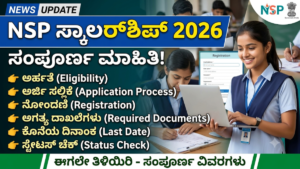
The National Scholarship Portal (NSP) Scholarship 2026 is an important online platform through which students can apply for various scholarships offered by the Government of India, State Governments, Union Territories, and participating government departments. For the 2026–27 academic year, the NSP portal opened from 1 June 2026. Students can use the portal to find suitable scholarship schemes, complete applications, undergo verification, and track scholarship-related services.
What Is NSP Scholarship 2026?
NSP stands for National Scholarship Portal. It is a centralized online system designed to bring multiple scholarship schemes onto one platform. Instead of visiting different websites for different government scholarships, eligible students can check available schemes through NSP and submit applications online.
The portal supports several types of scholarships for school students, college students, technical students, postgraduate students, students from economically disadvantaged backgrounds, students with disabilities, and other eligible categories. However, eligibility and financial benefits differ from one scheme to another.
NSP is not one single scholarship with identical benefits for everyone. It is a platform containing many individual scholarship schemes administered by different ministries and departments.
NSP Scholarship 2026 Important Dates
For the 2026–27 academic year, NSP states that the portal opened on 1 June 2026. The closing date depends on the individual scholarship scheme.
For example, several schemes currently listed on the portal have a student application deadline of 31 October 2026, followed by institute verification and government-level verification. Some schemes have earlier deadlines. The National Means-cum-Merit Scholarship, for example, shows a student application deadline of 31 August 2026, while some renewal applications have separate dates.
Therefore, students should not assume that every NSP scholarship has the same last date. The scheme-specific deadline displayed on the official portal should always be checked before submitting an application.
One Time Registration (OTR) for NSP
One of the most important changes for NSP applicants is One Time Registration (OTR). OTR is required for scholarship applications on NSP from the applicable academic years beginning with 2024–25.
According to the official portal, an OTR is a unique 14-digit number associated with the student and is intended to remain applicable throughout the student’s academic career on NSP. It can be generated using Aadhaar or an Aadhaar Enrolment ID, subject to the applicable process and requirements.
Students should complete OTR carefully because the information used during registration can affect the subsequent scholarship application process.
Who Can Apply for NSP Scholarship 2026?
There is no single eligibility rule for every NSP scholarship. Students must satisfy the conditions of the particular scheme they choose.
Depending on the scheme, eligibility may consider factors such as:
- Academic performance or merit
- Family income
- Category or social background
- Class or course of study
- Type of educational institution
- State or region of residence
- Gender
- Disability status
- Special circumstances specified by the sponsoring ministry
For instance, the 2026–27 NSP listings include scholarships for students with disabilities, SC students, OBC/EBC/DNT students, ST students, technical students, students from the North Eastern Region, and wards of specified personnel.
Students should read the official scheme specifications and eligibility conditions before applying rather than relying on generalized eligibility information.
Major Scholarships Available Through NSP
The NSP 2026–27 portal includes numerous schemes. Some examples include the PM-USP Central Sector Scheme of Scholarship for College and University Students, AICTE scholarships such as Pragati, Saksham and Swanath, scholarships for students with disabilities, scholarships for SC and ST students, the National Means-cum-Merit Scholarship, and various ministry-specific schemes.
The portal also distinguishes between merit-based and welfare-based scholarships. NSP currently states that, from academic year 2026–27, students may apply for one merit-based scholarship scheme and one or more welfare-based scholarship schemes, subject to the eligibility conditions of those schemes.
This does not mean that a student automatically qualifies for multiple scholarships. Every application remains subject to the relevant scheme rules.
How to Apply for NSP Scholarship 2026
The application process can generally be completed online through the official NSP website.
Step 1: Complete OTR
First, eligible students should generate their One Time Registration number through the NSP process. OTR is required for scholarship applications.
Step 2: Log in to NSP
After obtaining the OTR, students can use their OTR credentials to access the student section of the portal.
Step 3: Find the Appropriate Scholarship
Review the schemes available for the 2026–27 academic year. Carefully check the eligibility criteria, course requirements, income conditions, category requirements, and other scheme-specific rules.
Step 4: Fill in the Application
Enter personal, academic, bank, institutional and other required information accurately. Students should ensure that names, dates, identification details and other information match their official records.
Step 5: Upload or Provide Required Information
Depending on the scheme, supporting information or documents may be required. The exact requirements vary by scholarship.
Step 6: Submit the Application
Before final submission, carefully review the complete form. An incorrect application can create problems during verification.
Step 7: Complete Verification
NSP applications can pass through institutional and government-level verification. Students should monitor their application and respond to any requirement concerning defective or incomplete applications.
Documents Required for NSP Scholarship
The documents required depend on the selected scheme. Students may need information or documents relating to:
- Aadhaar or Aadhaar enrolment details
- OTR number
- Academic records or marksheets
- Admission or institution details
- Bank account information
- Income certificate, where required
- Caste/category certificate, where applicable
- Disability certificate or UDID information, where applicable
- Domicile or residence information, where required
- Other scheme-specific supporting documents
Students should check the exact document list displayed for their selected scholarship because requirements are not identical across all NSP schemes.
NSP Scholarship Application Status
After submitting an application, students should regularly check its status through the official NSP student section. The portal provides facilities for accessing scholarship applications and tracking related services. NSP also provides a separate facility for tracking scholarship payment through the Public Financial Management System (PFMS).
An application moving through different verification stages does not necessarily mean that payment has already been approved. Students should wait for completion of the required verification and sanction process.
Scholarship Payment
Scholarship payments are processed according to the rules of the respective scheme. NSP’s stated objective includes facilitating direct transfer of scholarship funds to beneficiaries and improving transparency in scholarship distribution.
Students should make sure that their bank and Aadhaar-related information is correct wherever required by the applicable scholarship process. Errors in financial or identification details can potentially affect payment processing.
What Students Should Remember
The most important point about NSP Scholarship 2026 is that NSP is a portal containing many scholarship schemes, not a single universal scholarship. The eligibility criteria, scholarship amount, required documents, application deadline and verification process can therefore vary significantly.
Students should use only the official NSP portal for current information and should avoid relying on social-media posts or unofficial websites for scholarship deadlines or payment claims.
For 2026–27, the official NSP portal is open, and several schemes are accepting applications. Students should check their preferred scheme and its current deadline before applying.
Conclusion
The NSP Scholarship 2026 provides students with a centralized way to access numerous government scholarship opportunities. The 2026–27 portal became operational on 1 June 2026, and students can use it to complete OTR, identify suitable schemes, submit applications, undergo verification and monitor their scholarship progress.
Because every scholarship has its own rules, students should carefully read the official eligibility requirements and deadlines before submitting an application. Completing OTR correctly, providing accurate information, checking verification status and keeping bank details updated are important steps toward a smooth application experience.
For the latest 2026–27 scheme list, deadlines and official instructions, students should refer directly to the National Scholarship Portal: Official NSP Portal
This article is newly written in original language and is not copied from another article. Official NSP information has been paraphrased and cited for accuracy. Scholarship rules and deadlines can change, so the official portal should be treated as the final authority.