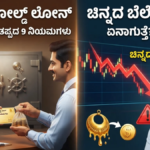
Gold loans are a popular financial option for people who need immediate funds without selling their jewellery. Farmers, small business owners, salaried employees, and families often pledge their gold ornaments with banks to meet agricultural expenses, medical emergencies, education costs, business requirements, and other financial needs.

However, borrowers should understand that taking a gold loan also comes with certain responsibilities. Changes in gold prices, repayment delays, interest accumulation, and loan-to-value requirements can affect the status of an existing gold loan.
Recently, fluctuations in the gold market have raised concerns among borrowers who have pledged their jewellery with banks. When the market value of pledged gold declines, the security value available against the outstanding loan may also decrease. Depending on the loan agreement and applicable banking regulations, the lender may ask the borrower to repay part of the outstanding amount or provide additional security.
Therefore, customers who have taken gold loans should not ignore bank notifications, repayment reminders, or requests for additional information.
In this article, let us understand the important gold loan repayment rules, what happens when gold prices fall, how borrowers can protect their pledged jewellery, when banks can initiate an auction, and whether farmers can receive lower interest rates by submitting agricultural land documents.
1. What Happens to Your Gold Loan When Gold Prices Fall?
Gold prices do not remain constant. They fluctuate depending on international market conditions, currency movements, interest rates, investment demand, and other economic factors.
When a customer pledges gold jewellery to obtain a loan, the bank evaluates the eligible value of the gold before deciding the loan amount.
For example, suppose a borrower pledges gold jewellery worth ₹5,00,000 and receives a loan of ₹3,50,000.
If the market value of the pledged jewellery subsequently decreases, the value of the security held by the bank may also decline. However, the outstanding loan amount does not automatically decrease just because gold prices have fallen.
This can affect the relationship between the loan balance and the current value of the pledged gold.
Depending on the lender’s policy and the terms agreed upon when the loan was issued, the bank may contact the borrower to discuss corrective measures.
These may include:
- Making a partial repayment towards the outstanding loan.
- Providing additional gold as security, if permitted.
- Clearing overdue interest or other outstanding charges.
- Reviewing the repayment schedule.
- Bringing the loan account within the applicable security requirements.
Borrowers should remember that a fall in gold prices does not automatically mean that their loan will be cancelled or that their jewellery will immediately be auctioned.
2. Understand the Loan-to-Value (LTV) Ratio
One of the most important concepts in gold lending is the Loan-to-Value ratio, commonly known as LTV.
LTV represents the percentage of the eligible value of pledged gold that a lender provides as a loan.
For example:
- Eligible gold value: ₹5,00,000
- Loan amount: ₹3,50,000
- Loan-to-Value ratio: 70%
If the eligible value of the gold changes, the LTV ratio may also change.
The calculation is:
LTV Ratio = (Outstanding Loan Amount ÷ Eligible Value of Pledged Gold) × 100
Suppose the outstanding loan is ₹3,50,000 and the eligible value of the pledged gold falls to ₹4,20,000.
The revised LTV would be approximately 83.33%.
This illustrates why changes in gold prices can become important for borrowers.
However, the applicable LTV limit depends on the loan category, lender, loan structure, and relevant RBI regulations. Customers should ask their bank whether any corrective action is actually required under their particular loan agreement.
3. Six Important Steps Every Gold Loan Borrower Should Follow
If you have received a message from your bank regarding a change in gold value, repayment, or loan security, take the following steps.
Step 1: Never Ignore Bank Notifications
Banks may communicate with customers through SMS, email, telephone calls, letters, or official mobile banking applications.
If you receive a message stating that your gold loan requires attention, contact the bank as soon as possible.
Do not click suspicious links or share OTPs, PINs, passwords, or banking details with unknown callers.
Always use the official bank website, customer care number, or branch contact information to verify the communication.
Step 2: Check the Current Value of Your Pledged Gold
Ask the bank how it currently assesses the gold pledged against your loan.
You should understand:
- The weight of the pledged gold.
- The purity considered during valuation.
- The applicable valuation rate.
- The eligible security value.
- Whether any change in valuation affects your loan account.
Remember that the market price of gold jewellery and its eligible lending value may differ. Banks generally consider eligible gold content and applicable valuation rules rather than simply using the retail jewellery price.
Step 3: Find Out Your Total Outstanding Loan Amount
Borrowers should regularly check their loan statements.
The total amount payable may include:
- Original loan principal.
- Accumulated interest.
- Overdue interest, if applicable.
- Applicable charges or other contractual dues.
Request an updated loan statement from your bank so that you know exactly how much needs to be repaid.
This will help you avoid unexpected repayment difficulties.
Step 4: Ask Whether Additional Gold Can Be Pledged
If the bank permits additional security under the existing loan arrangement, borrowers may consider pledging additional eligible gold.
This may help address a shortfall in the security value.
However, the bank will need to assess the additional jewellery and determine whether it can be accepted under the applicable lending terms.
Do not hand over jewellery without receiving proper documentation and an acknowledgement from the bank.
Step 5: Consider Making a Partial Loan Repayment
If you do not have additional gold to pledge, ask the bank whether a partial repayment can resolve the issue.
For instance, if the outstanding loan amount is higher than what you can comfortably manage, paying a portion of the principal may reduce the loan balance.
A lower outstanding balance can improve the LTV position, subject to the bank’s valuation and applicable requirements.
Before making a payment, confirm how the amount will be adjusted against principal, interest, and other dues.
Step 6: Keep Track of Your Loan Tenure and Interest
Gold loans may have different repayment structures.
Some require periodic interest payments, while others may allow repayment of principal and interest at maturity, depending on the product.
Customers should carefully check:
- Loan maturity date.
- Interest rate.
- Interest payment frequency.
- Principal repayment conditions.
- Renewal provisions.
- Late payment charges.
- Auction-related conditions.
Do not assume that paying interest alone automatically renews the loan. Renewal must be permitted by the lender and completed according to its rules.
4. What Happens If You Fail to Follow the Bank’s Instructions?
Ignoring repayment reminders or failing to respond to the bank’s communication can create financial complications.
The possible consequences depend on the loan agreement, account status, and applicable regulations.
Some important risks include:
1. Loan security concerns
If the value of pledged gold becomes insufficient compared with the outstanding loan, the lender may ask the borrower to take corrective action, subject to the applicable terms.
2. Accumulation of interest
If payments are delayed, interest may continue to accumulate according to the loan agreement.
This can increase the total amount payable.
3. Irregular loan account
Failure to meet repayment obligations may result in the account becoming overdue or irregular.
Depending on the applicable classification rules, prolonged default may also affect the borrower’s credit history.
4. Recovery proceedings
If the borrower does not repay the loan despite repeated communication, the bank may initiate recovery procedures in accordance with the agreement and applicable law.
5. Auction of pledged jewellery
If the borrower continues to default and the lender follows the required procedure, the pledged jewellery may eventually be auctioned to recover the outstanding dues.
Therefore, borrowers should communicate with the bank rather than allowing repayment problems to continue without action.
5. When Can a Bank Auction Pledged Gold?
One of the biggest concerns among gold loan customers is whether banks can auction their jewellery when they fail to repay the loan.
Banks generally have the contractual right to enforce the security when a borrower defaults. However, an auction must follow the applicable legal requirements, regulatory directions, and the terms of the loan agreement.
A fall in the market price of gold alone does not mean that the bank can immediately sell the pledged jewellery without following the required procedure.
Before an auction, borrowers should receive the notices and opportunities required under the applicable rules.
Important points borrowers should know:
- Banks must follow the applicable notice requirements.
- Customers should be informed about outstanding dues and repayment requirements.
- The lender must follow the prescribed auction procedure.
- The auction should be conducted transparently.
- The borrower should receive any surplus amount remaining after adjusting the recoverable dues and permitted expenses, as applicable.
- If auction proceeds are insufficient to clear the outstanding liability, the lender may have the right to recover the remaining amount according to the loan agreement and applicable law.
Important: Borrowers should not assume that a bank can auction pledged jewellery immediately after gold prices decline. The actual process depends on the applicable RBI directions, the loan agreement, and the required notices and procedures.
6. Can Farmers Get Lower Gold Loan Interest by Submitting RTC or Pahani Documents?
Many farmers in Karnataka have agricultural land registered in their names.
When applying for a gold loan, some farmers submit their RTC (Record of Rights, Tenancy and Crops), commonly known as Pahani, along with other land-related documents.
A common question is whether submitting these documents automatically reduces the interest rate on a gold loan.
The answer is that submitting an RTC does not automatically guarantee a lower interest rate.
However, certain banks offer agricultural credit products to eligible farmers under specific conditions.
If the gold loan is sanctioned as an eligible agricultural loan and the borrower satisfies the applicable requirements, the customer may qualify for preferential interest rates or government-supported interest benefits, where available.
The bank may ask for documents such as:
- Updated RTC or Pahani.
- Aadhaar or other accepted identity documents.
- Land ownership or cultivation records.
- Details of the proposed agricultural activity.
- Bank account information.
- Other documents required by the lender.
Farmers should ask the bank whether their loan can be classified as an eligible agricultural credit facility.
They should also clarify the applicable interest rate, repayment period, subsidy eligibility, and any government interest subvention conditions.
Important: Simply submitting land documents is not sufficient to claim an agricultural interest subsidy. Eligibility depends on the nature of the loan, purpose of borrowing, applicable scheme conditions, and the bank’s assessment.
7. Why Are Gold Prices Declining? Four Important Reasons
Gold prices are influenced by several international and domestic economic factors.
Although gold is traditionally considered a safe-haven investment, its price can experience significant fluctuations.
Here are four important factors that may contribute to a decline in gold prices.
1. Strengthening of the US Dollar
Gold is internationally traded in US dollars.
When the US dollar becomes stronger against other currencies, gold may become more expensive for buyers using different currencies.
This can reduce international demand and create downward pressure on gold prices.
Currency movements are therefore an important factor that influences the gold market.
2. Changes in US Federal Reserve Interest Rate Expectations
The US Federal Reserve plays an important role in global financial markets.
When investors expect higher interest rates, interest-bearing investments such as government bonds may become more attractive.
Since gold does not generate regular interest income, some investors may shift money from gold into other financial assets.
This can affect demand and put pressure on gold prices.
However, expectations about future interest rate cuts or increases can also change market sentiment quickly.
3. Profit Booking by Investors
Gold prices sometimes rise sharply over a short period.
After a significant increase, some investors choose to sell their gold holdings to secure profits.
This activity is known as profit booking.
When a large number of investors sell gold simultaneously, selling pressure can increase and prices may decline.
Such movements are common in financial markets and do not necessarily indicate a long-term fall in gold demand.
4. Changes in Global Economic Conditions
International economic developments can influence gold prices.
Important factors include:
- Inflation trends.
- Global economic growth.
- Geopolitical developments.
- Currency fluctuations.
- Central bank gold purchases.
- Investment demand.
- International bond yields.
During periods of uncertainty, investors may increase their gold holdings.
On the other hand, when confidence in financial markets improves, some investors may reduce their exposure to gold.
As a result, international economic conditions can cause gold prices to move in either direction.
8. Important Documents Gold Loan Borrowers Should Keep
Maintaining proper loan documents can help customers resolve disputes and monitor their repayment obligations.
Every gold loan borrower should preserve the following records:
- Original gold loan sanction letter.
- Loan agreement and terms and conditions.
- Gold appraisal or valuation receipt.
- Pledge receipt containing jewellery details.
- Loan account statement.
- Interest payment receipts.
- Repayment transaction records.
- Bank notifications and official correspondence.
- Loan closure certificate after full repayment.
When the loan is completely repaid, collect the pledged jewellery and verify its details against the original pledge documentation.
Do not leave the bank without obtaining confirmation that the loan has been closed and the jewellery has been returned.
9. Frequently Asked Questions About Gold Loans
Q1. Will my bank auction my jewellery immediately if gold prices fall?
No. A decline in gold prices does not automatically result in an immediate auction. The bank must follow the applicable loan conditions, recovery procedures, and required notices.
Q2. Can the bank ask me to repay part of my gold loan?
Depending on the loan agreement, security requirements, and applicable regulations, the lender may ask for corrective action. Contact your branch to understand the exact requirement.
Q3. Can I pledge additional gold to maintain my existing loan?
This may be possible if the bank permits additional security under its lending policy. The additional jewellery will be subject to valuation and documentation.
Q4. What should I do if I cannot repay the full loan amount?
Speak to your bank immediately. Ask whether partial repayment, a permitted renewal, or another repayment arrangement is available. Do not ignore overdue notices.
Q5. Will submitting my RTC reduce my gold loan interest rate?
Not automatically. Some agricultural credit facilities may provide preferential rates or eligible interest benefits, but the loan must satisfy the relevant conditions.
Q6. Can the bank recover the remaining amount if the auction proceeds are insufficient?
Depending on the loan agreement and applicable law, the lender may be entitled to recover the remaining outstanding dues.
Conclusion
Gold loans can provide timely financial assistance, but borrowers must carefully monitor their loan accounts, repayment dates, and pledged gold valuation.
Changes in gold prices may affect the security value of pledged jewellery and can sometimes lead to additional requirements from the lender.
Therefore, customers should respond promptly to official bank communications, check their outstanding loan balances, understand their LTV position, and make repayments on time.
Farmers who wish to obtain gold loans for agricultural purposes should also enquire about eligible agricultural credit facilities and applicable interest concessions rather than assuming that submitting RTC documents automatically provides a discount.
Most importantly, borrowers should maintain all loan-related documents and communicate directly with their bank whenever they face repayment difficulties.
Disclaimer: This article is intended for general financial awareness and educational purposes. Gold loan terms, interest rates, LTV limits, repayment requirements, and auction procedures may vary depending on the lender, loan category, agreement, and prevailing RBI regulations. Contact your bank for advice regarding your specific loan account.