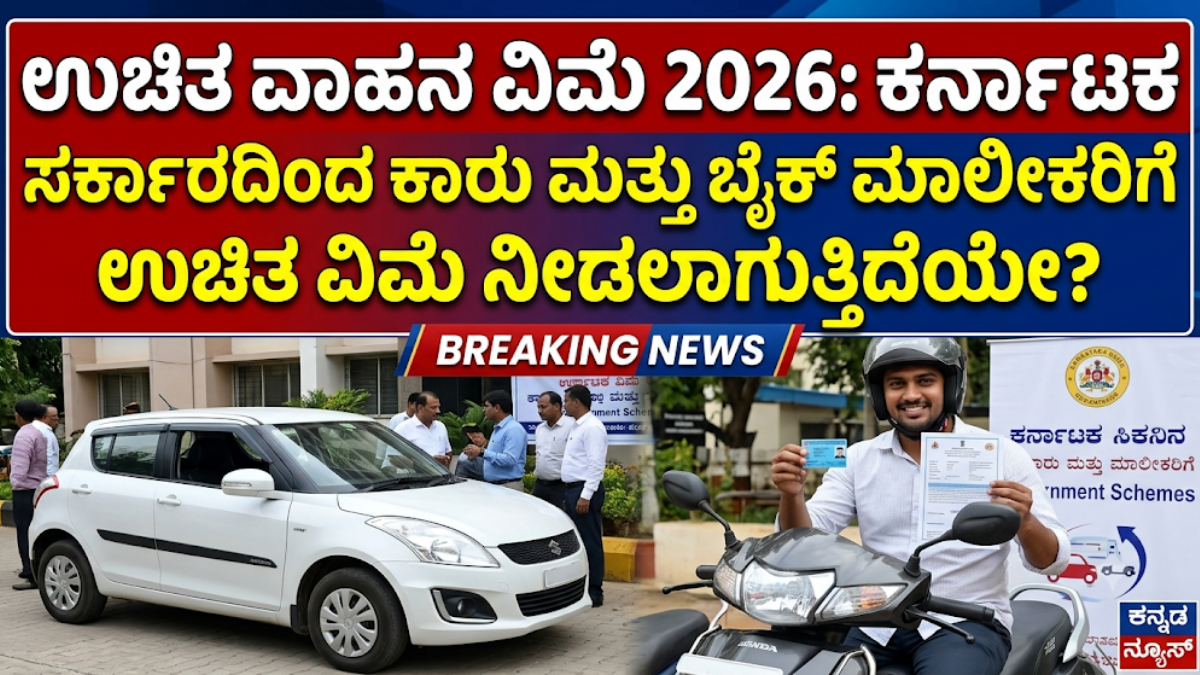
A message claiming that the Karnataka Government is providing free motor vehicle insurance to families that own cars, bikes, and other vehicles in 2026 has recently been circulating on social media and various websites.
The message encourages vehicle owners to click an “Apply Now” link and submit their details to receive free insurance. However, vehicle owners should be careful before sharing personal information or making any payment based on such claims.
At present, people should not assume that a free motor insurance scheme is genuine simply because it is being shared widely online. Before applying for any government benefit, it is important to verify the announcement through an official government department, government order, or other authoritative source.
Is Free Vehicle Insurance Being Offered by the Karnataka Government?
Claims about free insurance for families owning cars and motorcycles should be verified carefully.
A genuine government welfare scheme normally has clear information about its:
- Eligibility requirements
- Government department responsible for the scheme
- Official Government Order or notification
- Application procedure
- Required documents
- Start and closing dates
- Official application website
- Contact details for assistance
If these details cannot be confirmed through an official government source, vehicle owners should avoid submitting Aadhaar numbers, bank account information, OTPs, passwords, card details, or other sensitive information.
In particular, an unexpected website asking users to “apply immediately” should be treated with caution.
How to Verify a Government Scheme
Before applying for any scheme advertised online, follow these simple steps.
1. Check the Official Government Website
Look for the announcement on the relevant Karnataka Government department website or official government portal.
2. Look for an Official Notification
A legitimate scheme should generally have an official notification, circular, government order, or other authoritative announcement.
3. Check the Website Address
Be cautious if an application page is hosted on an unrelated website or a domain that does not appear to belong to the government or an authorized organization.
4. Never Share OTPs
Government departments, banks, and legitimate insurance providers should not require you to disclose an OTP received on your mobile phone to an unknown person.
5. Do Not Pay Unverified Application Fees
If a website suddenly asks for a registration fee, processing charge, or payment in exchange for supposedly free insurance, verify the claim before proceeding.
What Is Motor Vehicle Insurance?
Motor vehicle insurance is a financial protection product designed to protect vehicle owners against certain losses arising from accidents, theft, damage, and third-party liability.
Depending on the policy selected, insurance may cover damage to the insured vehicle as well as legal liability arising from injuries or property damage caused to another person.
In India, third-party motor insurance is generally mandatory for vehicles used on public roads. However, the exact insurance requirements and coverage depend on the type of vehicle and applicable regulations.
Major Types of Vehicle Insurance
1. Third-Party Insurance
Third-party insurance primarily protects the policyholder against certain legal liabilities arising from injury, death, or property damage caused to a third party.
It is generally the minimum insurance cover required for vehicles operating on public roads.
However, third-party insurance does not normally cover damage to the policyholder’s own vehicle.
2. Comprehensive Insurance
A comprehensive policy can provide broader protection.
Depending on the policy terms, it may cover:
- Accidental damage
- Theft
- Fire
- Natural disasters
- Floods and storms
- Riots and malicious damage
- Third-party liability
The exact coverage, exclusions, deductibles, and limits should always be checked in the policy document.
3. Personal Accident Cover
Personal accident protection may provide financial compensation in specified circumstances involving accidental death or permanent disability of the insured person.
The amount and conditions depend on the particular policy and applicable regulations.
4. Zero Depreciation Cover
Zero depreciation is an optional add-on available with certain motor insurance policies.
It can reduce the impact of depreciation deductions when eligible vehicle parts are replaced following an insured loss. Availability depends on the insurer, vehicle, policy, and applicable terms.
Common Motor Insurance Add-Ons
Vehicle owners may also find several optional covers when purchasing comprehensive insurance.
Examples include:
- Engine protection
- Roadside assistance
- Return-to-invoice cover
- Consumables cover
- Key replacement
- No-claim bonus protection
Not every add-on is necessary for every vehicle owner. The best choice depends on the vehicle’s age, usage, location, value, and the owner’s budget.
Documents Usually Required for Vehicle Insurance
Depending on the insurer and type of transaction, applicants may need information or documents such as:
- Vehicle Registration Certificate (RC)
- Previous insurance policy
- Driving licence details
- Aadhaar or another identity document, where applicable
- PAN details, where required
- Mobile number
- Email address
- Vehicle-related information
The insurer may request additional information depending on the circumstances.
How to Purchase or Renew Vehicle Insurance
Vehicle owners can purchase or renew insurance through an authorized insurer or other legitimate insurance distribution channel.
A typical process involves:
- Entering the vehicle registration and required vehicle details.
- Providing information requested by the insurer.
- Comparing available policies and coverage.
- Selecting appropriate protection and optional add-ons.
- Reviewing exclusions, deductibles, limits, and terms.
- Paying the applicable premium through an authorized payment method.
- Receiving the policy document electronically or in another permitted format.
Always keep a copy of the current policy document and check its expiry date.
What to Do After an Accident
If your vehicle is involved in an accident, contact the insurance company as soon as reasonably possible and follow its claim procedure.
Depending on the incident, you may need to:
- Inform the insurer promptly.
- Contact the police when required.
- Take photographs or videos of the accident and vehicle damage, where safe.
- Preserve relevant documents and evidence.
- Provide the information requested by the insurer.
- Cooperate with the insurer’s inspection or survey process.
- Repair the vehicle through an approved process or network, where applicable.
Never put yourself in danger to collect photographs or evidence after an accident.
What Is No Claim Bonus?
No Claim Bonus, commonly called NCB, is a benefit that may be available at renewal when an eligible policyholder has not made a claim during the relevant policy period.
The applicable percentage and conditions depend on the insurer and policy rules. A claim can affect the accumulated benefit, subject to the terms of the policy.
Why Vehicle Insurance Is Important
Adequate insurance can help vehicle owners manage unexpected financial liabilities.
Potential benefits include:
- Protection against covered vehicle damage
- Financial assistance following theft, subject to policy terms
- Protection against certain third-party liabilities
- Support for eligible accident-related expenses
- Optional roadside assistance and other services
- Compliance with mandatory insurance requirements
However, insurance is not unlimited protection. Every policy contains exclusions, conditions, deductibles, and coverage limits.
Be Careful With “Free Government Scheme” Messages
The biggest takeaway from the viral free-insurance claim is simple: do not apply merely because a social-media post tells you to do so.
If a website claims that the Karnataka Government is giving free insurance to every family owning a car or bike, first verify the announcement through an official source.
Do not provide:
- OTPs
- ATM or debit-card details
- Credit-card information
- Internet banking passwords
- UPI PINs
- Aadhaar details to unknown websites
- Bank account credentials
- Other sensitive information
If you have already entered sensitive financial information on a suspicious website, contact your bank or financial institution immediately and take appropriate steps to secure your accounts.
Final Word
Motor insurance is an important financial and legal protection for vehicle owners, but claims about free government-sponsored vehicle insurance should always be independently verified.
Do not rely solely on WhatsApp forwards, social-media posts, YouTube videos, or unofficial websites. Before applying, check whether the scheme has been officially announced, identify the responsible government department, and use only an authentic application channel.
For regular vehicle owners, maintaining valid mandatory insurance and choosing additional coverage according to the vehicle and personal requirements can provide valuable protection.
Most importantly, verify first and apply later. A genuine government benefit should be supported by clear official information, and there is no need to rush into an application through an unknown link.