Introduction
The Foreign Contribution (Regulation) Act, commonly known as FCRA, is one of the most important laws governing the receipt and utilization of foreign contributions in India. The Central Government introduced and continues to regulate FCRA to ensure that foreign funds are used transparently and for legitimate social, educational, cultural, economic, and religious purposes.
For non-governmental organizations (NGOs), charitable trusts, societies, educational institutions, and non-profit organizations, understanding FCRA compliance is essential. Failure to comply with the law can lead to suspension or cancellation of registration, financial penalties, and legal complications.
This article explains the Central Government’s FCRA framework and highlights seven key provisions that every organization should understand. Whether you are an NGO administrator, trustee, compliance officer, researcher, or donor, this comprehensive guide will help you understand the significance of FCRA and its impact on foreign funding in India.
What Is FCRA?
The Foreign Contribution (Regulation) Act is a law enacted by the Government of India to regulate the acceptance and utilization of foreign contributions and foreign hospitality by certain individuals, associations, and organizations.
The primary objective of FCRA is to ensure that foreign funding does not adversely affect India’s sovereignty, integrity, security, strategic interests, or democratic institutions. The Act seeks to maintain transparency and accountability in the use of foreign funds.
Organizations that receive donations, grants, or contributions from foreign sources must comply with FCRA regulations and obtain the necessary approval or registration from the Central Government.
Why Is FCRA Important?
FCRA plays a critical role in maintaining transparency in the non-profit sector. Foreign contributions can support various developmental activities such as:
- Education programs
- Healthcare initiatives
- Rural development projects
- Women’s empowerment programs
- Environmental conservation efforts
- Disaster relief activities
- Skill development and employment programs
While foreign funding can support social welfare, the government also needs mechanisms to ensure that such funds are not misused for unlawful or anti-national activities. FCRA serves this purpose by establishing a legal framework for monitoring and regulating foreign contributions.
Objectives of FCRA
The key objectives of FCRA include:
- Regulating foreign contributions received by organizations and individuals.
- Preventing misuse of foreign funds.
- Protecting national interests and security.
- Ensuring transparency in financial transactions.
- Promoting accountability among NGOs and associations.
- Monitoring utilization of foreign donations.
- Strengthening governance in the non-profit sector.
These objectives help create a balanced system where legitimate organizations can receive support while maintaining compliance with Indian laws.
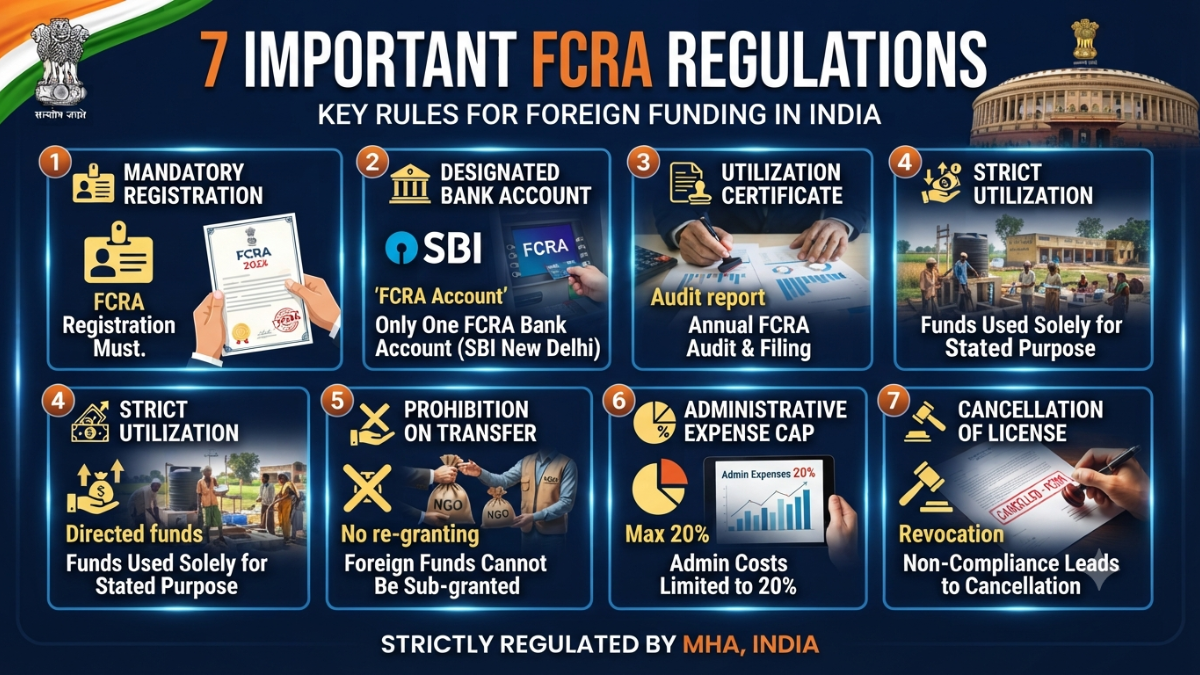
7 Key Provisions of Central Government FCRA
1. Mandatory FCRA Registration
One of the most important provisions under FCRA is the requirement for registration.
Any association, trust, society, or non-profit organization seeking to receive foreign contributions regularly must obtain FCRA registration from the Central Government.
To qualify for registration, organizations generally need:
- Legal registration under relevant laws.
- A track record of genuine activities.
- Proper governance structures.
- Compliance with financial regulations.
Without FCRA registration, organizations cannot legally receive foreign contributions except through specific prior permission mechanisms.
Benefits of Registration
- Legal receipt of foreign donations.
- Enhanced credibility.
- Better donor confidence.
- Long-term funding opportunities.
Organizations must maintain accurate records and comply with all reporting obligations after obtaining registration.
2. Designated FCRA Bank Account Requirement
Another major provision is the requirement to receive foreign contributions through a designated bank account.
Organizations receiving foreign funds must ensure that all foreign contributions are credited into the specified FCRA account approved under the regulations.
This provision aims to:
- Improve transparency.
- Facilitate monitoring of foreign funds.
- Prevent diversion of donations.
- Simplify regulatory oversight.
All foreign contributions must enter through the designated account before being utilized for approved activities.
Importance of Proper Banking Compliance
Maintaining separate records and accounts for foreign contributions helps organizations:
- Track expenditures accurately.
- Prepare annual returns efficiently.
- Demonstrate transparency during audits.
- Avoid compliance violations.
Proper banking practices are essential for smooth FCRA compliance.
3. Restrictions on Certain Persons and Organizations
FCRA imposes restrictions on specific categories of persons and entities.
Certain individuals and organizations are prohibited from accepting foreign contributions due to the nature of their roles or positions.
These restrictions are intended to:
- Protect democratic institutions.
- Prevent undue foreign influence.
- Maintain political neutrality.
- Safeguard national interests.
Organizations must verify donor sources and ensure compliance with all eligibility requirements before accepting foreign contributions.
Compliance Considerations
Before receiving foreign funds, organizations should:
- Verify donor credentials.
- Maintain documentation.
- Conduct internal reviews.
- Ensure legal eligibility.
Failure to comply may result in serious legal consequences.
4. Utilization of Foreign Contribution for Approved Purposes
Foreign contributions received under FCRA must be used only for the specific objectives and activities for which they were obtained.
Funds should support:
- Charitable activities.
- Educational initiatives.
- Social welfare projects.
- Development programs.
- Approved organizational objectives.
Using foreign contributions for unauthorized purposes may constitute a violation of FCRA regulations.
Best Practices for Utilization
Organizations should:
- Maintain project-specific budgets.
- Track expenditures carefully.
- Preserve invoices and receipts.
- Conduct periodic internal audits.
These practices help ensure accountability and compliance.
5. Annual Returns and Reporting Obligations
Transparency is a cornerstone of FCRA compliance.
Registered organizations are required to submit annual returns detailing:
- Foreign contributions received.
- Source of donations.
- Amount received.
- Utilization of funds.
- Financial statements.
Timely filing of annual returns is essential for maintaining active FCRA registration.
Why Reporting Matters
Annual reporting enables authorities to:
- Monitor fund utilization.
- Detect irregularities.
- Promote transparency.
- Ensure regulatory compliance.
Organizations should establish strong record-keeping systems to meet reporting requirements efficiently.
6. Suspension and Cancellation of Registration
The Central Government has the authority to suspend or cancel FCRA registration if an organization violates the provisions of the Act.
Common reasons may include:
- Misuse of foreign contributions.
- Non-submission of returns.
- False declarations.
- Violation of FCRA conditions.
- Activities inconsistent with organizational objectives.
Suspension or cancellation can significantly impact an organization’s operations and reputation.
Preventive Measures
To avoid regulatory action, organizations should:
- Maintain accurate records.
- Conduct regular compliance reviews.
- Train staff on FCRA requirements.
- Respond promptly to government communications.
Strong governance reduces compliance risks.
7. Renewal and Continuous Compliance
FCRA registration is not a one-time process. Organizations must ensure ongoing compliance and renew registration as required under applicable regulations.
Continuous compliance includes:
- Maintaining proper accounts.
- Filing annual returns.
- Updating organizational information.
- Following banking regulations.
- Adhering to utilization guidelines.
Organizations should treat FCRA compliance as an ongoing responsibility rather than a periodic requirement.
Importance of Renewal
Timely renewal helps organizations:
- Continue receiving foreign contributions.
- Maintain donor confidence.
- Avoid legal interruptions.
- Support long-term project planning.
Failure to renew registration may affect funding continuity and organizational operations.
Common FCRA Compliance Challenges
Many organizations face practical challenges while complying with FCRA regulations.
Some common issues include:
Documentation Errors
Incomplete records can create compliance risks. Organizations should maintain comprehensive documentation of all foreign contributions and expenditures.
Delayed Reporting
Late submission of annual returns can attract penalties and regulatory scrutiny.
Inadequate Internal Controls
Weak financial controls may increase the risk of errors or misuse of funds.
Lack of Compliance Awareness
Many smaller organizations struggle due to insufficient understanding of FCRA requirements.
Regular training and expert guidance can help overcome these challenges.
Best Practices for FCRA Compliance
Organizations can strengthen compliance by implementing the following best practices:
Maintain Accurate Records
Keep detailed records of:
- Donations received
- Bank transactions
- Project expenditures
- Financial statements
- Donor communications
Conduct Internal Audits
Regular audits help identify issues before they become major compliance concerns.
Establish Compliance Policies
Develop written procedures covering:
- Fund management
- Reporting obligations
- Approval processes
- Documentation standards
Monitor Regulatory Updates
FCRA regulations may evolve over time. Organizations should stay informed about government notifications and compliance requirements.
Seek Professional Guidance
Legal and financial experts can assist organizations in navigating complex compliance requirements and minimizing risk.
Impact of FCRA on NGOs and Civil Society Organizations
FCRA significantly influences how NGOs operate in India.
Positive Impacts
- Greater transparency.
- Improved accountability.
- Better financial governance.
- Increased donor confidence.
- Enhanced regulatory oversight.
Operational Challenges
- Administrative burden.
- Compliance costs.
- Reporting requirements.
- Documentation obligations.
Despite these challenges, strong compliance systems can help organizations manage regulatory requirements effectively.
Future of FCRA Compliance in India
As transparency and financial accountability continue to gain importance, FCRA compliance is expected to remain a key focus area for NGOs and charitable organizations.
Future trends may include:
- Increased digital reporting.
- Enhanced monitoring systems.
- Stronger transparency requirements.
- Greater emphasis on governance standards.
- Improved compliance technology solutions.
Organizations that invest in robust compliance frameworks will be better positioned to adapt to future regulatory developments.
Conclusion
The Foreign Contribution (Regulation) Act remains a critical component of India’s regulatory framework for foreign funding. By regulating foreign contributions, the Central Government seeks to balance developmental support with transparency, accountability, and national interests.
Understanding the seven key provisions of FCRA—registration, designated bank accounts, eligibility restrictions, proper utilization of funds, annual reporting, suspension and cancellation provisions, and continuous compliance—is essential for every organization receiving foreign contributions.
NGOs, trusts, societies, educational institutions, and charitable organizations should prioritize compliance, maintain transparent records, and establish strong governance systems to ensure lawful and effective utilization of foreign funds.
A proactive approach to FCRA compliance not only minimizes legal risks but also strengthens organizational credibility, donor confidence, and long-term sustainability. As regulations continue to evolve, staying informed and compliant will remain essential for organizations seeking to make a positive impact through foreign-funded initiatives.