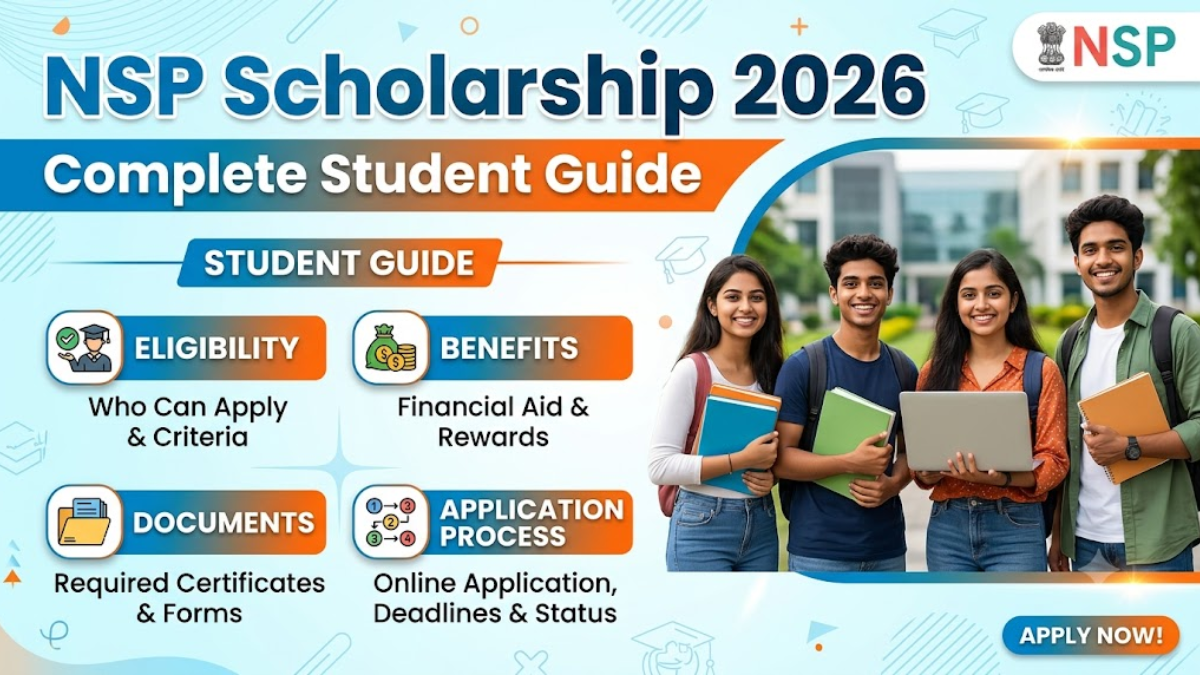
Education is one of the most valuable investments for a successful future. However, rising tuition fees, examination costs, hostel expenses, books, and other educational charges often create financial challenges for many students and their families. To ensure that deserving students are not forced to discontinue their education due to financial difficulties, the Government of India offers several scholarship schemes through the National Scholarship Portal (NSP).
The National Scholarship Portal is a single online platform that allows students to apply for multiple Central Government scholarship schemes without visiting different websites. It simplifies the entire scholarship process—from registration and application submission to verification and payment—making it easier, faster, and more transparent.
Whether you are studying in SSLC, PUC, ITI, Diploma, Polytechnic, Undergraduate (Degree), Engineering, Medical, Postgraduate, or any recognized professional course, this detailed guide explains everything you need to know about the NSP Scholarship 2026, including eligibility, benefits, required documents, application steps, common mistakes to avoid, and frequently asked questions.
What is the National Scholarship Portal (NSP)?
The National Scholarship Portal (NSP) is an online scholarship management system developed by the Government of India. It acts as a centralized platform where students can discover, apply for, and track various scholarship schemes offered by Central Government ministries and departments.
Instead of applying separately for different scholarships, students can use a single portal to complete the entire process. The portal also helps educational institutions and government authorities verify applications digitally, ensuring transparency and reducing paperwork.
One of the major advantages of NSP is that approved scholarship amounts are transferred directly to the student’s bank account through the Direct Benefit Transfer (DBT) system, reducing delays and eliminating intermediaries.
Objectives of the NSP Scholarship
The National Scholarship Portal was introduced with several important goals, including:
- Providing financial assistance to deserving students.
- Making scholarship applications simple and paperless.
- Offering a single platform for multiple scholarship schemes.
- Reducing duplicate applications and fraudulent claims.
- Ensuring transparent scholarship processing.
- Speeding up verification and approval.
- Transferring scholarship funds directly to beneficiaries.
- Encouraging students to continue higher education.
Who Can Apply for NSP Scholarship 2026?
Students enrolled in recognized educational institutions across India may be eligible to apply under one or more scholarship schemes available on the National Scholarship Portal.
Eligible students may include those studying in:
- SSLC (Class 10)
- PUC (Class 11 and Class 12)
- Higher Secondary Education
- ITI Courses
- Diploma Courses
- Polytechnic Courses
- Undergraduate Degree Programs
- Engineering Courses
- Medical Courses
- Nursing Courses
- Pharmacy Courses
- Agriculture Courses
- Law Courses
- Management Programs
- Postgraduate Courses
- Professional Courses
- Technical Education Programs
- Research and Higher Education Programs
Each scholarship scheme has its own eligibility criteria. Students should carefully read the guidelines before applying.
Categories of Students Covered
Different scholarship schemes are available for students belonging to various social and economic backgrounds.
These may include:
- Scheduled Caste (SC)
- Scheduled Tribe (ST)
- Other Backward Classes (OBC)
- Economically Weaker Sections (EWS)
- Minority Communities
- Students with Disabilities (where applicable)
- Meritorious Students
- Economically Disadvantaged Students
Eligibility depends on the specific scholarship scheme selected by the applicant.
Eligibility Criteria
The eligibility requirements differ from one scholarship scheme to another. However, most schemes generally consider the following factors:
Academic Qualification
Applicants should have passed the previous qualifying examination with the minimum percentage required under the chosen scholarship scheme.
Family Income
Most scholarships have an annual family income limit. Students should possess a valid income certificate if required.
Educational Institution
The student must be studying in a recognized school, college, university, or technical institution.
Category
Certain scholarships are specifically meant for students belonging to SC, ST, OBC, EWS, or Minority categories.
Course Eligibility
The applicant must be enrolled in an eligible course recognized under the scholarship guidelines.
Benefits of NSP Scholarship
Receiving an NSP scholarship can significantly reduce the financial burden of education.
Some major benefits include:
- Financial assistance for continuing education.
- Support for tuition fees.
- Maintenance allowance for eligible students.
- Assistance with academic expenses.
- Direct transfer of scholarship funds to the student’s bank account.
- Transparent online processing.
- Easy application tracking.
- Secure digital verification.
- Reduced paperwork.
- Faster scholarship disbursement through DBT.
These benefits help students focus more on academics and less on financial concerns.
Documents Required
Students should keep all necessary documents ready before starting the application process.
Commonly required documents include:
- Aadhaar Card
- Student Identity Card
- Passport Size Photograph
- Previous Year Marksheet
- Income Certificate
- Caste Certificate (if applicable)
- Domicile Certificate (where required)
- Bonafide Certificate
- Admission Receipt
- Fee Receipt
- Bank Passbook
- Mobile Number
- Email Address
- Disability Certificate (if applicable)
- Other documents required under the selected scholarship scheme
Make sure that all scanned documents are clear, readable, and uploaded in the prescribed format.
How to Apply for NSP Scholarship 2026
Applying for the NSP Scholarship is a straightforward online process.
Step 1: Visit the Official NSP Portal
Open the official National Scholarship Portal using a secure internet connection.
Step 2: Complete One-Time Registration (OTR)
New applicants must complete the One-Time Registration process by providing the required personal details and verifying their identity.
Step 3: Log In
After successful registration, log in using your credentials.
Step 4: Select the Appropriate Scholarship Scheme
Carefully review the available scholarship schemes and choose the one that matches your eligibility.
Step 5: Fill in Personal Information
Enter your name, address, Aadhaar details (where required), contact information, and other personal details carefully.
Step 6: Enter Academic Details
Provide information regarding your institution, course, year of study, examination results, and admission details.
Step 7: Add Bank Details
Enter your bank account information accurately to ensure successful scholarship payment.
Step 8: Upload Documents
Upload all required supporting documents in the prescribed size and format.
Step 9: Review the Application
Double-check every detail before submitting the application.
Step 10: Submit the Application
Submit the completed application online.
Step 11: Save the Acknowledgement
Download or print the application acknowledgement for future reference.
Step 12: Track Application Status
Regularly check your application status through the portal to stay updated on verification and approval.
Application Verification Process
After submission, the application generally goes through several verification stages.
These may include:
- Student submission
- Institute verification
- District or State verification (where applicable)
- Central Government verification
- Scholarship approval
- Direct Benefit Transfer to the student’s bank account
Verification by the educational institution is an important step. Students should ensure that their institution completes this process within the prescribed timeline.
Common Reasons for Scholarship Rejection
Many scholarship applications are rejected because of avoidable mistakes.
Some common reasons include:
- Incorrect Aadhaar information
- Wrong bank account details
- Incomplete application form
- Missing mandatory documents
- Poor-quality scanned copies
- Incorrect income certificate
- Invalid caste certificate
- Institution verification not completed
- Applying under an ineligible scholarship scheme
- Duplicate applications
- Mismatch between uploaded documents and application details
Carefully reviewing your application before submission can help prevent these issues.
Tips to Improve Approval Chances
Students can improve the likelihood of receiving the scholarship by following a few simple practices.
- Apply well before the last date.
- Read the eligibility criteria carefully.
- Choose the correct scholarship scheme.
- Enter accurate personal details.
- Ensure your bank account information is correct.
- Keep Aadhaar details updated where required.
- Upload clear and legible documents.
- Check your email and mobile number regularly for updates.
- Monitor application status frequently.
- Respond promptly if any correction is requested.
Paying attention to these details can help avoid unnecessary delays.
Important Points Every Student Should Know
Before applying, students should remember the following:
- Eligibility varies from one scholarship scheme to another.
- Meeting the eligibility criteria does not automatically guarantee scholarship approval.
- Students should submit only genuine information and authentic documents.
- Applications must be verified by the educational institution whenever required.
- Scholarship amounts are transferred through the Direct Benefit Transfer (DBT) system after successful approval.
- Students should apply only through the official National Scholarship Portal.
- Incorrect or false information may lead to rejection or cancellation of the scholarship.
Advantages of Using the National Scholarship Portal
The National Scholarship Portal offers several benefits compared to traditional offline scholarship applications.
These include:
- Single online platform
- Easy registration process
- Faster application submission
- Online document upload
- Transparent verification
- Reduced paperwork
- Real-time application tracking
- Secure digital records
- Direct bank transfer
- User-friendly interface
The portal saves both time and effort for students and educational institutions.
Who Should Apply?
Students pursuing various educational programs should check whether they qualify for an available NSP scholarship.
This includes students enrolled in:
- Government Schools
- Government-Aided Institutions
- Private Recognized Institutions
- Universities
- Colleges
- Technical Institutes
- Engineering Colleges
- Medical Colleges
- Polytechnic Colleges
- ITI Institutions
- Professional Education Programs
Students should always verify that their institution is recognized under the applicable scholarship scheme.
Frequently Asked Questions (FAQs)
Is the NSP Scholarship available for SSLC students?
Yes. Eligible SSLC students may apply under scholarship schemes that cover their level of education.
Can PUC students apply?
Yes. Several scholarship schemes are available for students pursuing Class 11 and Class 12, depending on eligibility.
Are Degree students eligible?
Yes. Undergraduate students studying in recognized institutions can apply for eligible scholarship schemes available on the National Scholarship Portal.
Can Diploma and ITI students apply?
Yes. Students enrolled in eligible Diploma, Polytechnic, and ITI programs may apply if they satisfy the requirements of the chosen scholarship scheme.
Are Engineering and Medical students eligible?
Yes. Students pursuing Engineering, Medical, Nursing, Pharmacy, and other professional courses can apply under eligible scholarship schemes.
Is Aadhaar compulsory?
Many scholarship schemes require Aadhaar authentication or another approved identification process. Students should check the specific requirements of their selected scheme.
Is family income considered?
Yes. Many scholarships have annual family income limits, so applicants should verify the income eligibility before applying.
Can students from any state apply?
Yes. Students from all states and Union Territories of India can apply for eligible Central Government scholarship schemes available through the National Scholarship Portal.
How is the scholarship amount paid?
Approved scholarship amounts are transferred directly to the student’s registered bank account through the Direct Benefit Transfer (DBT) system.
Can I edit my application after submission?
The availability of correction facilities depends on the NSP schedule and the specific scholarship scheme. Students should carefully review all information before final submission.
Final Words
The National Scholarship Portal (NSP) Scholarship 2026 serves as one of India’s most important scholarship platforms, helping students from different educational backgrounds receive financial support for their studies. Whether you are pursuing SSLC, PUC, ITI, Diploma, Polytechnic, Undergraduate Degree, Engineering, Medical, Nursing, Pharmacy, Postgraduate, or other professional courses, the portal provides access to multiple Central Government scholarship schemes through a single online system.
Applying through the NSP portal is a simple yet important process that requires accurate information, complete documentation, and timely submission. Students should carefully review the eligibility conditions of their chosen scholarship scheme, keep all required documents ready, complete the One-Time Registration (OTR), and regularly monitor their application status after submission.
A scholarship can significantly reduce educational expenses and help students focus on achieving academic excellence. If you meet the eligibility requirements, applying through the National Scholarship Portal could be an excellent opportunity to receive financial assistance and continue your educational journey with greater confidence.