Introduction
The Gruhalakshmi Scheme has become one of the most significant welfare initiatives for women in Karnataka. Introduced by the Government of Karnataka, the scheme aims to provide financial assistance to eligible women who are recognized as the heads of their households. Under this program, beneficiaries receive monthly financial support directly into their bank accounts, helping families manage household expenses and improve their financial stability.
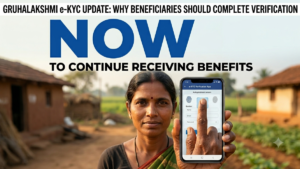
In recent months, discussions regarding e-KYC (Electronic Know Your Customer) updates have gained attention among beneficiaries. Government departments regularly conduct verification exercises to ensure that benefits reach eligible recipients without interruption. As a result, many beneficiaries have been advised to complete or update their e-KYC details whenever requested by the authorities.
This article explains the importance of e-KYC, the reasons for updating it, the benefits of completing the process, and the steps beneficiaries can follow to ensure smooth receipt of Gruhalakshmi scheme payments.
What is the Gruhalakshmi Scheme?
The Gruhalakshmi Scheme is a social welfare program designed to provide financial support to women heads of households in Karnataka. The primary objective of the scheme is to strengthen the economic position of women and provide direct monetary assistance for household needs.
Through Direct Benefit Transfer (DBT), eligible beneficiaries receive financial assistance directly into their bank accounts. This system minimizes delays, increases transparency, and reduces the possibility of fraud.
Since its launch, the scheme has benefited millions of women across the state and has become an important source of financial support for many families.
Understanding e-KYC
e-KYC stands for Electronic Know Your Customer. It is a digital verification process used by government agencies, banks, and financial institutions to confirm the identity of beneficiaries.
The process generally involves verifying personal information such as:
- Name
- Aadhaar details
- Mobile number
- Bank account information
- Address details
- Biometric verification, where applicable
e-KYC helps ensure that government benefits are credited to the correct person and that records remain accurate and up to date.
Why is e-KYC Important for Gruhalakshmi Beneficiaries?
Verification plays a crucial role in welfare schemes. Government authorities periodically review beneficiary records to maintain transparency and prevent errors.
Some of the key reasons e-KYC is important include:
1. Accurate Identification
e-KYC helps confirm that the registered beneficiary is the genuine recipient of scheme benefits. This reduces the risk of duplicate or incorrect records.
2. Direct Transfer of Benefits
Since Gruhalakshmi payments are transferred directly to beneficiaries’ bank accounts, accurate banking and identity information is essential. Updated e-KYC ensures successful fund transfers.
3. Prevention of Fraud
Verification helps authorities identify duplicate applications, fake beneficiaries, and other irregularities that may affect the integrity of the scheme.
4. Improved Database Management
Updated beneficiary records allow the government to maintain a reliable and efficient database for welfare program administration.
5. Faster Resolution of Payment Issues
Beneficiaries who complete e-KYC updates may experience fewer payment-related problems because their records remain current and verified.
Reasons Beneficiaries May Be Asked to Update e-KYC
There are several situations in which beneficiaries may receive instructions to complete or update their e-KYC details.
Aadhaar Verification Issues
If Aadhaar details are incomplete, outdated, or mismatched with scheme records, an update may be required.
Bank Account Changes
Beneficiaries who have changed their bank account or linked a new account may need to complete verification again.
Mobile Number Updates
A registered mobile number plays an important role in receiving notifications and OTP-based verification messages.
Data Corrections
Spelling mistakes, incorrect addresses, or other data entry errors may require updating beneficiary information.
Periodic Government Verification Drives
Government departments occasionally conduct verification campaigns to ensure the accuracy of beneficiary records.
Benefits of Completing e-KYC on Time
Completing e-KYC within the prescribed timeframe can offer several advantages.
Uninterrupted Financial Assistance
Verified records reduce the likelihood of payment delays or transaction failures.
Better Communication
Beneficiaries with updated mobile numbers and contact information can receive important scheme-related notifications.
Enhanced Security
Verification ensures that benefits are delivered to the rightful recipient and protects against unauthorized claims.
Access to Future Welfare Programs
Accurate records may help beneficiaries participate in other government welfare initiatives that require verified information.
How Beneficiaries Can Complete e-KYC
The exact process may vary depending on government instructions and local administrative arrangements. However, beneficiaries are generally advised to follow these steps:
Step 1: Gather Required Documents
Keep the following documents ready:
- Aadhaar Card
- Ration Card
- Bank Passbook
- Registered Mobile Number
- Other supporting documents, if requested
Step 2: Visit the Authorized Centre
Beneficiaries may be asked to visit an authorized service center, welfare office, or designated government facility for verification.
Step 3: Submit Required Information
Provide updated personal and banking information as required by the officials.
Step 4: Complete Biometric Verification
In some cases, fingerprint or iris authentication may be required to verify identity.
Step 5: Confirmation of Update
After successful verification, beneficiaries may receive a confirmation message or acknowledgment indicating that their e-KYC process has been completed.
Common Issues Faced During e-KYC
While the process is generally straightforward, some beneficiaries may encounter challenges.
Aadhaar and Bank Account Mismatch
Differences in name spelling or personal details can cause verification failures.
Biometric Authentication Problems
Fingerprint authentication may occasionally fail due to technical issues.
Incorrect Mobile Number
An outdated mobile number can prevent OTP verification.
Incomplete Documentation
Missing documents may delay the completion of the process.
Beneficiaries should ensure that all information is accurate and updated before visiting a verification center.
What to Do If Payments Are Delayed?
Some beneficiaries may experience payment delays due to verification-related issues.
If payments are not credited, beneficiaries can:
- Check Aadhaar-bank account linkage.
- Verify whether e-KYC has been completed successfully.
- Contact the concerned welfare department.
- Visit the nearest service center for assistance.
- Ensure that bank account details are active and accurate.
Prompt action can help resolve most payment-related concerns.
Safety Tips for Beneficiaries
As awareness about welfare schemes increases, fraudulent activities may also rise. Beneficiaries should remain cautious and follow these safety measures:
- Share personal information only with authorized officials.
- Do not disclose OTPs to unknown individuals.
- Avoid paying money to unauthorized agents.
- Verify information through official government channels.
- Keep copies of submitted documents and acknowledgment receipts.
Protecting personal information is essential for ensuring secure access to welfare benefits.
Role of Digital Governance
The adoption of e-KYC reflects the growing role of digital governance in public welfare programs. By using technology-based verification systems, governments can improve transparency, reduce administrative delays, and deliver benefits more efficiently.
Digital verification also enables faster record updates, improved beneficiary tracking, and better monitoring of welfare schemes.
As more government services move toward digital platforms, beneficiaries are encouraged to maintain updated records and stay informed about official announcements.
Conclusion
The Gruhalakshmi Scheme continues to play a vital role in supporting women and families across Karnataka. e-KYC verification is an important administrative process that helps ensure that benefits are delivered to eligible recipients accurately and efficiently.
Beneficiaries should regularly check official notifications and complete any requested verification procedures promptly. Keeping Aadhaar details, bank account information, and contact information updated can help prevent payment interruptions and ensure smooth access to financial assistance.
By cooperating with verification requirements and staying informed through official sources, beneficiaries can continue to receive the benefits of the Gruhalakshmi Scheme without unnecessary delays.