Studying can sometimes become stressful, especially when students have to understand lengthy textbook chapters, remember important dates, learn complicated scientific concepts, and prepare for examinations. Many students spend hours reading the same paragraphs repeatedly but still find it difficult to remember the information.
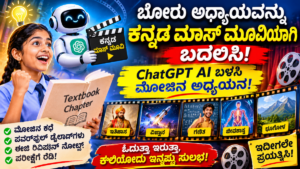
But what if studying could feel like watching an entertaining Kannada blockbuster movie?
Imagine a history chapter becoming a powerful historical action film, a science lesson turning into a science-fiction adventure, and a mathematics chapter becoming an exciting challenge between a hero and a villain. Instead of memorising textbook information in the usual way, students can understand important concepts through interesting characters, funny conversations, emotional scenes, and powerful Kannada mass dialogues.
Sounds exciting, right?
With the help of ChatGPT AI, students can transform almost any textbook topic into a creative Kannada movie-style learning experience. They can generate hero introductions, villain characters, comedy sequences, emotional dialogues, action scenes, and even an exciting climax based on their lessons.
The best part is that students do not need filmmaking knowledge, video-editing skills, or expensive software. A suitable prompt and the textbook chapter are enough to get started.
In this article, let us understand how to use ChatGPT to convert ordinary textbook chapters into Kannada mass movie stories, generate interesting study notes, prepare examination questions, and make daily revision more enjoyable.
What Is the Kannada Mass Movie Study Method?
The Kannada mass movie study method is a creative learning technique in which students use Artificial Intelligence to explain educational topics through movie-style storytelling.
Normally, textbooks present information through paragraphs, definitions, diagrams, examples, and explanations. Although this format is important for academic learning, some students may find it difficult to maintain their interest throughout lengthy lessons.
Using ChatGPT, students can request the same educational information in the form of a Kannada commercial movie.
For example, consider a history lesson about India’s freedom movement.
Instead of reading the entire chapter as a collection of historical events, students can ask ChatGPT to create a movie in which:
- Freedom fighters become the main heroes.
- Colonial rulers become the opposing characters.
- Important historical events become major movie scenes.
- Significant movements become powerful action sequences.
- Important speeches become memorable dialogues.
- India’s independence becomes the climax.
In the same way, a biology lesson can become a superhero adventure where different organs of the human body perform important missions.
A physics chapter can become a science-fiction movie explaining electricity, energy, motion, or gravity.
This approach connects educational information with imagination and storytelling. Students can use familiar Kannada movie elements to make unfamiliar concepts easier to understand.
However, the purpose is not to replace the textbook. The purpose is to make textbook learning more interesting and understandable.
Why Should Students Try ChatGPT for Creative Learning?
Every student has a different learning style. Some students understand topics quickly through reading, while others learn better through examples, conversations, illustrations, or storytelling.
ChatGPT can help students experiment with different explanation styles.
Here are some reasons why the Kannada mass movie learning technique can be useful.
1. Makes Difficult Chapters More Interesting
Reading a lengthy chapter can sometimes become repetitive. Turning it into a movie-style story introduces characters, situations, and interesting conversations.
Students may become more interested in understanding what happens next while learning the actual subject matter.
2. Helps Explain Complicated Concepts
Some educational topics are difficult to understand through textbook definitions alone.
Students can ask ChatGPT to explain these topics using simple Kannada dialogues, everyday examples, and fictional situations.
For instance, the concept of gravity can be explained through a funny scene in which a movie hero tries to jump over a building but discovers that Earth’s gravitational force pulls objects towards the ground.
3. Creates Memorable Dialogues
Powerful dialogues can help students associate important facts with memorable sentences.
For example, a lesson about the water cycle can be explained through a conversation between three characters representing evaporation, condensation, and precipitation.
Such dialogues can help students remember the sequence of events.
4. Supports Kannada-Medium and English-Medium Students
Students can ask ChatGPT to explain the same topic in simple Kannada, English, or a mixture of both languages.
This is particularly useful for students who understand concepts better in their mother tongue but need to write examination answers in English.
5. Makes Revision More Enjoyable
Instead of reading the same notes repeatedly, students can revise through short movie scenes, character conversations, quizzes, and question-and-answer sessions.
This can make revision more interactive and less monotonous.
How to Convert Any Textbook Chapter into a Kannada Mass Movie Using ChatGPT
Creating your own educational movie story is simple. Follow these steps to transform an ordinary textbook chapter into an entertaining Kannada learning experience.
Step 1: Select a Difficult or Boring Chapter
First, identify the textbook chapter that you find difficult to understand or remember.
You can choose topics from almost any subject, including:
- History
- Geography
- Physics
- Chemistry
- Biology
- Mathematics
- Economics
- Political Science
- Environmental Studies
- Social Science
For example, if you are studying the Indian Constitution, you can turn the chapter into a political courtroom drama.
If you are learning about the solar system, you can create a space adventure featuring the Sun, planets, and other celestial objects as characters.
Step 2: Open ChatGPT
Visit the official ChatGPT website or open the ChatGPT application on your mobile phone.
Start a new conversation and prepare the chapter content.
You can either type the chapter title, paste the relevant textbook material, or upload a supported document if that option is available.
For better explanations, provide the actual chapter content instead of only mentioning its title.
Step 3: Give ChatGPT a Kannada Movie-Style Prompt
Now comes the interesting part.
Ask ChatGPT to behave like a creative Kannada film director and an experienced teacher.
Explain that you want the educational chapter transformed into a commercial Kannada movie containing:
- Hero introduction.
- Villain introduction.
- Powerful mass dialogues.
- Comedy scenes.
- Emotional moments.
- Interesting twists.
- Action sequences.
- Educational explanations.
- A memorable climax.
Also instruct ChatGPT to preserve the original educational information.
This is important because the objective is to understand the chapter, not to create an entertaining story that changes the actual facts.
Step 4: Generate the Movie Story Scene by Scene
After receiving your prompt and chapter content, ChatGPT can prepare a movie-style explanation.
For example, it can divide the chapter into different scenes:
Scene 1: Hero Introduction
The main concept or historical personality is introduced through a powerful entry.
Scene 2: The Problem Begins
The main challenge, scientific question, or historical conflict is explained.
Scene 3: Comedy and Explanation
Difficult concepts are explained through funny conversations and simple examples.
Scene 4: The Big Twist
An important event or concept is introduced through an unexpected situation.
Scene 5: The Final Climax
The entire chapter is connected through an exciting conclusion.
Students can ask ChatGPT to explain every scene in simple Kannada so that the educational meaning remains clear.
Step 5: Ask for Powerful Kannada Dialogues
Movie-style dialogues can make the learning experience more entertaining.
For example, when learning about gravity, you can request a dialogue between a scientist and a movie hero.
Hero: “ನಾನು ಎಷ್ಟು ಎತ್ತರಕ್ಕೆ ಜಿಗಿದರೂ ಮತ್ತೆ ಭೂಮಿಗೆ ಬರಬೇಕಾ?”
Scientist: “ಅದೇ ಗುರುತ್ವಾಕರ್ಷಣೆಯ ಶಕ್ತಿ! ಭೂಮಿ ತನ್ನತ್ತ ವಸ್ತುಗಳನ್ನು ಆಕರ್ಷಿಸುತ್ತದೆ!”
Students can ask for similar dialogues based on their own textbook chapters.
Step 6: Create Revision Notes from the Movie
Once the movie story is ready, do not stop there.
Ask ChatGPT to convert the same chapter into:
- Short study notes.
- Important definitions.
- Key points.
- Important dates.
- Scientific formulas.
- Question-and-answer sets.
- Multiple-choice questions.
- Fill-in-the-blanks.
- One-mark and two-mark questions.
- Long-answer examination questions.
This helps students connect entertainment-based learning with actual examination preparation.
Best Copy-and-Paste ChatGPT Prompt to Create a Kannada Mass Movie
Students who want to try this method can directly copy the following prompt and paste their textbook chapter below it.
Kannada Mass Movie Learning Prompt
“Act as a professional Kannada commercial movie director, creative screenwriter, and experienced school teacher.
I will provide you with a textbook chapter. Your task is to transform the entire chapter into an entertaining Kannada mass movie-style educational story.
Make the story exciting and easy for school and college students to understand.
Include the following elements:
- A powerful hero introduction based on the main topic.
- Interesting supporting characters.
- A memorable villain or opposing force wherever suitable.
- Powerful Kannada mass dialogues.
- Funny comedy scenes.
- Emotional moments.
- Exciting action sequences where appropriate.
- Unexpected twists and interesting situations.
- Scene-by-scene explanations of the educational concepts.
- A meaningful and memorable climax.
IMPORTANT INSTRUCTIONS:
- Use simple, natural Kannada.
- Preserve all important educational facts.
- Do not change historical dates, scientific information, formulas, definitions, or important concepts.
- Explain difficult words using simple examples.
- Do not skip any important information from the chapter.
- Make the story entertaining without reducing its educational value.
At the end, provide:
- A short summary of the chapter.
- Important examination points.
- Key definitions.
- Important questions and answers.
- Ten multiple-choice questions with answers.
- Five short-answer questions.
- Five long-answer questions.
- A quick revision sheet.
Here is my textbook chapter:
[PASTE YOUR CHAPTER HERE]”
With this single prompt, students can request both an entertaining story and useful academic material.
Subject-Wise Ideas: How to Turn Every School Subject into a Kannada Movie
One of the biggest advantages of this technique is that students can experiment with different movie genres depending on the subject.
Here are some interesting examples.
1. History – Create a Powerful Historical Action Movie
History contains important personalities, kingdoms, wars, movements, and significant events.
Students can transform historical chapters into action-packed movies featuring historical personalities and major events.
For example, a chapter about India’s independence movement can become a historical drama featuring freedom fighters, important movements, and the struggle against British rule.
Suggested movie style: Historical action drama.
Learning benefits: Understanding historical events, remembering important dates, and identifying the contributions of different personalities.
2. Science – Create a Science-Fiction Blockbuster
Science becomes more interesting when difficult concepts are explained through imaginative situations.
A chapter about the solar system can become a space adventure.
A lesson about electricity can become a superhero movie where electric charges and circuits play important roles.
Suggested movie style: Science fiction and adventure.
Learning benefits: Understanding scientific processes, identifying important terms, and remembering how different systems work.
3. Mathematics – Turn Formulas into a Challenge Movie
Many students feel that mathematics is difficult because of formulas and numerical problems.
ChatGPT can transform mathematical topics into a competition between a hero and different challenge-based opponents.
For example, algebra can become a mystery-solving movie where the hero must discover unknown values to solve the final puzzle.
Suggested movie style: Comedy, mystery, and challenge drama.
Learning benefits: Understanding mathematical operations, learning formulas, and practising problem-solving methods.
4. Biology – Create a Superhero Movie Inside the Human Body
Imagine the human body as a giant city.
The heart becomes the pumping station, the lungs become the oxygen exchange centre, and the brain becomes the command headquarters.
Students can learn about the functions of different organs through conversations between superhero characters.
Suggested movie style: Superhero adventure.
Learning benefits: Understanding organ functions, biological systems, and the relationships between different body parts.
5. Geography – Create an Adventure Movie
Geography includes mountains, rivers, forests, oceans, climates, and natural resources.
Students can ask ChatGPT to create an adventure in which the main characters travel across different geographical regions.
For example, a river can become the central character in a journey explaining its origin, course, tributaries, and importance.
Suggested movie style: Travel adventure.
Learning benefits: Remembering geographical locations, understanding natural processes, and learning about environmental features.
6. Economics – Create a Business Empire Movie
Economics can be explained through a fictional business story.
A hero starts a small business, manages money, hires employees, faces competition, and learns about demand, supply, profit, and loss.
Suggested movie style: Business drama.
Learning benefits: Understanding economic concepts through practical situations.
More Useful ChatGPT Prompts for Students
Apart from creating an entire movie, students can use smaller prompts for different learning activities.
Prompt 1: Create a Kannada Comedy Version
“Explain this textbook chapter through a funny Kannada comedy story. Use entertaining conversations, humorous characters, and simple real-life examples. Make sure the educational facts remain accurate.”
Prompt 2: Create Powerful Mass Dialogues
“Convert the important concepts in this chapter into powerful Kannada mass dialogues. Make each dialogue short, memorable, and educational. Explain the meaning of every dialogue.”
Prompt 3: Create a Hero Introduction for a Topic
“Introduce the main topic of this textbook chapter like a Kannada movie hero entering a theatre. Use an exciting introduction and explain why this topic is important.”
Prompt 4: Create a Villain-Based Learning Story
“Turn the difficult concepts in this chapter into villains or challenges that the main character must overcome. Explain how the hero solves each problem using the correct educational concepts.”
Prompt 5: Generate Easy Examination Notes
“Convert this chapter into simple examination-oriented notes. Include important points, definitions, formulas, dates, and short explanations. Use easy English and Kannada wherever necessary.”
Prompt 6: Create a Movie Trailer
“Prepare a short Kannada movie trailer based on this textbook chapter. Include an exciting opening, three powerful dialogues, an interesting twist, and a memorable ending. Make sure the trailer introduces the main educational topic correctly.”
Prompt 7: Prepare a Quick Revision Quiz
“Act as a friendly teacher. Ask me 15 questions from this chapter one at a time. Wait for my answer, check whether it is correct, explain my mistakes, and give me a score at the end.”
How to Use ChatGPT Movie Stories for Better Examination Preparation
Creating a movie story is only the first step. Students should also use the generated material strategically to prepare for examinations.
Here is a simple learning routine.
First: Understand the concept.
Read the original textbook chapter and identify the topics you find difficult.
Second: Watch the story in your imagination.
Read the Kannada movie-style explanation generated by ChatGPT. Try to connect each scene with the corresponding textbook concept.
Third: Prepare your own notes.
Write down important definitions, dates, formulas, and explanations in a separate notebook.
Fourth: Test your knowledge.
Ask ChatGPT to generate questions from the chapter without showing the answers immediately.
Try answering them independently.
Fifth: Revise the textbook.
Return to your original textbook and check whether you understand all the important points.
Sixth: Practise writing examination answers.
Movie dialogues may help you remember concepts, but examination answers should be written using appropriate textbook terminology and the format expected by your school or college.
This combination of storytelling, textbook reading, and question practice can make your preparation more organised.
Important Things Students Should Remember While Using AI for Studies
Although ChatGPT can be a useful educational assistant, students should use it carefully.
1. Verify Important Facts: AI-generated content can occasionally contain incorrect dates, names, formulas, or explanations. Cross-check important information with your textbook and reliable educational sources.
2. Do Not Avoid Textbooks: Movie stories should support your learning, not replace your prescribed syllabus.
3. Use the Correct Language: If your examinations require answers in English, practise writing the final answers in English even when you understand the concepts through Kannada.
4. Avoid Unnecessary Entertainment: Do not allow comedy and dialogues to hide the actual educational information.
5. Learn Instead of Memorising: Focus on understanding why something happens rather than simply remembering a funny dialogue.
6. Use Your Own Examples: After reading the AI-generated story, try explaining the concept in your own words. This is a useful way to check your understanding.
Frequently Asked Questions (FAQs)
Q1. Can ChatGPT convert any textbook chapter into a Kannada movie story?
Yes. You can provide a chapter from subjects such as History, Science, Mathematics, Geography, Biology, and Economics and request a Kannada movie-style explanation.
Q2. Is this learning method suitable for school students?
Yes. Students can use it as a supplementary learning technique. The language and complexity can be adjusted according to their class level.
Q3. Can ChatGPT generate Kannada mass dialogues for educational topics?
Yes. You can request hero introductions, funny conversations, emotional dialogues, and memorable lines based on educational concepts.
Q4. Can I use this method for competitive examination preparation?
You can use it to understand basic concepts and revise topics. However, competitive examination preparation also requires detailed syllabus coverage, accurate reference materials, and regular question practice.
Q5. Can ChatGPT create MCQs and examination questions from the same chapter?
Yes. You can ask it to generate multiple-choice questions, short-answer questions, long-answer questions, and quizzes based on the chapter you provide.
Q6. Do I need video-editing software to use this method?
No. You can simply read the movie-style story created by ChatGPT. Video-editing tools are not necessary unless you want to turn the story into an actual video.
Q7. Can I generate study notes in both Kannada and English?
Yes. Ask ChatGPT to explain the concepts in Kannada and provide the final examination notes in English, or vice versa.
Q8. Will studying through movie stories guarantee better examination marks?
No particular learning technique can guarantee examination results. However, combining storytelling with textbook reading, active recall, regular revision, and question practice may improve understanding and learning engagement.
Final Words: Make Studying Feel Like Watching Your Favourite Kannada Blockbuster!
Learning does not always have to involve reading lengthy paragraphs and memorising difficult definitions. With the help of Artificial Intelligence, students can experiment with new and creative ways of understanding their lessons.
ChatGPT provides an opportunity to transform ordinary textbook chapters into entertaining Kannada movie-style stories featuring powerful hero entries, memorable dialogues, comedy scenes, exciting challenges, and meaningful endings.
Whether you are studying History, Science, Mathematics, Geography, or Biology, you can experiment with different movie genres and storytelling techniques.
You can also use the same AI conversation to prepare short notes, important questions, revision summaries, and practice quizzes.
The most effective approach is to combine this creative method with your regular textbook studies and examination preparation.
So, the next time you open a difficult textbook chapter, don’t immediately feel bored.
Give ChatGPT a creative prompt, turn your lesson into a Kannada mass blockbuster, understand the concepts, and make your study time more enjoyable!
Your textbook is the script. Your imagination is the director. And you are the hero of your learning journey!