For thousands of farmers across Karnataka, reaching their own agricultural fields is often one of the biggest challenges they face. Many farms are located far from the nearest village road, making it difficult for tractors, harvesters, and transport vehicles to access the land. During the rainy season, muddy pathways become nearly impossible to use, delaying farm operations and increasing transportation costs.
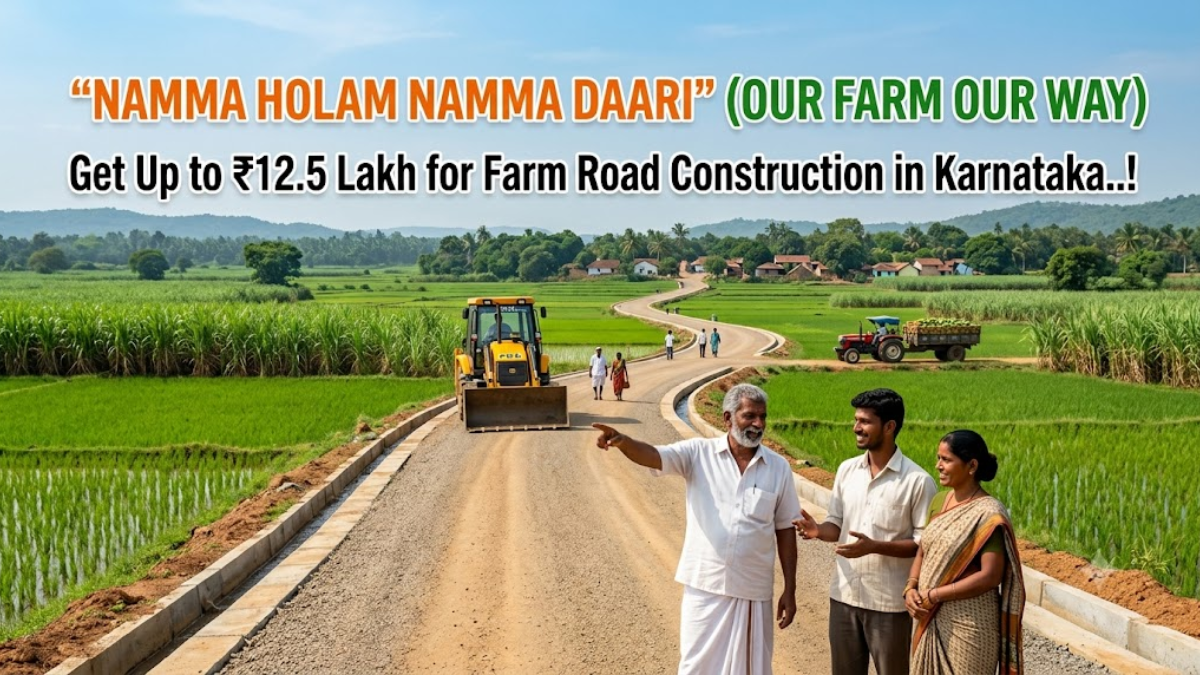
To address this long-standing issue, the Government of Karnataka introduced the “Namma Hola Namma Daari” (Our Farm, Our Road) scheme. This initiative focuses on improving rural connectivity by constructing all-weather access roads leading to agricultural lands. The program aims to reduce transportation difficulties, improve agricultural productivity, and make farming more profitable by providing better infrastructure.
One of the most attractive aspects of the scheme is that the government provides financial assistance of up to ₹12.5 lakh per kilometer for road construction, making it easier for eligible villages and farming communities to develop proper road connectivity.
This article explains everything you need to know about the scheme, including its objectives, benefits, funding pattern, eligibility conditions, and the complete application process.
What is the “Namma Hola Namma Daari” Scheme?
“Namma Hola Namma Daari” is a rural infrastructure development initiative launched by the Karnataka Government to improve road connectivity to agricultural lands.
The primary objective of the scheme is to construct durable farm access roads that allow tractors, jeeps, harvesters, and other agricultural vehicles to reach farmland safely throughout the year.
Instead of temporary mud tracks, the project focuses on building stronger rural roads that remain usable even during heavy rainfall. Improved road infrastructure enables farmers to transport agricultural inputs and harvested produce efficiently while reducing travel time and transportation expenses.
The scheme is designed to benefit entire farming communities rather than individual landowners.
Objectives of the Scheme
The government introduced this initiative with several important goals:
- Improve road connectivity to agricultural lands.
- Help farmers transport crops quickly to nearby markets.
- Enable tractors and farm machinery to reach fields without difficulty.
- Reduce crop losses caused by delayed transportation.
- Improve access during the rainy season.
- Promote rural infrastructure development.
- Increase agricultural productivity by ensuring better logistics.
- Strengthen the rural economy through improved transportation networks.
Financial Assistance Under the Scheme
One of the major highlights of the program is the substantial government funding allocated for road construction.
For every kilometer of approved farm road, the government provides financial assistance of approximately ₹12.5 lakh.
The funding is shared between two major sources.
1. MGNREGA Contribution – ₹9 Lakh
A significant portion of the project cost comes under the Mahatma Gandhi National Rural Employment Guarantee Act (MGNREGA).
Approximately ₹9 lakh per kilometer is allocated for:
- Earthwork
- Road leveling
- Metal road construction
- Labour expenses
- Basic infrastructure work
This funding also creates employment opportunities for rural workers while improving agricultural infrastructure.
2. Karnataka Government Contribution – ₹3.5 Lakh
The remaining ₹3.5 lakh per kilometer is provided by the Karnataka State Government.
This amount is mainly used for:
- Machinery expenses
- Heavy equipment
- Construction support
- Additional road development requirements
Together, these two funding sources provide a total financial assistance of around ₹12.5 lakh per kilometer.
Major Benefits for Farmers
The “Our Farm, Our Road” scheme offers several long-term benefits that can significantly improve farming operations.
1. Easy Vehicle Access
Once the road is completed, tractors, jeeps, mini trucks, harvesters, and agricultural machinery can reach the farmland directly.
Farmers no longer have to depend on narrow footpaths or temporary mud roads.
2. Lower Transportation Costs
Transporting fertilizers, seeds, pesticides, irrigation equipment, and harvested crops becomes much easier.
Instead of manually carrying produce over long distances, vehicles can reach the farm entrance, reducing labour costs and transportation expenses.
3. Better Market Access
Farmers can transport freshly harvested crops to markets more quickly.
This reduces post-harvest losses and helps farmers obtain better prices for perishable produce.
4. Improved Access During the Rainy Season
Many rural farm roads become waterlogged during monsoons.
The scheme focuses on constructing durable roads that remain usable even during heavy rainfall, allowing uninterrupted farming activities.
5. Time Savings
Farmers spend less time transporting equipment and harvested crops.
The saved time can be utilized for other agricultural activities, improving overall farm efficiency.
6. Increased Farm Productivity
Easy transportation encourages the use of modern agricultural machinery.
Mechanized farming often leads to higher productivity, better crop management, and improved yields.
7. Enhanced Safety
Safe roads reduce the risk of accidents while transporting crops and machinery.
This is especially beneficial for elderly farmers and women involved in farming activities.
8. Long-Term Rural Development
Improved road connectivity benefits not only agriculture but also nearby villages by enhancing access to schools, healthcare facilities, and local markets.
Eligibility Criteria
Although the scheme provides generous financial assistance, not every road proposal qualifies.
Certain conditions must be satisfied before approval.
Existing Road Must Be Recorded in Revenue Documents
The proposed road should already exist in official village records.
It should be identified as one of the following:
- Government road
- Cart track
- Village pathway
- Public access road
Roads that are not recorded in official land documents may not qualify for assistance.
The Road Must Benefit Multiple Farmers
The scheme is intended for community welfare.
Road construction is generally approved only when several farmers benefit from the same road.
Projects serving only one individual’s private land are generally not considered.
Voluntary Land Donation
In many cases, widening the road requires additional land from adjoining farms.
Landowners must voluntarily provide the required land through a legal donation document.
The government does not provide compensation for land donated for road widening under this scheme.
Therefore, mutual cooperation among neighbouring farmers is essential.
Documents That May Be Required
While document requirements can vary depending on the Gram Panchayat, applicants may generally need:
- Application or representation letter
- Identity proof
- Land ownership records
- Survey number details
- Village map showing the proposed road
- Signatures of affected farmers
- Consent letters from adjoining landowners (if required)
- Road usage details
Applicants should confirm the exact document list with their local Gram Panchayat office.
How to Get a Road Approved Under the Scheme
The approval process involves coordination between farmers, the Gram Panchayat, and local authorities.
Step 1: Prepare a Joint Representation
Farmers who use the proposed road should jointly prepare a written request.
The representation should clearly explain:
- Lack of road access
- Difficulties faced during farming
- Transportation challenges
- Number of farmers who will benefit
- Importance of the proposed road
A joint application carries greater weight than an individual request.
Step 2: Submit the Request to the Gram Panchayat
Visit the local Gram Panchayat office and submit the representation to the Panchayat Development Officer (PDO).
Request that the road be included under the Namma Hola Namma Daari scheme.
The Panchayat authorities will review the proposal and verify whether it satisfies the eligibility conditions.
Step 3: Raise the Proposal in the Gram Sabha
Approval by the Gram Sabha is one of the most important stages.
Farmers should attend the Gram Sabha meeting and request that the proposal be discussed officially.
If the Gram Sabha approves the proposal, the chances of obtaining administrative approval improve significantly.
Step 4: Technical Inspection
Concerned officials may inspect the proposed road location.
During the inspection, they verify:
- Existing pathway
- Number of beneficiary farmers
- Land records
- Feasibility of construction
- Required road width
Step 5: Recommendation by Local Representatives
Support from the local Member of the Legislative Assembly (MLA) or other elected representatives can help expedite the proposal.
Although approval depends on official procedures, public representatives often assist in recommending deserving projects.
Step 6: Administrative Approval
After verification and technical clearance, the project is forwarded for administrative sanction.
Once approved, funding is allocated under the respective components of the scheme.
Construction work begins according to government guidelines.
Why Community Participation Matters
The success of this scheme depends heavily on cooperation among farmers.
Neighbouring landowners should work together by:
- Supporting the proposal.
- Providing necessary land where required.
- Attending Gram Sabha meetings.
- Coordinating with Panchayat officials.
- Ensuring smooth implementation.
Collective participation increases the likelihood of project approval.
How the Scheme Helps Rural Agriculture
Road connectivity directly influences agricultural profitability.
With improved roads, farmers can:
- Purchase farm inputs more easily.
- Reduce vehicle operating costs.
- Access government services.
- Transport milk, vegetables, fruits, and grains quickly.
- Reduce spoilage of perishable crops.
- Encourage mechanized farming.
- Improve irrigation management.
- Increase overall farm income.
Good infrastructure also attracts investment in rural areas and contributes to sustainable agricultural development.
Important Points to Remember
Before applying under the scheme, farmers should keep these important points in mind:
- The proposed road should already exist in official village records.
- The road should benefit multiple farmers rather than a single landowner.
- Additional land required for widening must be donated voluntarily.
- No compensation is provided for donated land.
- Approval requires Gram Sabha support.
- Final sanction depends on technical and administrative verification.
Final Thoughts
The “Namma Hola Namma Daari” scheme is a significant initiative aimed at improving rural road infrastructure and supporting Karnataka’s farming community. By investing up to ₹12.5 lakh per kilometer in farm road development, the government seeks to make agriculture more accessible, efficient, and economically viable.
Reliable road connectivity enables farmers to transport crops, fertilizers, seeds, and machinery with ease while reducing transportation costs and saving valuable time. Most importantly, it strengthens rural development by connecting agricultural lands to markets and essential services.
Farmers who believe their village qualifies for the scheme should coordinate with neighbouring landowners, prepare a joint representation, approach their Gram Panchayat, participate actively in Gram Sabha meetings, and follow the official approval process. With community cooperation and proper planning, improved road connectivity can become a reality, benefiting generations of farmers and contributing to the long-term growth of rural Karnataka.