Even in today’s digital age of UPI, net banking, and instant fund transfers, cheques continue to play an important role in financial transactions. Many people still rely on cheques for paying house rent, repaying loans, settling business transactions, issuing security deposits, or clearing large sums of money.
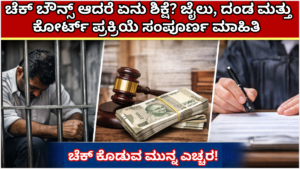
Often, people casually issue cheques thinking:
- “There isn’t enough money in my account right now, but I’ll deposit it before the cheque is presented.”
- “The other party won’t deposit it immediately.”
- “It’s just a formality; nothing serious will happen.”
However, this assumption can prove extremely dangerous.
If a cheque issued by you gets dishonoured (commonly called a “cheque bounce”), the consequences can go far beyond a simple bank penalty. In India, cheque bounce is not merely a civil dispute — it is treated as a criminal offence under the law. In serious cases, it can even lead to imprisonment.
This article explains in detail:
- What cheque bounce actually means
- Why it is considered a criminal offence
- The legal process involved
- Possible punishments
- Financial consequences
- How to avoid getting into such trouble
Let’s understand everything step by step.
What Is a Cheque Bounce?
A cheque bounce occurs when a cheque presented to the bank for payment is returned unpaid. This typically happens when the drawer (the person who issued the cheque) does not have sufficient funds in their bank account.
However, insufficient balance is not the only reason a cheque can bounce. Some common reasons include:
- Insufficient funds in the account
- Signature mismatch
- Overwriting or alteration on the cheque
- Account closed
- Stop payment instructions
- Expired (stale) cheque
- Damaged cheque
- Incorrect date or amount mismatch in words and figures
When a cheque is dishonoured, the bank returns it along with a written reason mentioned in a document called a “return memo” or “cheque return memo.”
Many people think this is just a minor inconvenience. Unfortunately, that is not the case.
Cheque Bounce Is a Criminal Offence – The Legal Position
Under Section 138 of the Negotiable Instruments Act, 1881, cheque bounce due to insufficient funds is treated as a criminal offence.
This is a very important point.
Many people mistakenly assume that cheque bounce is only a civil matter (like a recovery dispute). But the law clearly states that issuing a cheque without maintaining sufficient balance can lead to criminal prosecution.
The purpose of this law is to ensure financial discipline and maintain trust in cheque-based transactions. If cheques could be issued casually without consequences, commercial transactions would lose credibility.
What Are the Punishments Under Section 138?
If a person is found guilty under Section 138, the court may impose one or more of the following punishments:
1. Imprisonment
The accused may face imprisonment for up to two years.
2. Monetary Fine
The court may impose a fine that can extend up to twice the amount of the cheque.
For example:
If the cheque amount is ₹5,00,000, the fine can go up to ₹10,00,000.
3. Both Imprisonment and Fine
Depending on the seriousness of the case, the court may impose both imprisonment and fine.
The exact punishment depends on factors such as:
- Nature of the transaction
- Intent of the drawer
- Previous record
- Settlement efforts
- Amount involved
What Happens After a Cheque Bounces? The Legal Process Explained
Contrary to popular belief, you are not immediately sent to jail if your cheque bounces. The law provides a structured process and gives you an opportunity to correct your mistake.
Here’s how the legal process works:
Step 1: Bank Return Memo
When the cheque is dishonoured, the bank issues a return memo stating the reason for non-payment. The cheque is returned to the payee (the person who deposited it).
This memo becomes an important legal document.
Step 2: Legal Notice Within 30 Days
After receiving the returned cheque, the payee must send a legal notice to the drawer.
This notice must be sent within 30 days from the date of receiving the bank’s return memo.
The notice typically includes:
- Details of the cheque
- Amount involved
- Reason for dishonour
- Demand for payment
This notice is usually sent through a lawyer.
Step 3: 15 Days to Make Payment (Very Crucial Stage)
After receiving the legal notice, the drawer gets 15 days to make the payment.
This is a golden opportunity.
If the drawer pays the cheque amount within these 15 days, the matter ends. No criminal case can proceed further.
Many cases are settled at this stage itself.
However, if the drawer ignores the notice or fails to pay within 15 days, the payee gains the right to file a criminal complaint.
Step 4: Filing of Criminal Complaint
If payment is not made within 15 days, the payee can file a complaint in the Magistrate’s Court.
This complaint must be filed within 30 days after the expiry of the 15-day period.
Once the complaint is filed:
- The court examines the documents.
- If satisfied, the court issues summons to the accused.
- The accused must appear before the court.
If the accused repeatedly ignores summons, the court may issue a warrant.
This is when the matter becomes serious.
Important Points to Understand
- Cheque bounce cases are compoundable (meaning they can be settled even during trial).
- Courts often encourage settlement.
- However, ignoring court proceedings can worsen the situation.
- A criminal record can damage reputation and career prospects.
Financial Consequences Beyond Court Punishment
Even before the court’s decision, cheque bounce can severely affect your financial life.
Let’s look at the hidden financial damages.
1. Bank Penalties
Banks charge penalties every time a cheque is dishonoured.
Usually:
- ₹250 to ₹750 per instance (varies by bank)
- Charges may apply to both issuer and depositor
Repeated cheque bounces may lead to:
- Warning notices from the bank
- Downgrading of account status
- Closure of account in extreme cases
2. Credit Score Damage (CIBIL Impact)
One of the most serious consequences is damage to your credit score.
Frequent cheque bounces can negatively impact your CIBIL score (or credit score maintained by credit bureaus).
A drop of even 50–70 points can significantly reduce your creditworthiness.
A low credit score affects:
- Home loan approvals
- Vehicle loans
- Personal loans
- Credit card applications
- Business financing
Banks consider cheque bounce as a sign of financial indiscipline.
3. Difficulty in Getting Future Loans
Once your financial track record shows defaults or dishonoured payments:
- Banks may reject loan applications.
- You may be charged higher interest rates.
- Your repayment credibility comes under question.
In emergency situations, access to credit may become impossible.
4. Reputation Damage
In business transactions, cheque bounce can harm your professional reputation.
Vendors, landlords, clients, and partners may lose trust.
In commercial circles, reputation is everything. One bounced cheque can affect long-term relationships.
Common Mistakes People Make
Many cheque bounce cases occur due to avoidable negligence rather than fraud.
Here are common mistakes:
- Issuing a cheque without checking balance
- Forgetting about previously issued cheques
- Not maintaining minimum balance
- Ignoring bank SMS alerts
- Not updating signature with bank
- Failing to inform payee about financial difficulty
- Ignoring legal notice
Most of these can be avoided with basic financial discipline.
What Should You Do If You Receive a Legal Notice?
If you receive a cheque bounce legal notice:
- Do not panic.
- Do not ignore it.
- Consult a lawyer immediately.
- Verify the details mentioned in the notice.
- If the liability is genuine, try to settle within 15 days.
Settlement at an early stage saves:
- Legal expenses
- Court visits
- Criminal proceedings
- Mental stress
Ignoring the notice only complicates matters.
Practical Tips to Avoid Cheque Bounce Cases
1. Always Check Your Account Balance
Never issue a cheque based on expected deposits. Wait until funds are actually credited.
2. Maintain a Buffer Amount
Keep extra funds to cover unforeseen transactions.
3. Track Issued Cheques
Maintain a record of post-dated cheques.
4. Inform the Payee in Advance
If you anticipate financial difficulty, communicate honestly and request time.
5. Use Digital Alerts
Enable SMS and email notifications for transactions.
6. Avoid Issuing Blank Cheques
Never hand over signed blank cheques.
7. Respond Promptly to Legal Notices
Early action prevents escalation.
Can a Cheque Bounce Case Be Settled?
Yes.
Cheque bounce cases are compoundable. This means both parties can settle the matter even after a case is filed.
Courts often encourage compromise because the primary objective is recovery of money, not punishment.
Settlement usually involves:
- Payment of cheque amount
- Additional compensation
- Withdrawal of complaint
However, settlement terms depend on mutual agreement.
Is Every Cheque Bounce a Criminal Case?
Not automatically.
Certain conditions must be satisfied:
- The cheque must have been issued for legally enforceable debt or liability.
- It must be presented within validity period (currently 3 months).
- Legal notice must be sent within prescribed time.
- Payment must not be made within 15 days of notice.
If any legal requirement is not met, the case may fail.
Psychological and Social Impact
Beyond financial and legal consequences, cheque bounce cases cause:
- Mental stress
- Court visits and repeated hearings
- Time loss
- Public embarrassment
- Strain in personal and business relationships
The litigation process can last months or even years.
Why the Law Is Strict
The law aims to:
- Maintain trust in commercial transactions
- Prevent financial fraud
- Ensure accountability
- Protect genuine creditors
If cheque bounce were treated casually, the entire banking and business ecosystem would suffer.
Hence, the strict provisions.
Disclaimer
This article provides general awareness about cheque bounce laws. It is not a substitute for professional legal advice. Laws may change over time, and individual cases vary based on specific facts and circumstances. Always consult a qualified legal professional for case-specific guidance.
Final Words
A single cheque may look like just a piece of paper — but legally, it is a serious financial commitment.
Issuing a cheque without ensuring sufficient funds can:
- Trigger criminal proceedings
- Lead to heavy fines
- Result in imprisonment
- Damage your credit score
- Harm your reputation
- Affect your future financial opportunities
Financial discipline and legal awareness are your best safeguards.
Before signing and issuing a cheque, pause and verify.
A small precaution today can save you from years of legal trouble tomorrow.
Stay responsible. Stay informed.