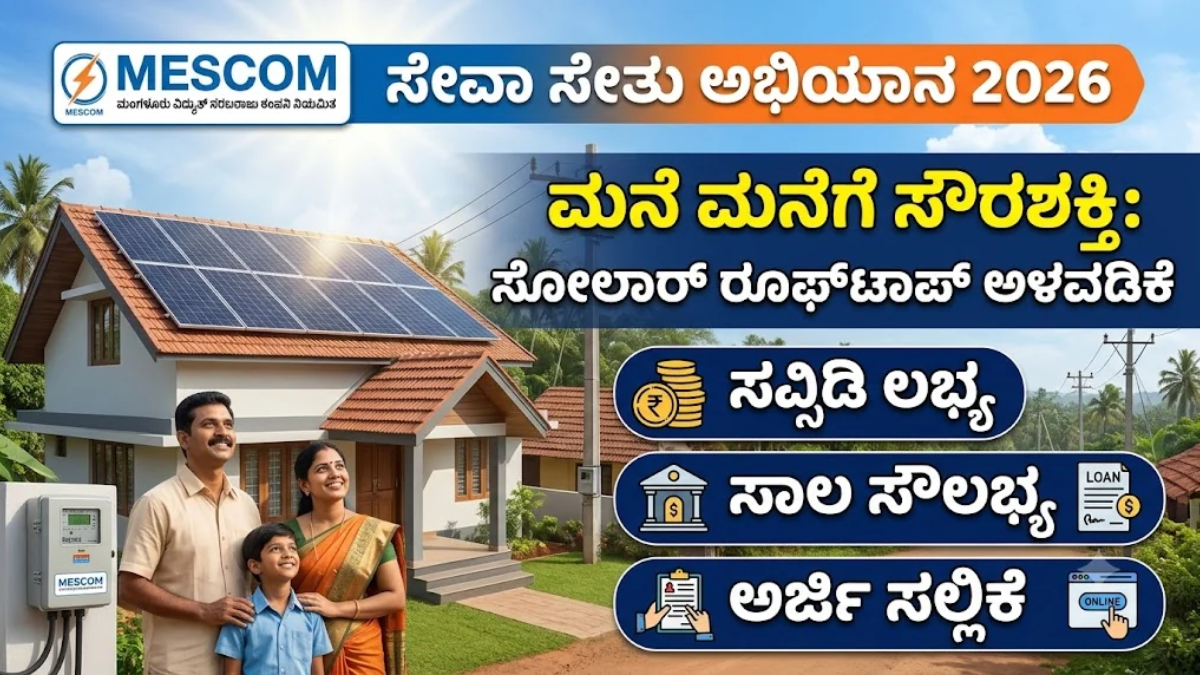
Looking to install a solar power system on your rooftop and reduce your household electricity expenses? The MESCOM Seva Sethu Campaign 2026, organised by the Mangalore Electricity Supply Company Limited (MESCOM), offers residential electricity consumers an opportunity to learn about rooftop solar installations, government subsidies, financing options, and the application process at a single location.
According to the announcement provided, the campaign was organised by the MESCOM Belthangady Subdivision from October 14 to October 16, 2026. The initiative was intended to help local electricity consumers understand how rooftop solar systems work, what financial assistance may be available, and which steps are required to install a solar power system at home.
For households considering a switch to solar energy, the campaign provides an opportunity to obtain information from solar vendors, seek assistance with applications, and understand the documentation needed to begin the process.
In this article, we explain the campaign’s key features, the potential benefits of rooftop solar, the documents applicants should prepare, the role of subsidies and bank loans, and the important points consumers should check before proceeding.
1. What Is the MESCOM Seva Sethu Campaign 2026?
The MESCOM Seva Sethu Campaign is described in the supplied announcement as a public assistance initiative focused on encouraging residential consumers to explore rooftop solar energy.
Installing solar panels at home can help households generate electricity from sunlight instead of relying entirely on electricity purchased from the grid. However, many consumers are unsure about the installation procedure, the cost of equipment, the availability of government subsidies, and the steps involved in applying for financial assistance.
The campaign was designed to bring relevant information and support services together in one place.
Instead of visiting multiple offices or independently searching for information about vendors, financing, and application requirements, visitors could seek guidance from the representatives participating in the programme.
The announcement highlights the participation of solar vendors and bank officials, who were expected to provide information about installation options, available financing facilities, and the application process.
Important date update: The announced campaign dates were October 14–16, 2026. As the current date is October 27, 2026, those dates have already passed. Consumers who missed the event should contact the MESCOM Belthangady Subdivision to enquire about future programmes or assistance with rooftop solar applications.
2. Campaign Location and Schedule
The supplied announcement provides the following details about the programme.
| Particular | Details |
|---|---|
| Campaign name | MESCOM Seva Sethu Campaign 2026 |
| Organising division | MESCOM Belthangady Subdivision |
| Announced dates | October 14–16, 2026 |
| Duration | Three days |
| Venue | Outside the MESCOM Belthangady Subdivision Office |
| Main objective | Promote residential rooftop solar installations |
| Intended participants | Electricity consumers in Belthangady Taluk |
The initiative was intended primarily for electricity consumers within the Belthangady Taluk area who were interested in installing solar panels on their homes.
Consumers planning to participate in a future programme should confirm the venue, timings, eligibility requirements, and availability of application assistance directly with MESCOM before travelling.
3. Key Services Offered Through the Campaign
The announcement identifies several services intended to help consumers understand and begin the rooftop solar installation process.
Information from Solar Vendors
Solar vendors can explain the types of rooftop solar systems available for residential buildings and help consumers understand the technical requirements of an installation.
Their guidance may cover:
- The number and capacity of solar panels required for a household.
- Suitable locations for installing panels on the rooftop.
- Inverter selection and other system components.
- Installation charges and equipment costs.
- Maintenance requirements and product warranties.
- The process for connecting the system to the electricity grid.
The most suitable system depends on the household’s electricity consumption, available rooftop space, roof condition, and budget.
Before choosing a vendor, consumers should compare written quotations, equipment specifications, warranties, and the terms of installation.
They should also verify that the selected vendor meets the applicable requirements of the relevant rooftop solar programme.
Assistance With Applications
Another important feature mentioned in the announcement is assistance with submitting applications.
Consumers who are unfamiliar with online application procedures may need help entering their electricity connection details, providing personal information, selecting an appropriate system capacity, or understanding the documents required.
Application assistance can make the process easier, especially for households that are applying for rooftop solar for the first time.
However, consumers should ensure that applications are submitted through the appropriate official portal or authorised process. They should retain their application reference number and copies of submitted documents.
An application does not automatically guarantee approval, subsidy eligibility, or installation.
Guidance on Government Subsidies
Government financial assistance can reduce the initial expense of installing a rooftop solar system, subject to the applicable scheme rules.
During the announced campaign, consumers were expected to receive information about available subsidies and the conditions attached to them.
The amount of assistance a household may receive depends on the scheme in force, the applicant’s eligibility, the system capacity, and compliance with the prescribed installation and verification requirements.
Consumers should confirm the current subsidy amount, payment procedure, and eligibility conditions through official government channels before making a financial commitment.
They should not assume that every solar installation qualifies for a subsidy or that the subsidy will be paid immediately.
Information About Bank Loans
The campaign announcement also mentions guidance from bank officials regarding financing options for rooftop solar installations.
For households that cannot comfortably pay the entire installation cost upfront, a suitable loan may help spread the expense over a longer period.
Depending on the lender and the available scheme, consumers may be able to enquire about interest rates, repayment periods, processing charges, eligibility requirements, and documentation.
Before accepting a loan, compare the total repayment amount rather than considering only the monthly instalment.
Consumers should also understand how the loan repayment schedule fits within their household budget and whether the expected electricity savings justify the investment.
Guidance on Documents and Eligibility
The application process may involve verification of electricity connection details, identity information, bank details, and installation-related documents.
The documents required can differ according to the programme and application stage. Consumers should obtain an official checklist before submitting their applications.
Keeping the necessary documents ready can help avoid delays caused by missing information.
4. What Is a Rooftop Solar System?
A rooftop solar system consists of solar panels installed on a building to convert sunlight into electrical energy.
The panels generate direct-current electricity, which is converted into usable alternating-current electricity by an inverter.
In a grid-connected residential system, the installation is connected to the electricity network in accordance with the applicable technical and safety requirements.
Depending on the approved system configuration and metering arrangements, electricity generated by the panels can be used by household appliances, potentially reducing the amount of electricity drawn from the grid.
If the system produces more electricity than the household consumes at a particular time, the treatment of surplus electricity depends on the applicable metering and billing rules.
Solar generation varies with sunlight, weather, shading, panel orientation, and the time of year.
A conventional grid-connected rooftop solar system generally shuts down during a grid outage for safety reasons unless it includes an appropriately designed backup arrangement.
Consumers should discuss these details with their installer before selecting a system.
5. Benefits of Installing Solar Panels at Home
Rooftop solar can provide several potential benefits for residential electricity consumers.
Lower Electricity Expenses
A properly designed solar installation can reduce the amount of electricity purchased from the grid.
The actual savings depend on household consumption, system size, sunlight availability, tariff structure, and applicable electricity billing rules.
Consumers should request an estimate based on their recent electricity bills instead of relying on generic savings claims.
Greater Use of Renewable Energy
Solar power uses sunlight to generate electricity without directly burning fossil fuels during operation.
By adopting rooftop solar, households can contribute to the wider use of renewable energy and reduce their reliance on conventional electricity generation.
Better Long-Term Energy Planning
A solar system can help households manage part of their electricity demand over the long term.
However, solar panels are a financial investment. Consumers should consider the initial installation cost, maintenance, inverter replacement, financing charges, and the expected useful life of the equipment.
Potential Financial Assistance
Where a household qualifies for an applicable government programme, a subsidy may reduce the initial investment.
The subsidy should be treated as conditional assistance rather than a guaranteed benefit until the application and eligibility requirements have been verified.
6. Documents to Keep Ready for a Rooftop Solar Application
The supplied campaign announcement lists four items that consumers should bring when seeking application assistance.
1. Recent electricity bill
The electricity bill helps identify the consumer account and connection details. Keep a recent bill available so that the information can be entered correctly.
2. Passport-size photograph
A recent photograph may be requested during the application process. Check the applicable format and upload requirements before submitting an online application.
3. Aadhaar card
The announcement lists Aadhaar as an identity document to bring. Applicants should verify which identity documents are accepted under the relevant programme and provide personal information only through authorised channels.
4. Mobile phone for OTP verification
A working mobile phone may be required to receive a one-time password during registration or application verification.
Keep access to the registered mobile number available when completing the process.
Depending on the scheme, additional documents may be required, such as bank account information, proof of account ownership, or technical details related to the proposed installation.
This list is based on the supplied campaign announcement and should not be treated as a complete, universally applicable document checklist.
7. How to Apply for a Residential Rooftop Solar System
Consumers who are interested in installing solar panels can follow these general steps.
Step 1: Review Your Electricity Consumption
Examine your recent electricity bills to understand your average monthly usage.
This information helps determine an appropriate system capacity. A qualified vendor can assess your consumption and recommend a suitable installation.
Step 2: Check Your Rooftop
Confirm that the roof has sufficient space and is structurally suitable for the proposed panels.
Shading from trees, nearby buildings, water tanks, and other structures can affect electricity generation.
Step 3: Verify the Applicable Scheme
Check the official rooftop solar programme requirements, eligibility conditions, subsidy provisions, and application procedure.
For residential consumers, the central government’s PM Surya Ghar: Muft Bijli Yojana is an important programme to investigate. Applicants should confirm the current rules and whether their particular installation qualifies.
Step 4: Submit an Application Through the Official Process
Use the official programme portal or the application channel specified by the electricity distribution company.
Enter the electricity connection information accurately and keep a record of the application reference number.
Do not assume that attending an information campaign or submitting an initial application completes every approval requirement.
Step 5: Compare Vendors and Quotations
Review the proposed system capacity, panel specifications, inverter details, installation cost, warranties, and after-sales service.
Verify the vendor’s eligibility under the applicable scheme before making a payment.
Step 6: Complete the Required Approvals and Installation
Follow the prescribed procedure for technical approval, installation, grid connection, inspection, or other applicable requirements.
The exact sequence may vary according to the programme and local distribution company’s procedures.
Step 7: Complete Verification and Subsidy Formalities
Where the applicable scheme provides a subsidy, complete the required installation verification and submit any additional documents requested through the official process.
The release of assistance depends on eligibility and compliance with the scheme’s requirements.
8. How Much Subsidy Can a Household Receive?
The subsidy amount is one of the most important considerations for households planning to install solar panels.
However, the amount cannot be determined from the campaign announcement alone. It does not provide a verified subsidy schedule, a specific system capacity, or confirmation of individual eligibility.
Under a government rooftop solar scheme, assistance may depend on the approved capacity, the category of consumer, the installation requirements, and the rules applicable at the time of application.
Consumers should verify the latest subsidy information through the official PM Surya Ghar programme portal and the relevant distribution company.
Do not rely on headlines promising a fixed subsidy for every household without checking the underlying conditions.
Similarly, a solar system advertised at a particular price may not include every installation component, electrical upgrade, service charge, or financing expense.
Ask for a written quotation that clearly separates the total installation price, any applicable subsidy, the amount payable by the consumer, and any loan-related costs.
9. Is a Bank Loan Necessary for Solar Installation?
No. A bank loan is not necessarily required for every rooftop solar installation.
Households that can afford the upfront cost may choose to pay directly, subject to the vendor’s payment terms. Others may explore financing if a suitable loan is available.
A loan should be evaluated using the interest rate, processing fees, repayment term, total interest payable, and any additional charges.
For example, a low monthly instalment may appear attractive but could result in a higher overall repayment if the loan term is long.
Consumers should also remember that projected electricity savings are estimates, not guaranteed monthly returns. Solar generation and household electricity consumption can change over time.
A careful comparison of total system cost, expected savings, subsidy eligibility, and loan repayment obligations can help families make a more informed decision.
10. Important Precautions Before Installing Rooftop Solar
Before proceeding with an installation, keep the following precautions in mind.
- Verify that the vendor is authorised or eligible under the relevant programme.
- Obtain a written quotation and understand what the quoted price includes.
- Check equipment specifications, warranties, and after-sales support.
- Confirm the current subsidy rules directly through official channels.
- Do not pay an individual who promises guaranteed subsidy approval in exchange for an unofficial fee.
- Never share an OTP, banking password, or payment PIN with a vendor or an unknown person.
- Confirm the electricity distribution company’s technical and grid-connection requirements.
- Read the installation agreement and payment terms carefully.
- Keep copies of receipts, application references, approvals, and warranty documents.
These precautions can help reduce the risk of unexpected expenses, misleading claims, and avoidable application delays.
11. Where Can Belthangady Consumers Get Further Information?
The campaign described in the announcement was organised at the MESCOM Belthangady Subdivision Office premises. Since the announced dates have passed, interested consumers should contact the subdivision office or consult MESCOM’s official communication channels for information about future assistance programmes.
Consumers should use official sources to verify eligibility, current subsidy provisions, application status, and the steps required for installation.
If online application assistance is needed, ask the electricity distribution company about the available support facilities.
Conclusion
The MESCOM Seva Sethu Campaign 2026 was announced as an initiative to help residential electricity consumers in Belthangady explore rooftop solar installations, understand subsidy provisions, learn about bank financing, and obtain assistance with applications.
For households seeking to reduce their dependence on grid electricity, rooftop solar may offer long-term financial and environmental benefits when the system is appropriately designed and installed.
However, the actual savings, installation cost, financing terms, and subsidy eligibility vary from one household to another.
The announced campaign took place from October 14 to October 16, 2026. Consumers who could not attend should contact MESCOM for information about future programmes and verify the latest rooftop solar requirements through official channels.
Before investing, compare vendors, understand the applicable scheme rules, prepare the required documents, and evaluate the total cost carefully. These steps can help households make a more confident and informed decision about adopting solar energy.
Suggested SEO title: MESCOM Seva Sethu Campaign 2026: Rooftop Solar Subsidy, Application Process and Required Documents
Suggested meta description: Learn about the MESCOM Seva Sethu Campaign 2026 in Belthangady, rooftop solar installation, subsidy eligibility, bank loan options, required documents, and how to apply through official channels.
Editorial note: The event dates and listed documents above are based on the supplied announcement. The campaign’s occurrence, individual services, and current subsidy provisions have not been independently verified. Confirm these details with MESCOM and the relevant official scheme before publishing time-sensitive claims.