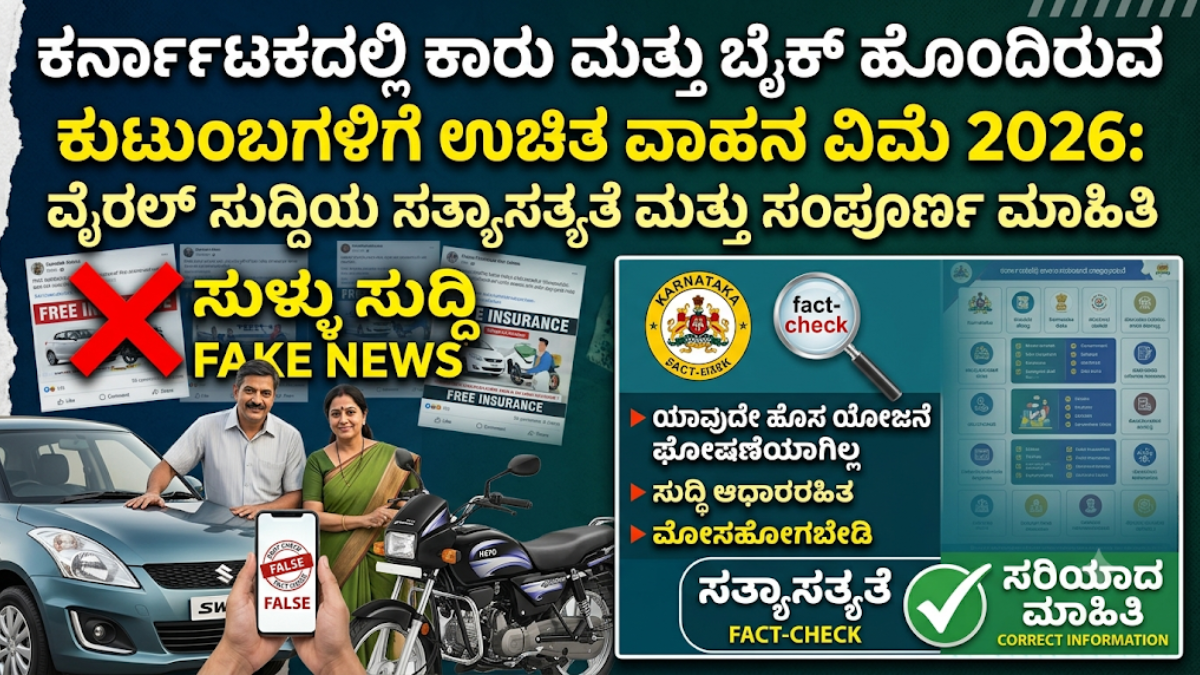
A message claiming that the Karnataka Government is providing free motor vehicle insurance to families who own cars, bikes, or other vehicles has been circulating widely on social media and messaging platforms in 2026. Such messages often encourage people to click an “Apply Now” button or submit personal and financial information.
Before applying for any scheme, it is important to verify whether the announcement is genuine and whether it has been officially introduced by the Karnataka Government or the concerned department.
Is Free Vehicle Insurance Available from the Karnataka Government?
At present, people should not assume that a viral social-media message is an official government announcement. A genuine government welfare scheme normally has supporting information such as an official notification, Government Order (GO), department circular, eligibility conditions, application procedure, and details of the implementing authority.
Therefore, anyone receiving a message claiming that Karnataka is offering free insurance for cars and bikes should first check official government sources before submitting an application.
Do not rely solely on a website, YouTube video, WhatsApp message, Facebook post, or forwarded advertisement claiming that applications are open.
If an official scheme is introduced in the future, applicants should verify its eligibility requirements, documents, application dates, and official application portal through the relevant government department.
Important Safety Advice Before Applying
Fake government-scheme advertisements can sometimes be designed to collect personal information, banking details, OTPs, or payments.
Before clicking an application link:
- Check whether the announcement appears on an official government website.
- Look for an official Government Order or departmental notification.
- Confirm the name of the department implementing the scheme.
- Check whether the website belongs to a genuine government authority.
- Never share your OTP, PIN, password, or banking credentials with unknown persons.
- Avoid paying an application fee unless the official notification clearly requires one.
- Be cautious of websites promising guaranteed insurance or government benefits in exchange for personal information.
If there is no official notification supporting the claim, it is safer not to apply through the link circulated on social media.
What Is Motor Vehicle Insurance?
Motor vehicle insurance is financial protection designed to cover certain losses or liabilities arising from the use of a vehicle. Depending on the policy selected, insurance may provide protection against third-party liability, accidents, theft, fire, natural disasters, and other specified risks.
In India, insurance requirements for vehicles are governed by applicable motor vehicle laws and regulations. A vehicle being used on public roads generally needs the legally required third-party liability insurance.
Insurance requirements can differ depending on the type of vehicle and circumstances, so vehicle owners should ensure that their policy complies with the applicable rules.
Main Types of Vehicle Insurance
1. Third-Party Insurance
Third-party liability insurance is the basic form of motor insurance required under Indian law for vehicles used on public roads.
It primarily protects the policyholder against certain legal liabilities arising from injury, death, or property damage caused to a third party.
However, third-party insurance generally does not pay for damage to the policyholder’s own vehicle.
2. Comprehensive Motor Insurance
A comprehensive policy provides broader protection than basic third-party insurance.
Depending on the policy terms, it can cover:
- Damage caused by road accidents
- Theft of the insured vehicle
- Fire-related damage
- Floods and other natural disasters
- Storms and certain other environmental events
- Riots and malicious damage
- Third-party liability
The exact coverage, exclusions, deductibles, and claim conditions depend on the individual policy.
3. Personal Accident Cover
Personal accident protection may provide financial compensation to an eligible insured person in specified circumstances involving accidental death or permanent disability.
The availability and terms of personal accident cover depend on the policy and applicable regulations.
Vehicle owners should carefully read the policy wording rather than assuming that every type of accident or medical expense is automatically covered.
4. Zero Depreciation Cover
Zero depreciation is generally offered as an additional cover with eligible policies.
Under applicable claim conditions, it can reduce the impact of depreciation deductions on certain vehicle parts when a claim is settled. It is particularly considered by owners of newer vehicles.
However, zero depreciation does not mean that every claim will be paid in full. Policy conditions, deductibles, exclusions, and other limits continue to apply.
Popular Add-On Covers
Depending on the insurer and vehicle, policyholders may be able to purchase additional protections such as:
- Engine protection
- Roadside assistance
- Return-to-invoice protection
- Consumables cover
- Key replacement
- No-claim bonus protection
These are optional in many cases and increase the premium. Vehicle owners should choose add-ons according to their actual requirements instead of purchasing unnecessary coverage.
Documents Usually Required for Vehicle Insurance
The documents required can vary between insurers and transactions, but commonly requested information may include:
- Vehicle Registration Certificate (RC)
- Valid driving licence details
- Existing insurance policy for renewal
- Vehicle-related information
- Mobile number
- Email address, where required
- PAN or other identity information where applicable
An insurer may request additional information depending on the vehicle, policy type, and application process.
How to Purchase or Renew Vehicle Insurance
Vehicle owners can purchase or renew insurance through an authorised insurer or an authorised insurance platform.
A typical process involves:
- Entering the vehicle registration and other required details.
- Providing relevant vehicle and policy information.
- Comparing available insurance options.
- Selecting the required coverage and suitable add-ons.
- Reviewing the premium, exclusions, deductibles, and policy conditions.
- Making the payment through the authorised channel.
- Receiving and downloading the insurance policy document.
Always make sure the insurer and payment page are genuine before providing personal or financial information.
What to Do After an Accident
If your insured vehicle is involved in an accident, inform the insurance company as soon as reasonably possible and follow its claim procedure.
Depending on the circumstances, you may need to:
- Notify the insurer.
- Take photographs or videos of the vehicle and accident scene where it is safe to do so.
- File an FIR when required.
- Provide the vehicle and policy documents.
- Cooperate with the insurer’s inspection or survey process.
- Submit the required claim forms and supporting documents.
The final settlement depends on the policy terms, assessment of the damage, deductibles, exclusions, and other applicable conditions.
What Is No-Claim Bonus?
A No-Claim Bonus (NCB) is a benefit that may be available at renewal when an eligible policyholder has not made a claim during the relevant policy period.
NCB conditions and discounts depend on the applicable insurance rules and policy terms. Policyholders should check the renewal documents carefully to understand how their NCB is calculated and whether it can be transferred or retained under the applicable rules.
Why Vehicle Insurance Is Important
Having appropriate motor insurance can provide several benefits:
- Protection against covered financial losses
- Compliance with mandatory insurance requirements
- Protection against certain third-party liabilities
- Assistance with eligible repair expenses
- Financial support following theft or covered damage
- Access to services such as cashless repairs where offered under the policy
Insurance is not simply a formality. Choosing appropriate coverage can reduce the financial impact of unexpected vehicle-related events.
What Happens If a Vehicle Is Not Properly Insured?
Driving a vehicle without the legally required insurance can result in penalties and other legal consequences under applicable law.
In addition, an uninsured vehicle owner may have to personally bear eligible third-party liabilities and repair expenses that could otherwise have been covered by insurance.
For this reason, vehicle owners should check their policy’s expiry date and renew it on time.
What About Claims of Free Insurance for Cars and Bikes?
The most important point is to distinguish between general motor insurance information and a specific government welfare scheme.
A social-media message stating that every Karnataka family owning a car or bike can receive free insurance does not, by itself, establish that such a scheme exists.
Before applying, citizens should look for:
- An official government notification
- A Government Order or departmental circular
- The name of the implementing department
- Clearly stated eligibility criteria
- Official application instructions
- Application opening and closing dates
- An official government application portal
If these details cannot be verified through official sources, citizens should avoid submitting personal documents or financial information through the advertised link.
Final Conclusion
The claim that Karnataka Government is providing free motor vehicle insurance to families owning cars and bikes should be treated cautiously unless it is supported by an official government notification.
Vehicle owners should continue to maintain the insurance legally required for their vehicles and select additional coverage according to their needs. Third-party insurance provides the basic legally required protection, while comprehensive insurance and suitable add-ons can offer broader coverage.
Most importantly, citizens should verify every government-scheme announcement through official sources before applying. Do not provide Aadhaar details, bank information, OTPs, passwords, card details, or other sensitive information to an unverified website.
If Karnataka Government or the relevant department officially launches a free vehicle-insurance scheme, the authentic announcement should specify the eligibility criteria, required documents, application process, closing date, and official application link. Until such information is officially confirmed, citizens should not treat viral “Apply Now” messages as proof of a government scheme.