India’s livestock sector plays a crucial role in supporting rural livelihoods and generating income for farmers and entrepreneurs. Among various livestock businesses, goat farming has emerged as one of the most profitable and sustainable ventures due to growing demand for goat meat, milk, and breeding animals. However, setting up a commercial goat farm requires substantial investment in infrastructure, livestock procurement, feed management, healthcare facilities, and operational expenses.
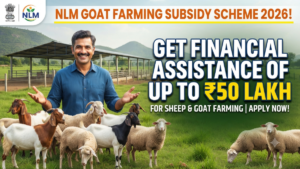
NLM Goat Farming Subsidy Scheme 2026!
To encourage entrepreneurship in the livestock sector, the Government of India has introduced several financial assistance programs. One of the most significant initiatives is the National Livestock Mission (NLM), which provides financial support to eligible individuals and organizations interested in establishing livestock-based enterprises.
Under the Entrepreneurship Development Programme (EDP) component of the National Livestock Mission, eligible applicants can receive a capital subsidy of up to 50% of the approved project cost. For qualifying sheep and goat breeding projects, the subsidy amount can go up to ₹50 lakh, making it a valuable opportunity for aspiring livestock entrepreneurs.
This article explains the NLM Goat Farming Subsidy Scheme 2026, including its objectives, benefits, eligibility criteria, subsidy structure, loan process, required documents, application procedure, and important guidelines applicants should know before applying.
Understanding the National Livestock Mission (NLM)
The National Livestock Mission is a centrally sponsored scheme launched by the Government of India to promote sustainable growth in the livestock sector. The mission focuses on improving livestock productivity, generating employment opportunities, strengthening rural economies, and encouraging modern livestock farming practices.
The scheme aims to support entrepreneurs and farmers through financial assistance, technology adoption, scientific breeding methods, infrastructure development, and better management systems.
By providing financial incentives and subsidies, the government seeks to create a more organized and productive livestock industry while increasing income opportunities for rural communities.
Major Objectives of NLM
The National Livestock Mission has several key objectives:
- Promote entrepreneurship in livestock farming.
- Encourage scientific and commercial livestock management.
- Improve livestock productivity through quality breeding.
- Create employment opportunities in rural areas.
- Strengthen fodder and feed production systems.
- Support infrastructure development for livestock enterprises.
- Enhance income generation for farmers and livestock owners.
- Encourage private sector participation in livestock development.
Through these objectives, the mission contributes to the overall development of India’s agriculture and livestock sectors.
Livestock Activities Supported Under NLM
The National Livestock Mission covers a wide range of livestock-related activities and businesses. Some of the major sectors supported under the scheme include:
Sheep and Goat Breeding
Financial assistance is available for establishing commercial sheep and goat breeding farms with quality infrastructure and scientific management systems.
Poultry Farming
Entrepreneurs interested in poultry production, breeding, and related infrastructure may also receive support under specific components of the scheme.
Pig Farming
The scheme encourages scientific pig farming through financial assistance and infrastructure development support.
Camel, Horse, and Donkey Breeding
Special provisions are available for conservation and breeding of specific livestock species.
Feed and Fodder Production
The mission supports projects focused on fodder cultivation, feed manufacturing, and livestock nutrition.
Hay and Silage Production Units
Financial assistance may be provided for establishing hay and silage processing units that help improve livestock feed availability.
Fodder Block Manufacturing
Entrepreneurs can receive support for setting up units that produce compressed fodder blocks.
Total Mixed Ration (TMR) Units
The scheme promotes balanced livestock nutrition through support for TMR production facilities.
Fodder Seed Processing
Projects related to fodder seed production, processing, and distribution may also qualify for assistance under NLM.
Why Goat Farming Is Becoming Popular
Goat farming has gained popularity across India because of its relatively low entry barriers and strong market demand.
Some advantages of goat farming include:
- High demand for goat meat throughout the year.
- Relatively lower investment compared to large dairy farms.
- Faster reproduction cycle.
- Suitable for small and marginal farmers.
- Ability to adapt to different climatic conditions.
- Additional income from manure production.
- Potential for breeding stock sales.
Because of these benefits, goat farming has become an attractive business opportunity for rural entrepreneurs, farmer groups, and agribusiness investors.
Goat Farming Subsidy Under NLM 2026
One of the most attractive features of the National Livestock Mission is the capital subsidy available for eligible goat breeding projects.
Subsidy Benefits
Eligible applicants may receive:
- Capital subsidy of up to 50% of the approved project cost.
- Maximum subsidy amount up to ₹50 lakh for eligible sheep and goat breeding projects.
- Financial support for infrastructure and approved project components.
- Encouragement for establishing scientifically managed livestock enterprises.
The exact subsidy amount depends on several factors, including:
- Total approved project cost.
- Nature and size of the project.
- Eligible expenditure under NLM guidelines.
- Compliance with scheme requirements.
- Approval by competent authorities.
It is important to understand that the subsidy is not automatically granted to every applicant. Each project undergoes scrutiny, evaluation, and approval according to the scheme guidelines.
How the NLM Subsidy Model Works
Many applicants misunderstand the subsidy process and assume that the government directly provides cash assistance upon application. In reality, the process involves several stages.
Step 1: Project Planning
The applicant prepares a detailed business plan or Detailed Project Report (DPR). This report includes:
- Farm size.
- Number of goats.
- Breed selection.
- Infrastructure requirements.
- Estimated project cost.
- Feeding arrangements.
- Veterinary care plan.
- Marketing strategy.
- Financial projections.
Step 2: Financial Contribution
The applicant may be required to contribute a portion of the project cost from personal resources, depending on the project structure and financing arrangements.
Step 3: Bank Financing
If additional funding is required, a bank loan may be sought.
Banks assess:
- Applicant’s financial profile.
- Creditworthiness.
- Project viability.
- Repayment capacity.
- Business feasibility.
Loan approval remains entirely at the discretion of the lending institution.
Step 4: Government Subsidy
Once the project receives approval under NLM guidelines, the eligible subsidy is processed according to the prescribed procedure.
The subsidy is linked to project implementation and compliance with the approved conditions.
Who Can Apply for NLM Goat Farming Subsidy?
The scheme is designed to support a wide range of individuals and organizations involved in livestock entrepreneurship.
Eligible categories may include:
Individual Entrepreneurs
Individuals interested in establishing commercial livestock enterprises can apply under eligible categories.
Farmer Producer Organizations (FPOs)
Registered FPOs involved in livestock activities may qualify for assistance.
Self-Help Groups (SHGs)
Eligible SHGs engaged in livestock-based income generation activities can participate.
Joint Liability Groups (JLGs)
Groups formed for collective farming and business activities may also apply.
Farmer Cooperative Organizations
Livestock-focused cooperatives may receive support under the scheme.
Section 8 Companies
Non-profit organizations registered under Section 8 of the Companies Act and involved in livestock development may be eligible.
Applicants must satisfy all technical, financial, and operational requirements specified under the latest NLM guidelines.
Eligibility Conditions
Although eligibility requirements may change over time, applicants generally need to fulfill conditions related to:
- Legal status of the applicant.
- Project feasibility.
- Availability of land or infrastructure.
- Financial capability.
- Compliance with livestock management standards.
- Submission of a detailed project report.
- Adherence to scheme guidelines.
Applicants should carefully review the latest official guidelines before investing money or submitting applications.
Infrastructure Requirements for Goat Farming Projects
A successful goat farming enterprise requires proper infrastructure.
Some common infrastructure components include:
Goat Sheds
Well-designed sheds provide protection from weather, improve animal health, and support efficient farm management.
Feeding Facilities
Proper feeding systems ensure adequate nutrition and reduce feed wastage.
Water Supply
Clean and continuous water supply is essential for maintaining livestock health.
Veterinary Care Facilities
Regular health monitoring and disease management are critical for commercial farming.
Breeding Infrastructure
Quality breeding arrangements help improve productivity and profitability.
Storage Facilities
Storage areas for feed, medicines, and equipment support efficient farm operations.
These infrastructure costs may form part of the project expenditure considered under the subsidy scheme, subject to applicable guidelines.
Documents Required for NLM Goat Farming Subsidy Application
The exact document requirements may vary based on the applicant category and project type.
Generally, applicants may need:
Identity Documents
- Aadhaar Card
- PAN Card
Address Proof
- Voter ID
- Utility bill
- Driving licence
- Other acceptable address documents
Financial Documents
- Bank account details
- Passbook copies
- Bank statements, if required
Land Documents
- Ownership records
- Lease agreements
- Land use permissions, where applicable
Project Documents
- Detailed Project Report (DPR)
- Cost estimates
- Technical feasibility reports
Business Documents
For organizations:
- Registration certificates
- Incorporation documents
- Society registration certificates
- Cooperative registration records
Supporting Documents
- Quotations for equipment
- Infrastructure cost estimates
- Technical training certificates
- Experience certificates, if applicable
Applicants should verify the latest document checklist from official sources before applying.
How to Apply for NLM Goat Farming Subsidy Online
The National Livestock Mission has introduced a digital application system to improve transparency and efficiency.
Step 1: Develop a Detailed Project Report
Prepare a comprehensive DPR covering:
- Farm objectives.
- Number of animals.
- Infrastructure requirements.
- Estimated costs.
- Revenue projections.
- Risk assessment.
- Operational strategy.
A well-prepared DPR significantly improves the chances of project approval.
Step 2: Verify Eligibility
Ensure that:
- Your project qualifies under NLM.
- You belong to an eligible applicant category.
- You can meet the financial and operational requirements.
Step 3: Register on the Official Platform
Applicants need to use the official NLM application portal and complete the registration process.
Step 4: Submit Application
Fill in all required information and upload supporting documents.
Carefully review all entries before final submission.
Step 5: Technical Evaluation
Authorities examine the proposal to assess:
- Project feasibility.
- Technical viability.
- Compliance with NLM guidelines.
- Financial requirements.
Step 6: Bank Processing
Where applicable, banks may evaluate the proposal for loan sanction.
Step 7: Approval and Implementation
After receiving approvals, the applicant can proceed with project implementation according to approved plans and conditions.
Importance of a Strong Project Report
A Detailed Project Report is one of the most important aspects of the application process.
A quality DPR should include:
- Business objectives.
- Breed selection strategy.
- Infrastructure plan.
- Financial estimates.
- Cash flow projections.
- Market analysis.
- Risk management strategy.
- Revenue expectations.
Professional and realistic project planning improves project credibility and increases approval prospects.
Important Points Applicants Must Remember
Before applying for the subsidy, applicants should keep the following points in mind:
Subsidy Is Not Guaranteed
Submitting an application does not automatically guarantee approval.
Maximum Limit Is Not Automatic
The maximum subsidy amount of ₹50 lakh is only the upper limit for eligible projects. Actual assistance depends on project approval and eligibility.
Bank Loans Are Subject to Approval
Financial institutions independently assess loan applications.
Compliance Is Mandatory
Projects must follow all applicable guidelines and approved conditions.
Use Official Sources
Applicants should rely only on official government portals and authorized information channels.
Beware of Fraud
Avoid agents or intermediaries claiming guaranteed subsidy approval in exchange for money.
Stay Updated
Scheme guidelines, eligibility criteria, and application procedures may be revised periodically.
Always verify the latest information before proceeding.
Benefits of NLM for Rural Entrepreneurs
The National Livestock Mission offers several advantages to rural communities and entrepreneurs:
- Reduced financial burden through capital subsidy.
- Increased opportunities for self-employment.
- Better livestock productivity.
- Improved access to modern farming practices.
- Strengthened rural economy.
- Promotion of organized livestock enterprises.
- Enhanced income generation opportunities.
- Development of livestock-related infrastructure.
These benefits contribute significantly to sustainable rural development.
Future Potential of Commercial Goat Farming in India
India remains one of the world’s largest producers and consumers of goat meat. Rising population, increasing income levels, and changing dietary preferences continue to drive demand for quality livestock products.
Commercial goat farming offers opportunities in:
- Meat production.
- Breeding stock sales.
- Organic farming integration.
- Manure production.
- Rural employment generation.
With government support through initiatives like the National Livestock Mission, the sector is expected to attract more entrepreneurs and investors in the coming years.
Conclusion
The National Livestock Mission (NLM) Goat Farming Subsidy Scheme 2026 presents a valuable opportunity for individuals, farmer groups, cooperatives, and organizations interested in establishing or expanding commercial goat farming operations. By offering capital assistance of up to 50% of the approved project cost, with a maximum subsidy limit of ₹50 lakh for eligible sheep and goat breeding projects, the scheme aims to reduce investment barriers and encourage scientific livestock entrepreneurship.
However, applicants should understand that subsidy approval depends on project feasibility, eligibility, documentation, financial assessment, and compliance with official guidelines. A well-prepared project report, proper planning, and adherence to government requirements are essential for success.
Before making any investment decisions, prospective applicants should carefully review the latest National Livestock Mission guidelines and obtain information only from official government sources. With proper planning and execution, the scheme can serve as a strong foundation for building a profitable and sustainable goat farming enterprise in India.