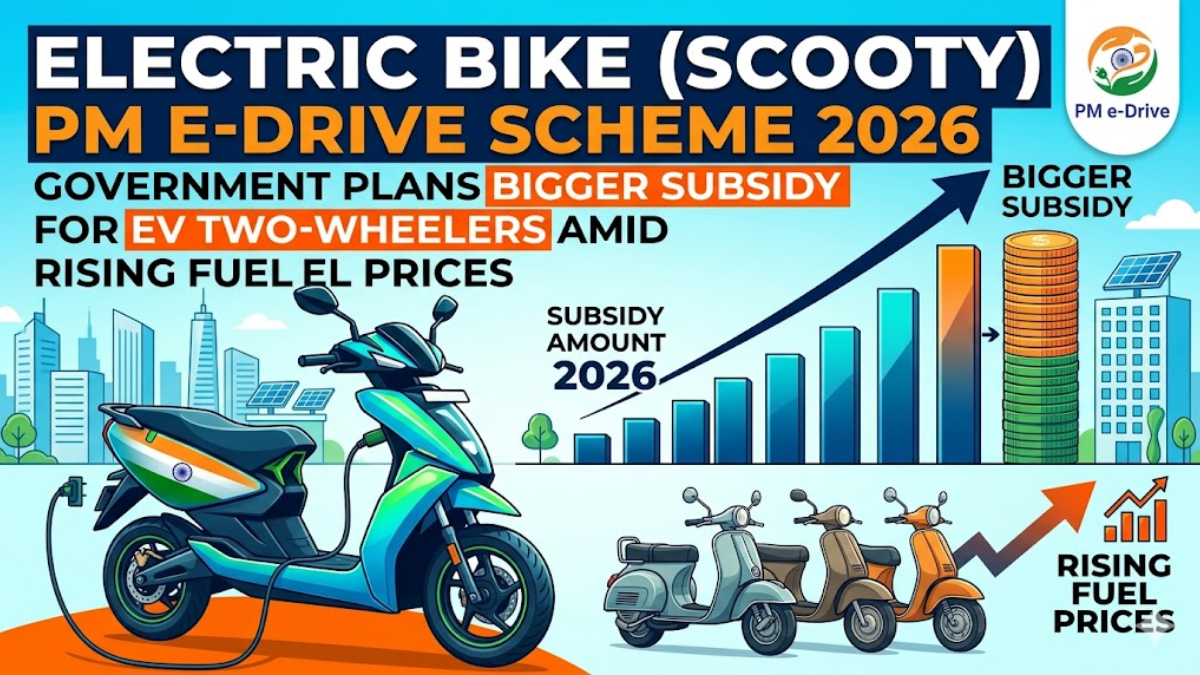
The continuous rise in petrol and diesel prices has become a major concern for millions of families across India. Every month, people are spending more money on fuel for their daily transportation needs.
Whether it is office workers, students, delivery staff, or small business owners, the increasing cost of petrol has affected everyone’s budget. In this situation, the Central Government is reportedly preparing to provide fresh relief to citizens by strengthening support for electric vehicles under the PM e-Drive Scheme 2026.
The government is now considering increasing subsidies for electric scooters and bikes to encourage more people to shift from fuel-powered vehicles to electric mobility. This move is expected to make electric two-wheelers more affordable and accessible for middle-class and lower-income families across the country.
Rising Fuel Prices Push Demand for Electric Vehicles
Over the past few years, petrol and diesel prices have witnessed repeated hikes. In many cities, petrol prices have crossed levels that were once unimaginable for ordinary citizens. As transportation costs rise, household expenses also increase because fuel affects almost every sector, including food delivery, public transport, logistics, and personal commuting.
Due to this situation, many people have started exploring alternative transportation options. Electric vehicles, especially electric scooters and bikes, have emerged as one of the best solutions because they significantly reduce fuel expenses. Charging an electric scooter costs much less compared to filling petrol regularly. For daily commuters, this can result in major monthly savings.
Recognizing this growing demand, the Central Government introduced several EV promotion schemes in recent years. One of the most important among them is the PM e-Drive Scheme, which aims to support electric mobility adoption throughout India.
What is the PM e-Drive Scheme?
The PM e-Drive Scheme is a government initiative launched to encourage people to purchase electric vehicles by providing financial assistance in the form of subsidies. Under this scheme, buyers of eligible electric scooters and bikes receive direct price reductions, making EVs more affordable.
The program was designed to reduce India’s dependence on imported fuel while also promoting environmentally friendly transportation. Since electric vehicles produce less pollution compared to petrol and diesel vehicles, they play a major role in reducing urban air pollution and carbon emissions.
The scheme mainly focuses on:
- Encouraging electric vehicle adoption
- Reducing fuel import dependency
- Lowering pollution levels
- Supporting domestic EV manufacturing
- Making EVs affordable for common citizens
Under previous subsidy programs, many electric scooters became significantly cheaper, leading to increased public interest. However, the government believes that EV adoption still needs stronger support to achieve large-scale success.
Scheme Extended Due to Slower-than-Expected Sales
Although electric vehicle sales have improved in recent years, the government reportedly expected even faster growth. Due to slower-than-anticipated sales numbers in some regions, authorities have decided to extend the PM e-Drive Scheme until July 2026.
The extension gives manufacturers and consumers additional time to benefit from existing subsidies while allowing the government to restructure future incentives. Reports suggest that officials are now discussing fresh budget allocations that could increase subsidy amounts even further.
If implemented, the revised subsidy structure may reduce the prices of electric scooters and bikes substantially. This could encourage more people to switch to EVs, especially those who were previously unable to afford them.
How Increased Subsidies Could Benefit Common People
One of the biggest challenges for EV adoption has been the upfront purchase cost. While electric scooters save money in the long run, many buyers still hesitate because EVs often cost more initially than petrol vehicles.
An increased subsidy can directly solve this issue by lowering showroom prices. For example, if the government raises financial support per vehicle, manufacturers may pass those benefits to customers through reduced prices.
This would help:
1. Middle-Class Families
Many middle-income households depend on two-wheelers for daily travel. Lower EV prices would make electric scooters a practical option for family transportation.
2. Students and Young Professionals
Young commuters looking for affordable transportation may prefer electric scooters because of low maintenance and charging costs.
3. Delivery Workers and Small Businesses
Gig workers and delivery partners who travel long distances every day spend large amounts on petrol. EV adoption can significantly reduce their operational expenses.
4. Women Riders
Lightweight electric scooters are increasingly popular among women riders due to their convenience and easy handling.
5. Rural and Semi-Urban Users
As charging infrastructure expands, EVs may also become more practical in smaller towns and semi-urban areas.
Reduction in Monthly Fuel Expenses
The primary attraction of electric vehicles is lower running costs. Petrol-powered vehicles require frequent refueling, engine maintenance, oil changes, and regular servicing. Electric scooters, on the other hand, have fewer moving parts and lower maintenance requirements.
A person spending thousands of rupees monthly on petrol could reduce transportation expenses dramatically by switching to an electric scooter. Over time, the savings can become substantial.
For example:
- Charging an EV costs far less than petrol refueling
- Maintenance expenses are lower
- Battery technology is improving
- Modern EVs offer longer range and better reliability
As electricity costs remain relatively stable compared to fuel prices, EV owners may enjoy better long-term affordability.
Government’s Goal: Reduce Oil Import Dependence
India imports a large percentage of its crude oil requirements from foreign countries. Rising international oil prices directly affect domestic fuel costs. This creates economic pressure on both the government and consumers.
By promoting electric mobility, the government hopes to reduce dependence on imported petroleum products. If more citizens adopt EVs, national fuel consumption could decrease gradually over time.
This strategy offers several advantages:
- Reduced foreign exchange spending on oil imports
- Better energy security
- Improved economic stability
- Lower exposure to global fuel price fluctuations
The transition to electric mobility is therefore not just an environmental initiative but also an economic strategy for the country’s future.
Environmental Benefits of Electric Vehicles
Air pollution remains a serious issue in many Indian cities. Vehicle emissions are one of the major contributors to poor air quality, especially in urban areas with heavy traffic congestion.
Electric vehicles help reduce pollution because they do not produce tailpipe emissions like conventional petrol or diesel vehicles. Increased EV adoption can improve air quality and contribute to cleaner cities.
Environmental advantages include:
- Reduced carbon emissions
- Lower air pollution
- Less noise pollution
- Cleaner urban transportation systems
As climate concerns continue to grow globally, governments around the world are investing heavily in green transportation technologies. India’s EV push aligns with these international sustainability goals.
Big Opportunity for Electric Vehicle Companies
A stronger subsidy policy could also provide major benefits to EV manufacturers. If prices decrease and demand rises, companies producing electric scooters and bikes may experience rapid business growth.
Several Indian and international brands are already competing in the EV market by launching new models with advanced features such as:
- Longer battery range
- Fast charging
- Smart connectivity
- Improved safety systems
- Stylish designs
Higher sales volumes could encourage companies to invest more in manufacturing, battery technology, and charging infrastructure.
This may also create:
- New employment opportunities
- Growth in EV-related industries
- Expansion of battery manufacturing
- Increased research and development
Expansion of Charging Infrastructure
One important factor influencing EV adoption is charging availability. Many potential buyers worry about finding charging stations during long-distance travel.
To support EV growth, both government agencies and private companies are investing in charging infrastructure across India. More charging stations are expected to be installed in cities, highways, apartment complexes, offices, and public spaces.
Future improvements may include:
- Fast-charging networks
- Battery swapping systems
- Solar-powered charging stations
- Smart charging technology
As charging infrastructure becomes more accessible, public confidence in electric vehicles is likely to increase further.
Challenges Still Facing the EV Industry
Despite rapid progress, some challenges remain in India’s electric vehicle ecosystem.
Battery Costs
Battery technology remains expensive, contributing significantly to vehicle prices.
Charging Accessibility
Certain rural and remote areas still lack adequate charging facilities.
Consumer Awareness
Some people remain unfamiliar with EV maintenance, battery life, and performance.
Resale Concerns
Buyers sometimes worry about long-term resale value and battery replacement costs.
However, experts believe these challenges will gradually reduce as technology improves and adoption increases.
Future of Electric Mobility in India
India’s EV market is growing steadily every year. Government policies, rising fuel costs, environmental awareness, and technological advancements are all driving this transformation.
Industry experts predict that electric scooters and bikes may become the preferred transportation option for many Indian families within the next decade. Affordable pricing, improved battery performance, and wider charging networks could accelerate this transition even more.
If the government officially announces enhanced subsidies under the PM e-Drive Scheme 2026, it may become a major turning point for the Indian EV industry.
How Citizens Can Prepare
People interested in purchasing electric scooters or bikes should stay updated with official government announcements regarding subsidy revisions and eligibility criteria.
Before buying an EV, consumers should consider:
- Vehicle range
- Charging time
- Battery warranty
- Service availability
- Subsidy eligibility
- Running costs
Comparing different models and understanding long-term savings can help buyers make informed decisions.
Conclusion
The Central Government’s reported plan to increase subsidies for electric scooters and bikes under the PM e-Drive Scheme 2026 has generated strong public interest. At a time when rising petrol and diesel prices are affecting household budgets across the country, affordable electric mobility could provide significant financial relief to millions of people.
If the subsidy increase becomes official, electric two-wheelers may become much cheaper and more accessible for ordinary citizens. This would not only reduce transportation expenses but also support cleaner energy adoption, reduce pollution, and decrease India’s dependence on imported oil.
The coming months may prove crucial for India’s electric vehicle revolution. With stronger government support, better infrastructure, and growing consumer awareness, electric scooters and bikes could soon become a common sight on roads across the nation.