Introduction
In the digital age, information spreads faster than ever before. While this has many advantages, it also creates challenges, especially when false or misleading information circulates widely. One such claim that has recently gained attention across social media platforms is that the Government of India has launched a new scheme providing ₹3000 per month to girls and ₹2000 per month to boys for their education.
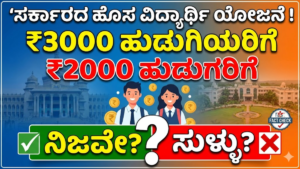
This message has been shared widely on platforms like WhatsApp, Facebook, and YouTube, leading many students and parents to believe that they are eligible for financial assistance. Naturally, such an offer sounds attractive, especially for families facing financial difficulties.
However, before accepting such claims as true, it is essential to verify the facts. This article aims to provide a complete, clear, and factual explanation of the claim, examine whether such a scheme exists, and highlight real government initiatives that support students.
Does This ₹3000/₹2000 Scheme Actually Exist?
To put it simply, there is no official nationwide scheme in India that provides ₹3000 monthly to girls and ₹2000 monthly to boys across all student categories.
Government authorities and fact-checking organizations have clarified that such claims are false and misleading. The confusion mainly arises from misinterpretation of existing scholarship programs and deliberate spreading of misinformation online.
No official announcement has been made by the central government regarding such a universal financial assistance program.
Why Do People Believe This Claim?
There are several reasons why this claim has become so popular:
1. Attractive Financial Promise
A monthly payment of ₹2000–₹3000 is significant for many families. Such benefits naturally attract attention and are quickly shared.
2. Lack of Awareness
Many people are not familiar with official government schemes, making it easier for false information to spread.
3. Social Media Virality
Content creators sometimes post exaggerated or incorrect information to gain views, likes, and followers.
4. Similar Amounts in Real Schemes
Some legitimate scholarship programs offer benefits in a similar range, which adds to the confusion.
The Truth Behind the Numbers
Although the viral claim is false, the amounts ₹2000 and ₹3000 are not completely random. They are inspired by real government scholarship programs.
One important example is the Prime Minister’s Scholarship Scheme (PMSS).
What Is the Prime Minister’s Scholarship Scheme?
The Prime Minister’s Scholarship Scheme is a genuine initiative designed to support the education of children from defense families.
Key Highlights:
- It is meant for children and widows of armed forces personnel, including ex-servicemen.
- It supports students pursuing professional and technical courses.
- Financial assistance is provided monthly to help cover education costs.
Scholarship Amount:
- Female students: approximately ₹3000 per month
- Male students: approximately ₹2500 per month
These figures are close to the viral claim, which is why people often misunderstand and assume that the scheme applies to all students.
Why Are Girls Given Higher Financial Support?
Many government programs offer slightly higher benefits for girls. This is done intentionally for social and developmental reasons.
Key Reasons:
1. Promoting Female Education
In some regions, girls still face barriers to education. Financial support encourages families to prioritize their education.
2. Reducing Gender Inequality
Providing higher incentives helps balance opportunities between boys and girls.
3. Preventing Early Dropouts
Girls are more likely to drop out of school due to financial or social reasons. Scholarships help them continue their studies.
4. Empowering Women
Education is a powerful tool for independence and empowerment.
Other Genuine Government Schemes for Students
Although the ₹3000/₹2000 scheme is not real, India has several legitimate programs that provide financial support to students.
1. National Scholarship Programs
The government offers multiple scholarships through centralized platforms for students from different backgrounds.
2. Schemes for Economically Weaker Sections
Students from low-income families can receive financial assistance to continue their education.
3. Initiatives for Girl Child Education
Various programs focus specifically on encouraging girls to study and complete their education.
4. State-Level Scholarships
Each state government runs its own schemes, offering financial support based on local needs and policies.
Risks of Fake Scheme Information
Believing in fake schemes can have serious consequences. It is not just harmless misinformation—it can lead to real problems.
1. Financial Scams
Fraudsters may ask for registration fees or processing charges.
2. Identity Theft
Fake websites can collect sensitive information such as Aadhaar numbers and bank details.
3. Wasted Time
Students may spend time applying for schemes that do not exist.
4. False Expectations
Families may plan finances based on benefits that are never received.
How to Identify Fake Government Schemes
To stay safe and informed, it is important to verify any scheme before trusting it.
1. Check Official Sources
Always visit government websites or official portals for accurate information.
2. Verify News Reports
Trust only well-known and reliable news organizations.
3. Be Careful with Social Media
Do not blindly trust messages forwarded on WhatsApp or shared on Facebook.
4. Look for Official Announcements
Real schemes are always announced through proper government channels.
5. Avoid Paying Fees
Most government schemes do not require payment for application.
Importance of Student Financial Support
Even though this specific scheme is false, the need for student support is very real.
Why Financial Aid Matters:
- Helps students from poor families continue education
- Reduces dropout rates
- Encourages higher studies
- Supports skill development
- Builds a stronger workforce
Government schemes play a vital role in ensuring equal educational opportunities for all.
What Should Students Do Instead?
Instead of relying on viral messages, students should take practical steps to benefit from real opportunities.
1. Apply Through Official Portals
Use government scholarship websites to find genuine programs.
2. Stay Updated
Follow official announcements and verified news.
3. Ask School or College Authorities
Teachers and administrators often have accurate information.
4. Spread Awareness
Inform friends and family about fake schemes to prevent misinformation.
Understanding Why Fake News Spreads
Fake schemes often spread because they appeal to emotions and needs.
Common Reasons:
- Financial insecurity
- Hope for easy support
- Trust in government-related messages
- Lack of digital literacy
Recognizing these factors can help people become more cautious.
Government Efforts to Stop Fake Information
The government has taken several steps to combat misinformation:
- Launching fact-checking services
- Issuing public awareness campaigns
- Promoting digital literacy
- Warning citizens against online fraud
These efforts aim to protect people from scams and false claims.
The Role of Awareness in Society
Awareness is the most powerful tool against misinformation. When people verify facts before sharing information, the spread of fake news can be reduced significantly.
Students, in particular, should develop critical thinking skills and learn to question information that seems too good to be true.
Conclusion
The claim that the Government of India provides ₹3000 per month to girls and ₹2000 per month to boys under a new student scheme is not true. It is a result of misunderstanding and misinformation spread through social media.
However, this does not mean that students are left without support. There are many genuine government schemes that provide financial assistance, but they are targeted toward specific groups and require proper eligibility.
In today’s world, where information is easily accessible, it is equally important to verify its authenticity. Students and parents should rely only on official sources and avoid falling into the trap of viral but false claims.
By staying informed and cautious, individuals can make better decisions and take advantage of real opportunities rather than chasing false promises.