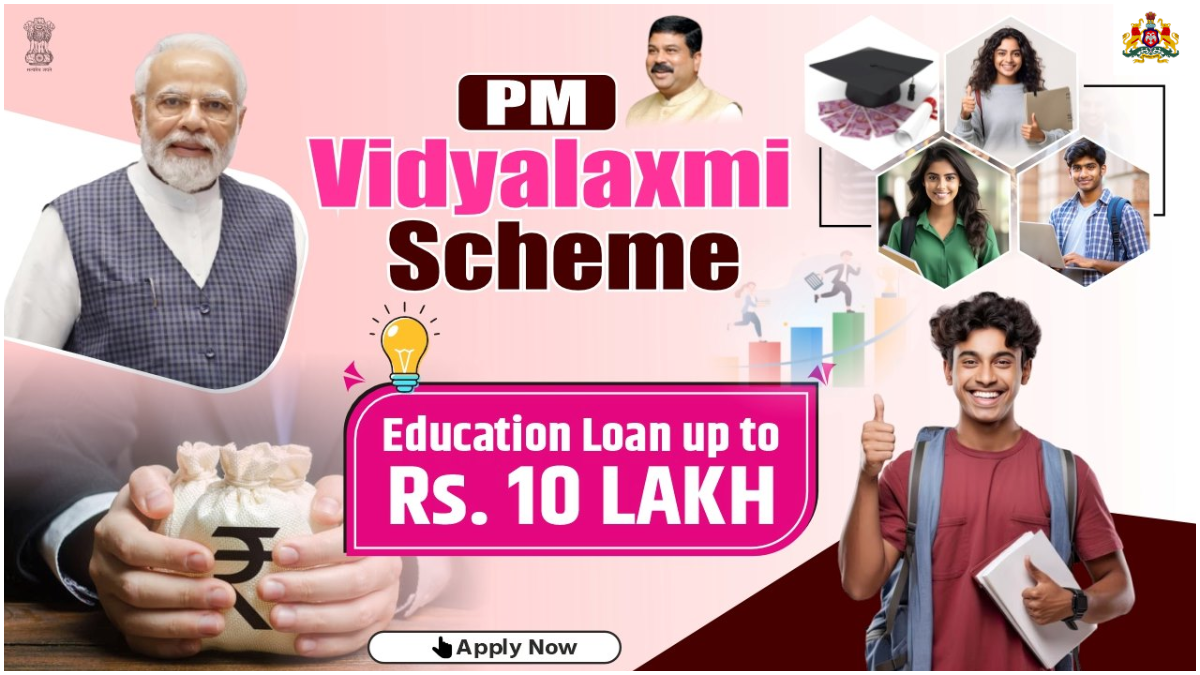
Education is one of the most powerful tools for personal growth and national development. However, the rising cost of higher education often becomes a major barrier for students from economically weaker backgrounds. To address this challenge and ensure that financial limitations do not prevent deserving students from pursuing higher studies, the Government of India introduced the Vidya Lakshmi Scheme, commonly referred to as the Vidya Lakshmi Scholarship or Education Loan Scheme.

The Vidya Lakshmi Scheme is a landmark initiative aimed at simplifying access to education loans and scholarships through a single online platform. It plays a crucial role in supporting students who aspire to pursue higher education in India or abroad but lack sufficient financial resources.
This article provides a detailed, comprehensive, and easy-to-understand explanation of the Vidya Lakshmi Scheme, including its objectives, features, eligibility criteria, application process, benefits, and overall impact on Indian students.
What Is the Vidya Lakshmi Scheme?
The Vidya Lakshmi Scheme is a Government of India initiative launched to provide a single-window online platform for students to apply for education loans and scholarships offered by multiple banks and government departments. The scheme is managed through the Vidya Lakshmi Portal, which acts as a centralized system for loan applications.
Unlike a traditional scholarship that provides direct financial grants, Vidya Lakshmi primarily focuses on education loans, while also enabling students to explore and apply for available scholarships. The scheme aims to ensure transparency, efficiency, and accessibility in the education financing system.
Objectives of the Vidya Lakshmi Scheme
The Vidya Lakshmi Scheme was introduced with several key objectives:
- Promote Access to Higher Education
The scheme ensures that students from all economic backgrounds can pursue higher education without financial stress. - Simplify the Education Loan Process
It eliminates complex paperwork and multiple bank visits by allowing online submission of applications. - Provide a Single Platform for Students
Students can apply to multiple banks using one common application form. - Ensure Transparency and Accountability
The portal allows students to track the status of their loan applications in real time. - Encourage Financial Inclusion
By bringing students into the formal banking system, the scheme promotes responsible borrowing and financial literacy.
Background and Implementation
The Vidya Lakshmi Scheme was developed under the guidance of the Department of Financial Services, Ministry of Finance, in collaboration with the Ministry of Education and Indian Banks Association (IBA). The portal integrates various education loan schemes offered by public and private sector banks across India.
The scheme reflects the government’s commitment to the vision of “Education for All”, ensuring that no student is deprived of education due to financial constraints.
Key Features of the Vidya Lakshmi Scheme
The Vidya Lakshmi Scheme offers several student-friendly features:
1. Single Common Application Form
Students can fill out one standardized form and submit it to multiple banks simultaneously.
2. Multiple Bank Options
The portal includes loan schemes from numerous public and private sector banks, allowing students to compare options.
3. Real-Time Application Tracking
Applicants can track the progress of their loan application online.
4. Access to Scholarship Information
The portal provides information about government scholarships linked to education financing.
5. Secure Digital Platform
The system ensures data security and confidentiality of student information.
6. Reduced Processing Time
Online processing significantly reduces delays compared to traditional offline methods.
Types of Courses Covered Under the Scheme
The Vidya Lakshmi Scheme supports a wide range of academic and professional courses, including:
- Undergraduate programs (BA, BSc, BCom, BTech, etc.)
- Postgraduate programs (MA, MSc, MCom, MBA, MTech, etc.)
- Professional courses (Medicine, Engineering, Law, Architecture)
- Diploma and vocational courses
- Technical and skill-based programs
- Courses pursued in India or abroad (subject to bank policies)
Eligibility Criteria for Vidya Lakshmi Scheme
Although eligibility conditions may vary slightly depending on the bank, the general criteria include:
- Nationality
The applicant must be an Indian citizen. - Educational Qualification
The student should have secured admission to a recognized institution in India or abroad. - Academic Merit
Banks may require minimum academic performance based on course and institution. - Age Limit
There is usually no strict age limit, but students must meet bank-specific norms. - Co-Applicant Requirement
A parent, guardian, or spouse is typically required as a co-borrower.
Documents Required for Application
Students applying under the Vidya Lakshmi Scheme generally need the following documents:
- Proof of identity (Aadhaar card, passport, etc.)
- Proof of residence
- Educational certificates and mark sheets
- Admission letter from the institution
- Fee structure of the course
- Income proof of co-applicant
- Bank statements
- Passport-size photographs
Step-by-Step Application Process
The application process under the Vidya Lakshmi Scheme is simple and fully online.
Step 1: Registration
Students must create an account on the Vidya Lakshmi Portal using basic personal details.
Step 2: Fill Common Education Loan Application Form
Applicants complete the online form with academic, personal, and financial details.
Step 3: Select Banks and Loan Schemes
Students can choose multiple banks and loan schemes based on their requirements.
Step 4: Submit Application
Once submitted, the application is forwarded electronically to the selected banks.
Step 5: Track Application Status
Students can log in to track the status and receive updates from banks.
Role of Banks in the Scheme
Banks play a critical role in implementing the Vidya Lakshmi Scheme. They:
- Evaluate loan applications
- Verify documents
- Assess creditworthiness
- Determine loan amount, interest rate, and repayment terms
- Communicate approvals or rejections through the portal
Benefits of the Vidya Lakshmi Scheme
1. Financial Support for Students
The scheme helps students manage tuition fees, hostel charges, books, and other expenses.
2. Equal Educational Opportunities
Students from rural and economically weaker sections gain access to quality education.
3. Transparency and Convenience
Online processing reduces corruption, bias, and unnecessary delays.
4. Reduced Financial Burden on Families
Parents are relieved from arranging large sums for education expenses.
5. Encouragement of Skill Development
Students are motivated to pursue professional and technical courses.
Vidya Lakshmi Scheme and Scholarships
While Vidya Lakshmi primarily focuses on education loans, it also connects students with various government scholarship schemes. These scholarships may help reduce loan amounts or provide additional financial assistance to eligible students, especially those from marginalized communities.
Challenges and Limitations
Despite its benefits, the scheme faces certain challenges:
- Lack of awareness among students in rural areas
- Dependence on bank-specific approval criteria
- Documentation complexity for some applicants
- Processing delays in certain cases
Addressing these challenges through awareness campaigns and improved digital literacy can further strengthen the scheme.
Impact of Vidya Lakshmi Scheme on Indian Education
The Vidya Lakshmi Scheme has had a positive impact on the education sector by:
- Increasing enrollment in higher education
- Promoting digital governance
- Enhancing transparency in education financing
- Supporting national development through skilled human resources
Future Scope of the Vidya Lakshmi Scheme
With continuous improvements in digital infrastructure, the Vidya Lakshmi Scheme has immense potential for growth. Integration with more scholarship programs, faster loan approvals, and increased awareness can make it an even more powerful tool for students across India.
Conclusion
The Vidya Lakshmi Scheme is a transformative initiative that bridges the gap between ambition and affordability in education. By providing a unified platform for education loans and scholarships, it empowers students to focus on learning rather than financial constraints. The scheme reflects the government’s commitment to inclusive education and human capital development.
For students dreaming of higher education but struggling with financial barriers, the Vidya Lakshmi Scheme serves as a beacon of hope—making education not a privilege, but a right accessible to all.