“My field is close by, but tractors cannot reach it… During the rainy season, even walking becomes impossible…”
This is not just one farmer’s complaint. It reflects the daily struggle of thousands of farmers across rural Karnataka. Many farmers grow quality crops but face serious difficulties transporting their produce to the market due to the lack of proper road connectivity. In several villages, farm roads turn into muddy tracks during monsoon, making it nearly impossible for vehicles to pass.
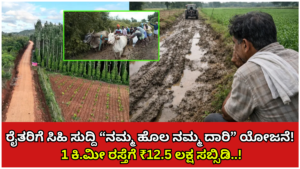
To address this long-standing issue, the Government of Karnataka has introduced a farmer-friendly initiative called “Namma Hola Namma Daari” (Our Field, Our Road). This scheme aims to provide permanent and reliable road access directly to agricultural lands in rural areas.
If you are a farmer wondering what this scheme is, who can apply, how much funding is provided, and how to get your road approved — this detailed guide explains everything you need to know.
What is the “Namma Hola Namma Daari” Scheme?
The primary objective of this scheme is to provide proper road connectivity to agricultural lands in rural parts of Karnataka. Instead of temporary mud paths that become unusable during rains, the government plans to develop durable rural roads with proper improvement work.
Under this scheme:
- Roads leading to farmlands will be developed and strengthened.
- Each road project can receive funding of up to ₹12.5 lakh per kilometer.
- The focus is on ensuring that tractors, jeeps, small goods vehicles, and other agricultural transport vehicles can directly reach farms.
The idea is simple yet powerful: when a farmer has reliable road access, half of their struggle is already reduced.
Why is This Scheme Important?
Agriculture does not end with cultivation. Transportation plays a crucial role in a farmer’s income. Without road access:
- Farmers carry produce manually.
- Transportation costs increase.
- Middlemen gain control due to dependency.
- Harvests get damaged during transit.
- Fertilizers and equipment cannot be transported efficiently.
A well-constructed road improves productivity, reduces physical strain, and enhances income opportunities.
Key Benefits for Farmers
1. Direct Tractor Access to the Field
One of the biggest advantages is that tractors and other agricultural vehicles can directly reach the farm boundary. This reduces the need for manual transportation and makes mechanized farming easier.
2. Lower Transportation Costs
When lorries or tractors can reach the farmland directly:
- Loading becomes easier.
- Multiple labor costs are reduced.
- Time spent on transport decreases.
- Fuel expenses are optimized.
Farmers can transport crops like sugarcane, paddy, vegetables, and fruits without depending on head-load workers or bullock carts.
3. No More Mud Problems During Rainy Season
In many villages, farm paths turn into slippery, muddy stretches during monsoon. Vehicles get stuck, and sometimes farmers lose access completely for days.
With improved roads under this scheme, year-round connectivity becomes possible.
4. Round-the-Clock Access
Better roads allow farmers to visit their fields anytime — early morning, late night, or during emergencies. This is especially important during irrigation management, pest attacks, or harvesting time.
5. Improved Market Access
Better roads mean quicker transport to local markets, reducing spoilage of perishable crops and helping farmers get better prices.
How Much Funding is Provided? (₹12.5 Lakh Per Kilometer Explained)
The government has structured funding carefully to ensure smooth implementation. The total allocation per kilometer is ₹12.5 lakh. This amount is divided into two major components:
₹9.00 Lakh – Under MGNREGA
A major portion of funding comes from the Mahatma Gandhi National Rural Employment Guarantee Act (MGNREGA).
This amount covers:
- Labor costs
- Road base preparation
- Basic improvement and strengthening
- Certain structural works including metal layering (where applicable)
MGNREGA ensures that rural employment is generated while developing infrastructure.
₹3.50 Lakh – State Government Special Grant
The remaining ₹3.50 lakh is provided as a special grant by the Karnataka state government.
This amount is mainly used for:
- Machinery operations
- Road leveling
- Compaction work
- Transport of construction materials
Together, the total amount of ₹12.5 lakh per kilometer ensures meaningful road development rather than just temporary repair work.
Who is Eligible?
Not every private landowner can automatically demand a road under this scheme. There are specific eligibility conditions that must be satisfied.
1. The Road Must Be Recorded in Official Village Maps
The proposed road should already be marked in village revenue records as:
- Government road
- Cart track
- Public pathway
- Recognized rural access route
If the road does not exist in official land records, approval becomes difficult.
2. It Should Benefit Multiple Farmers
This scheme is not meant to provide a private road to a single individual. The road must serve:
- Multiple farmers
- Agricultural communities
- A cluster of farmlands
The broader the public benefit, the stronger the case for approval.
3. Land Must Be Voluntarily Given for Widening
If additional width is required for road development:
- Adjacent landowners must voluntarily provide land.
- The government does not pay compensation.
- A donation agreement (written consent) must be submitted.
This condition ensures that public funds are not used for land acquisition.
Step-by-Step Process to Get the Road Approved
Farmers must take initiative. Roads are not automatically sanctioned. Here’s the complete procedure:
Step 1: Prepare a Joint Petition
Farmers who will benefit from the road must come together and draft a written request.
The petition should include:
- Description of current difficulties
- Importance of road connectivity
- Number of farmers benefiting
- Length of road required
- Signatures of supporting farmers
The stronger the collective support, the better the chances.
Step 2: Submit Petition to the Panchayat (PDO)
Visit your local Gram Panchayat office and meet the PDO (Panchayat Development Officer).
Submit the written request under the “Namma Hola Namma Daari” scheme and ask for it to be included in the development plan.
Follow up regularly to ensure it moves forward.
Step 3: Raise the Issue in the Gram Sabha
This is a critical stage.
The proposal must be discussed and approved in the Gram Sabha meeting. Without Gram Sabha approval:
- The project cannot move ahead.
- Budget allocation may not be possible.
Attend the meeting, explain the need clearly, and ensure community support.
Step 4: Seek Support from the Local MLA
The role of the local Member of Legislative Assembly (MLA) can be very important.
Approach your constituency representative, explain the issue, and request their recommendation. Political backing often speeds up administrative approval.
Important Points to Remember
- This is a public welfare scheme, not a private benefit.
- Proper documentation is crucial.
- Follow-up is necessary.
- Collective action increases approval chances.
- Land donation for widening must be voluntary.
Long-Term Impact on Rural Development
Beyond helping individual farmers, the scheme contributes to:
- Rural infrastructure development
- Increased agricultural productivity
- Employment generation through MGNREGA
- Better rural transportation networks
- Economic upliftment of villages
Good roads can transform rural economies. When farmers earn more, local businesses grow. Transporters benefit. Markets expand. Villages become better connected.
Common Challenges Farmers May Face
Even though the scheme is beneficial, farmers may encounter:
- Delays in administrative approvals
- Record verification issues
- Disagreements over land donation
- Budget constraints in specific financial years
Patience and consistent follow-up are essential.
Frequently Asked Questions
Is this scheme available across Karnataka?
Yes, it is intended for rural areas across Karnataka, subject to budget allocation and eligibility criteria.
Can a single farmer apply?
No. The road must serve multiple farmers and must be recognized in official records.
Is compensation given for land used?
No. Land for widening must be voluntarily donated.
How long does approval take?
Approval time depends on:
- Gram Sabha clearance
- Panchayat priority list
- Budget allocation
- Administrative verification
Why Farmers Should Act Now
Waiting passively will not bring change. Roads are approved based on proposals and community demand. If farmers organize and apply properly, they can secure funding.
A good road:
- Saves time
- Reduces expenses
- Protects crops
- Increases income
- Improves quality of life
Final Words
Dear farmer friends, infrastructure is the backbone of agriculture. A proper road to your farm is not a luxury — it is a necessity. When roads improve, opportunities expand.
Do not wait for someone else to take the initiative. Visit your Gram Panchayat office today. Discuss with fellow farmers. Prepare a petition. Attend Gram Sabha meetings.
With the support of the Government of Karnataka and active participation from rural communities, the “Namma Hola Namma Daari” scheme can truly transform farmland connectivity across Karnataka.
A better road means a better future for farmers.