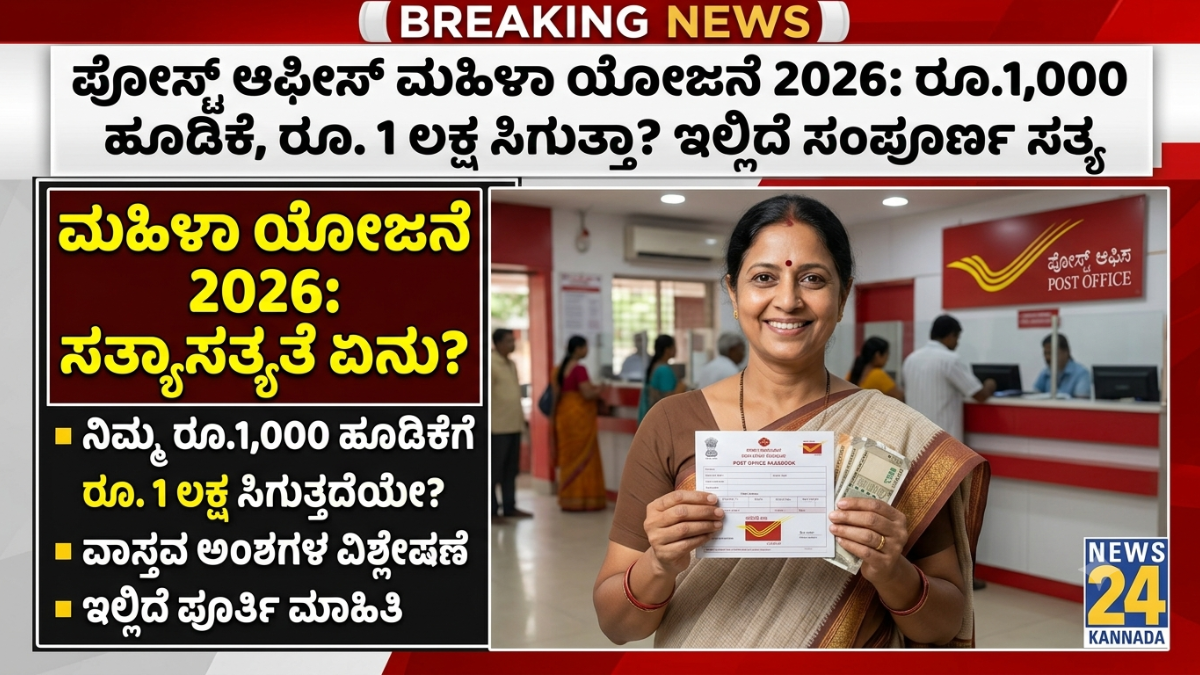
A message claiming that women can deposit ₹1,000 in a Post Office and receive ₹1 lakh has been attracting attention online. Some versions describe it as a special government gift for women around the Var Mahalakshmi festival, while others present it as a “new Post Office women scheme 2026.”
Before making any investment based on such a message, it is important to separate the genuine Post Office savings schemes from exaggerated or outdated online claims.
The scheme frequently mentioned in these viral stories is the Mahila Samman Savings Certificate, or MSSC. It was indeed a real government-backed savings product, but it was introduced as a limited-period scheme, not as a permanent women-only savings plan.
MSSC Was a Genuine Scheme — But It Is Not New in 2026
The Government introduced the Mahila Samman Savings Certificate in 2023 to encourage savings among women and girls.
Under the scheme, an eligible woman could open an account in her own name. A guardian could also open an account for a minor girl. The minimum deposit was ₹1,000, while the maximum overall deposit limit was ₹2 lakh under the applicable rules.
The account had a two-year maturity period and offered an interest rate of 7.5% per year, compounded quarterly. India Post’s own publications clearly stated that the scheme was available from April 1, 2023, to March 31, 2025.
The Department of Posts later issued a specific order confirming that after March 31, 2025, no new deposits could be accepted under MSSC.
This means that calling MSSC a “new 2026 Post Office scheme” is incorrect.
Does ₹1,000 Really Become ₹1 Lakh?
No.
This is perhaps the biggest misunderstanding in viral posts.
The MSSC allowed an investment starting from ₹1,000, but that does not mean the government added ₹99,000 to the investor’s account.
The interest rate was 7.5% annually, with quarterly compounding. At that rate, a ₹1,000 investment for two years would produce a maturity value of approximately ₹1,161, not ₹1 lakh.
In other words, the ₹1,000 figure represented the minimum investment amount. It was not an eligibility condition for receiving a government cash gift of ₹1 lakh.
Similarly, there is no basis for assuming that depositing ₹100 or ₹500 into a Post Office account automatically results in a government payment of ₹1 lakh.
Why Are Such Headlines Going Viral?
Financial headlines often use attractive phrases such as:
“Women deposit ₹1,000 and get ₹1 lakh.”
“Government’s Var Mahalakshmi gift for women.”
“Apply now at your nearest Post Office.”
Such headlines can create the impression that the government has launched a new financial assistance scheme.
In reality, the underlying story may be referring to an old savings product, a different scheme, or an entirely unofficial promotion.
The safest approach is to check whether the scheme appears on the official India Post or Department of Economic Affairs website and whether the scheme is currently open for applications.
Savings Options Women Can Explore
The closure of MSSC does not mean women have no Post Office savings options. Several small-savings products remain available subject to their individual eligibility and rules.
Sukanya Samriddhi Account
Sukanya Samriddhi is designed for eligible girl children and is intended for long-term savings.
It can be particularly useful for parents or guardians who want to build a fund for a daughter’s future education or other major financial requirements. The government periodically announces the applicable interest rate.
The interest rate should always be checked for the relevant quarter before opening an account or calculating future returns.
Recurring Deposit
A Post Office Recurring Deposit is designed for people who prefer systematic savings.
Instead of making one large investment, an investor contributes a fixed amount regularly. This can make it easier for salaried employees, homemakers and small-income households to develop a savings habit.
The applicable interest rate and account conditions should be confirmed at the time of opening the account.
National Savings Certificate
NSC is another Post Office savings instrument that can be considered for medium-term financial planning.
It has a defined maturity period and a government-notified interest rate. Depending on the investor’s tax situation and prevailing tax rules, certain contributions may also qualify for tax-related benefits.
Investors should not rely on old interest-rate figures circulating on social media because small-savings rates are subject to periodic government notifications.
What Documents May Be Needed?
For Post Office savings accounts, applicants generally need standard KYC documentation. Depending on the product, the Post Office may request:
- Proof of identity
- Proof of address
- PAN or applicable tax documentation
- Passport-size photograph
- Account-opening form
- Bank details, where applicable
- Guardian documentation for accounts involving minors
Requirements can vary, so customers should confirm the current list with the Post Office before submitting documents.
Protect Yourself From Online Scams
If an advertisement asks you to pay a registration fee, processing charge or “application fee” to receive a supposed government benefit, do not transfer money without verification.
Also avoid websites that ask for sensitive information such as:
- Aadhaar OTP
- Bank OTP
- UPI PIN
- ATM PIN
- Internet banking password
- Debit or credit card details
A genuine Post Office savings product does not require customers to reveal banking passwords or UPI PINs to an unknown person.
Final Verdict
The viral claim that women can newly invest ₹1,000 in the Mahila Samman Savings Certificate in 2026 and receive ₹1 lakh is misleading.
MSSC was a genuine government savings scheme, but its new-account window ended on March 31, 2025. The official Department of Posts specifically instructed that no new deposits would be accepted after that date.
The former scheme offered 7.5% annual interest compounded quarterly, meaning ₹1,000 would grow to only around ₹1,161 over two years, rather than ₹1 lakh.
Women looking for safe savings opportunities in 2026 should instead review currently available Post Office products and compare their eligibility, interest rates, tenure, withdrawal conditions and tax treatment.
Most importantly, never treat a social-media headline as proof that a government scheme exists. The Department of Economic Affairs maintains official information on small-savings schemes and publishes periodic interest-rate notifications.
Before investing money or submitting personal documents, verify the scheme directly through India Post or the Government of India’s official financial-information channels.