Introduction
The year 2026 marks an important transformation in the Karnataka Pre-University education system, especially for students appearing for the 2nd PUC (Pre-University Course) examinations. Traditionally, students who failed in one or more subjects had limited opportunities through supplementary exams, often leading to delays in academic progression and increased stress. Recognizing these challenges, the Karnataka School Examination and Assessment Board (KSEAB) has introduced a more flexible and student-centered system.
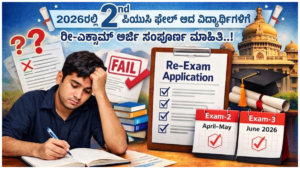
Under the revised structure, students now have access to multiple examination attempts within the same academic year. This new system includes Exam-1, Exam-2, and Exam-3, offering students more chances to pass or improve their performance without losing an entire year.
This article provides a comprehensive explanation of the re-exam application process, eligibility criteria, important rules, timelines, benefits, preparation strategies, and psychological guidance for students who did not pass the 2nd PUC examination in 2026.
Understanding the New Examination System
The updated examination model in 2026 is designed to reduce academic pressure and provide flexibility. Instead of a single supplementary exam, students now have three opportunities:
- Exam-1 (Main Examination): Conducted in February–March
- Exam-2 (First Re-Exam Opportunity): Conducted in April–May
- Exam-3 (Second Re-Exam Opportunity): Conducted in June
This system allows students to recover quickly from failure and continue their education without interruption. It also encourages students to improve their scores if they are not satisfied with their initial results.
What Does “Failing” Mean in 2nd PUC?
In the 2nd PUC system, a student is considered to have failed if they do not meet the minimum passing marks in one or more subjects. Even if a student performs well in most subjects but fails in one, the overall result is marked as “fail.”
However, the new system ensures that:
- Students do not need to repeat the entire academic year
- They can reappear for only the subjects they failed in
- They can attempt the exam again within a short period
This approach significantly reduces the emotional and academic burden associated with failure.
Key Changes Introduced in 2026
1. Introduction of Multiple Attempts
The most significant change is the introduction of two additional attempts—Exam-2 and Exam-3. This ensures that students have more than one chance to succeed within the same academic year.
2. Elimination of Traditional Supplementary Exams
The older supplementary system has been replaced with a more structured and predictable schedule. Instead of waiting months for a single re-exam, students now have multiple, well-planned opportunities.
3. Opportunity for Improvement
Students are not limited to clearing failed subjects. They can also:
- Reappear for subjects they have already passed
- Improve their marks for better academic or career opportunities
This is especially beneficial for students aiming for competitive courses where higher marks are required.
4. Limited Time Frame for Attempts
Students are generally given a limited number of years (usually two academic years) to clear or improve their subjects. This ensures that students remain focused and complete their education within a reasonable timeframe.
5. Revised Passing Criteria
The updated passing criteria are designed to be more student-friendly:
- Minimum marks required per subject: 30%
- Overall aggregate: 33%
This adjustment helps reduce the failure rate while maintaining academic standards.
Step-by-Step Re-Exam Application Process
Applying for the re-exam is straightforward, but students must follow the process carefully to avoid errors.
Step 1: Check the Results
After the announcement of Exam-1 results:
- Visit the official results portal
- Review subject-wise marks
- Identify failed or improvement subjects
Step 2: Contact Your College
Students should immediately inform their PU college:
- Colleges act as the primary point of contact
- They provide application forms and guidance
- They help ensure accurate submission
Step 3: Fill Out the Application Form
Students must provide:
- Registration number
- Name and personal details
- Subjects for re-examination
- Contact information
Accuracy is important to avoid complications later.
Step 4: Pay the Examination Fee
The fee depends on:
- Number of subjects
- Type of application (regular or late)
Late applications may incur additional charges.
Step 5: Submit Before the Deadline
Deadlines are usually strict:
- Regular submission window lasts about one week
- Late submission is allowed with a penalty
Missing deadlines may result in losing the opportunity.
Step 6: Download Hall Ticket
Before the exam:
- Hall tickets are released online or via colleges
- Students must verify details
- Carry the hall ticket to the exam center
Important Dates (Tentative for 2026)
While exact dates may vary, the general schedule is as follows:
- Result Announcement: April 2026
- Exam-2 Application: Early April 2026
- Exam-2 Dates: Late April to early May 2026
- Exam-3 Application: Mid-May 2026
- Exam-3 Dates: June 2026
Students are advised to regularly check official notifications for updates.
Eligibility for Re-Examination
The re-exam system is inclusive and allows various categories of students to apply:
- Students who failed in one or more subjects
- Students who were absent in the main exam
- Students who want to improve their marks
- Regular students enrolled in colleges
- Private candidates and repeaters
This broad eligibility ensures that no student is left without an opportunity.
Benefits of the New System
1. No Loss of Academic Year
Students can complete their exams within the same year and proceed with higher education without delay.
2. Reduced Stress and Anxiety
Multiple opportunities reduce the fear of failure and allow students to perform with confidence.
3. Flexibility in Learning
Students can focus on weak subjects and improve their performance without pressure.
4. Better Career Opportunities
Improving marks can help students qualify for:
- Competitive exams
- Professional courses
- Scholarships
5. Faster Results and Admissions
Quick re-exam results help students participate in college admissions on time.
Exam Pattern for Re-Exams
The re-exam pattern remains the same as the main exam:
- Duration: 3 hours
- Types of questions:
- Multiple-choice questions (MCQs)
- Short answer questions
- Long descriptive answers
Marking Scheme:
- Science Stream:
- 70% theory
- 30% practical
- Commerce and Arts:
- 80% theory
- 20% internal assessment
Students should prepare according to the same syllabus and pattern.
Documents Required
Students should keep the following ready:
- Registration number
- Previous hall ticket
- Marks card or result copy
- Passport-size photographs
- Fee payment receipt
Proper documentation ensures a smooth application process.
Common Mistakes to Avoid
Students often make avoidable errors, such as:
- Missing application deadlines
- Selecting incorrect subjects
- Not verifying hall ticket details
- Underestimating the difficulty of re-exams
- Ignoring exam instructions
Avoiding these mistakes can improve the chances of success.
Effective Preparation Strategies
1. Identify Weak Areas
Students should analyze:
- Which topics caused difficulty
- Where marks were lost
2. Focus on Important Topics
- Study frequently asked questions
- Review previous years’ papers
- Practice important chapters thoroughly
3. Create a Study Schedule
- Allocate time for each subject
- Balance strong and weak areas
- Include revision sessions
4. Practice Writing Answers
- Improve speed and accuracy
- Practice time management
- Write structured answers
5. Seek Guidance
Students should not hesitate to:
- Ask teachers for help
- Join coaching classes if needed
- Use online learning resources
Emotional and Psychological Support
Failure can be discouraging, but it is important to remember:
- It is a temporary phase
- It does not define a student’s future
- Many successful individuals have faced similar setbacks
Students should:
- Stay positive and focused
- Avoid comparing themselves with others
- Take care of their mental health
Role of Parents and Teachers
Support from parents and teachers is essential:
- Encourage rather than criticize
- Provide a calm and supportive environment
- Help students stay motivated
Positive reinforcement can significantly improve performance.
Opportunities After Passing the Re-Exam
Once students clear their re-exams, they can:
- Apply for undergraduate degree programs
- Prepare for entrance exams
- Choose professional or vocational courses
Importantly, clearing the re-exam ensures that students remain on track with their career goals.
Conclusion
The reforms introduced in the 2026 Karnataka 2nd PUC examination system represent a progressive step toward student welfare and academic flexibility. By replacing the traditional supplementary exams with a structured system of Exam-2 and Exam-3, the board has created a supportive environment where students can recover from setbacks without losing valuable time.
The re-exam application process is simple, and the rules are designed to benefit students. With proper planning, consistent effort, and the right mindset, students can successfully clear their subjects and move forward in their educational journey.
Failure is not the end—it is an opportunity to learn, improve, and come back stronger. The new system ensures that every student has the chance to succeed and build a bright future.