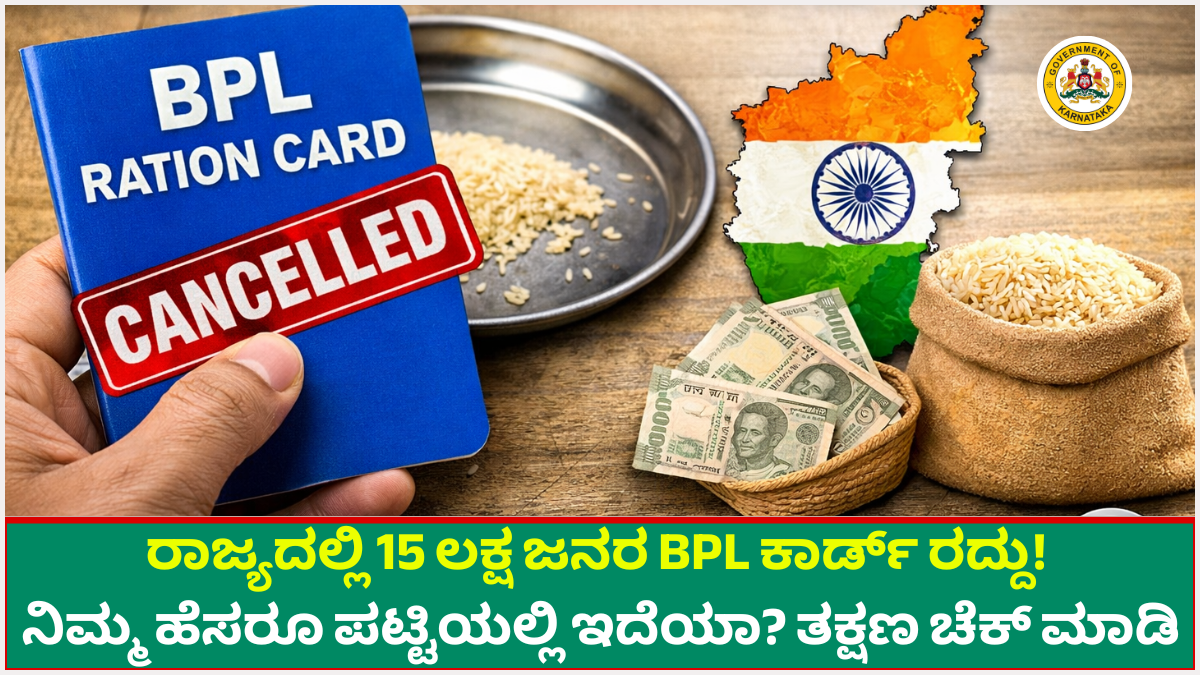
Bengaluru: In a major move aimed at ensuring welfare benefits reach only the truly deserving, the Karnataka government has taken strict action against ineligible ration card holders. Over the last five months, the Department of Food, Civil Supplies and Consumer Affairs has quietly carried out a large-scale verification drive across the state. As a result, more than 15.12 lakh individuals associated with Below Poverty Line (BPL) ration cards have lost their eligibility for benefits.
The decision has come as a shock to many households that were receiving government subsidies such as free rice and benefits under various state guarantee schemes. Officials say the step was necessary because many financially stable families were reportedly misusing BPL cards that are meant exclusively for economically weaker sections.
If you currently hold a ration card in Karnataka, you may want to check whether its status has changed. The government has already begun converting several BPL cards into Above Poverty Line (APL) cards or cancelling them entirely if they were found to be obtained through false information.
This article explains who has been affected, why the government took this decision, how many cards were changed or cancelled, and how you can check your ration card status online.
Why the Karnataka Government Took Action
The BPL ration card system is designed to help low-income families by providing subsidized food grains and access to social welfare programs. However, during recent audits and data checks, the state government found that a large number of ineligible individuals were using BPL cards to access benefits meant for the poor.
Authorities discovered several cases where people with high incomes, government jobs, or significant assets were still listed as BPL beneficiaries. This raised concerns that deserving families might not be receiving the full support intended for them.
To address this issue, the government initiated a verification drive. Using income records, vehicle registration data, tax filings, and other government databases, officials identified households that did not meet the criteria for BPL eligibility.
The main objective behind the operation was to ensure fairness and transparency in welfare distribution. According to officials, removing ineligible beneficiaries will allow resources to be directed more effectively toward families that genuinely need support.
Who Has Lost BPL Eligibility?
The review process targeted several categories of individuals who were found to be financially stable but still holding BPL cards. Below are some of the major groups affected by the government’s action.
1. Income Tax Payers
One of the primary criteria used in the verification drive was whether a person pays income tax. Individuals who file income tax returns and earn substantial annual incomes are generally considered financially capable of supporting themselves.
Officials found that some income tax payers were still listed under the BPL category. In such cases, their ration cards have now been converted from BPL to APL status, meaning they will no longer receive the same level of subsidized benefits.
2. Government Employees
Government employees receive regular salaries and job security, which makes them ineligible for BPL benefits under most circumstances.
However, the verification process revealed that a number of government staff members were still using BPL ration cards. As a result, the authorities have taken action by either converting their cards to APL or cancelling them where necessary.
3. Owners of Private Four-Wheelers
Another factor used to determine financial eligibility was vehicle ownership. Families that own private four-wheeler vehicles not used for commercial purposes were considered financially stable enough to fall outside the BPL category.
Many such households were identified during the review process. Consequently, their BPL cards were also reclassified.
4. Households With Higher Annual Income
The government also examined income levels within households. According to eligibility rules, families with an annual income exceeding ₹1.20 lakh are typically not eligible for BPL benefits.
If government records indicated that a household’s income crossed this threshold, their BPL ration card was either converted to an APL card or cancelled entirely.
Major Changes Made in the Last Five Months
The scale of the verification drive has been significant. According to data released by the Department of Food and Civil Supplies, thousands of ration cards have already been modified or cancelled during the operation.
Here are some of the key statistics:
Conversion of BPL Cards to APL
Approximately 4.09 lakh families, representing about 14.68 lakh individual beneficiaries, have had their ration cards shifted from the BPL category to the APL category.
This means they are no longer eligible for several benefits reserved exclusively for below-poverty-line households.
Permanent Cancellation of Cards
Authorities also found cases where ration cards had been obtained using false declarations or misleading information. In such situations, the government has taken strict action.
A total of 5,632 ration cards have been permanently cancelled after investigations confirmed that the applicants provided incorrect or fraudulent details.
Temporary Suspension of Cards
In addition to cancellations and conversions, some ration cards are currently under review. Around 23,038 cards have been temporarily suspended because officials identified inconsistencies or doubts in the supporting documents.
These cases are still being examined, and the cardholders may be asked to provide additional proof to verify their eligibility.
Impact on Welfare Schemes
The change in ration card status can affect more than just access to subsidized food grains. In Karnataka, several government welfare programs are linked to BPL eligibility.
If a household’s BPL card has been converted to an APL card, they may lose access to certain schemes or financial assistance.
Free Rice Distribution
One of the most important benefits associated with BPL cards is the distribution of free or heavily subsidized rice through the public distribution system (PDS). When a card is moved to the APL category, this benefit may either be reduced or removed entirely.
Anna Bhagya Scheme
The Anna Bhagya scheme provides food security by offering additional food grain support to eligible families. Households that lose BPL status might not receive these benefits in the future.
Gruha Lakshmi Scheme
The Gruha Lakshmi program, which provides ₹2,000 per month to eligible women heads of households, is also connected to certain eligibility criteria that often include ration card status.
If a family’s BPL card has been changed to an APL card, there is a possibility that their eligibility for this financial assistance could be affected.
Because of these potential consequences, many residents are now checking their ration card details to confirm whether their status has changed.
How to Check Your Ration Card Status Online
The Karnataka government has provided an online platform where citizens can easily check the status of their ration cards.
If you want to verify whether your BPL card is still active or has been converted to APL, follow these steps:
Step 1: Visit the Official Website
Open your internet browser and go to the official Food and Civil Supplies Department website:
ahara.kar.nic.in
Step 2: Navigate to e-Services
On the homepage, locate the “e-Services” section. This menu provides access to various online services related to ration cards.
Step 3: Select e-Ration Card Option
Under the e-Services menu, choose the “e-Ration Card” option.
Step 4: Click on Ration Card Details
Within the e-Ration Card section, select “Ration Card Details” to proceed.
Step 5: Enter Your Information
You will be asked to select your district and enter your ration card number.
Step 6: View Card Status
After submitting the information, the system will display details about your ration card, including whether it is classified as BPL, APL, suspended, or cancelled.
This process only takes a few minutes and can help you quickly determine whether any changes have been made to your card.
What to Do If Your Card Was Cancelled by Mistake
Sometimes errors can occur during large verification drives. If you believe your ration card was cancelled or converted incorrectly despite meeting the eligibility criteria, you have the right to request a review.
Here are the steps you can take:
- Collect relevant documents such as income certificates, identity proof, and any other records that demonstrate your eligibility.
- Visit your local Tahsildar’s office or the nearest Food and Civil Supplies Department office.
- Submit an appeal or application for re-verification along with supporting documents.
- Wait for the authorities to review your case and update the card status if the cancellation was indeed incorrect.
Officials have stated that genuine beneficiaries will be given an opportunity to correct mistakes and restore their eligibility.
Government’s Message to the Public
The state government has emphasized that the aim of this initiative is not to punish citizens but to improve the fairness of welfare distribution.
By removing ineligible beneficiaries, the government hopes to ensure that the available resources are directed toward families who truly need financial support and food security.
Officials have also encouraged people who are financially stable but still holding BPL cards to voluntarily update their information and avoid penalties in the future.
Conclusion
The Karnataka government’s recent verification drive has resulted in a significant reshuffling of ration card eligibility across the state. With more than 15 lakh beneficiaries affected, the move highlights the administration’s efforts to eliminate misuse of welfare schemes.
While the decision may come as a surprise to many families, authorities believe it will strengthen the system by ensuring that government assistance reaches those who genuinely require it.
If you hold a ration card in Karnataka, it is advisable to check your card status online as soon as possible. Doing so will help you understand whether your benefits remain unchanged or if any updates have been made.
In case you find that your card has been cancelled or converted incorrectly, remember that you can still approach the relevant authorities and request a review with proper documentation.
Ultimately, the success of welfare programs depends on accurate data and honest participation from citizens. By keeping records updated and reporting discrepancies promptly, both the government and the public can work together to ensure that support reaches the people who need it the most.