New Delhi:
The stage is officially set for one of the most closely watched financial events in the country—the Union Budget for the financial year 2026–27. From household expenses to national infrastructure projects, the Union Budget shapes the economic direction of India for an entire year. With the government announcing the complete schedule for the Budget Session of Parliament, anticipation across the country has reached a new high.
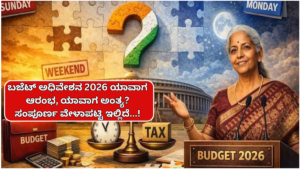
Following the approval of President Droupadi Murmu, Union Minister for Parliamentary Affairs Kiren Rijiju formally shared the dates and structure of the Budget Session. This year’s session is particularly noteworthy, not just for its length, but also for a few unusual and strategically significant features that have sparked widespread public interest.
At a time when inflation, employment, taxation, and welfare schemes dominate everyday conversations, the Union Budget 2026 is being viewed as a decisive moment—one that could bring relief to some sections of society while posing tough choices for others.
A Sunday Budget: When Economics Takes Priority Over Holidays
In a break from routine, the Union Budget will be presented on Sunday, February 1, 2026. Traditionally, Sundays are non-working days for government offices. However, when it comes to the nation’s economy, there are no holidays.
On this day, Finance Minister Nirmala Sitharaman is expected to present the full Union Budget in the Lok Sabha at 11:00 AM. The decision to present the Budget on a Sunday is being seen as a practical move—allowing citizens across the country to watch the Budget speech live without the constraints of work or school schedules. As a result, viewership and public engagement are expected to be higher than usual.
This will mark yet another milestone in India’s evolving parliamentary traditions, reinforcing the importance the government places on transparency and public participation in economic policymaking.
Budget Session 2026: A Two-Phase Parliamentary Exercise
The Budget Session of Parliament 2026 will be conducted in two distinct phases, making it one of the longer and more detailed sessions in recent years. This structure allows for both high-level discussion and in-depth scrutiny of government expenditure.
Phase One: Foundation and Presentation
1. Session Begins – January 28, 2026
The Budget Session will begin on January 28, marking the first parliamentary session of the year. As per tradition, President Droupadi Murmu will address a joint sitting of both Houses of Parliament.
This address is not merely ceremonial. It outlines the government’s policy priorities, economic vision, and legislative agenda for the coming year. It effectively sets the tone for all discussions that follow, including debates on the Union Budget.
2. Economic Survey – January 29, 2026
A day after the President’s address, the government will table the Economic Survey on January 29. Often described as the “report card” of the Indian economy, the Economic Survey provides a comprehensive overview of economic performance over the past year.
The document covers:
- GDP growth trends
- Inflation and fiscal deficit
- Employment indicators
- Sectoral performance (agriculture, manufacturing, services)
- Global economic challenges and opportunities
The Economic Survey plays a crucial role in shaping expectations around the Budget, offering context for policy decisions and fiscal allocations.
3. Budget Day – February 1, 2026
The most awaited moment arrives on February 1, when the Finance Minister presents the Union Budget for FY 2026–27. The Budget outlines:
- Revenue and expenditure estimates
- Tax proposals and reforms
- Allocations for welfare schemes
- Infrastructure and capital expenditure plans
- Fiscal deficit targets
Following the presentation, initial debates on the Budget will begin in Parliament.
4. Phase One Concludes – February 13, 2026
The first phase of the session will continue until February 13, during which Members of Parliament will participate in preliminary discussions on the Budget and related issues.
The Mid-Session Recess: Not a Break, but a Deep Dive
After February 13, Parliament will go into a recess until March 9. While it may appear like a pause, this period is one of the most critical stages of the Budget process.
During this recess:
- Parliamentary Standing Committees examine the detailed expenditure demands of individual ministries.
- Each ministry must justify how and why it intends to spend public funds.
- MPs analyze schemes, allocations, efficiency, and outcomes.
- Recommendations are prepared based on these reviews.
This behind-the-scenes scrutiny ensures accountability and prevents unchecked spending. Every rupee allocated in the Budget undergoes close examination during this phase.
Phase Two: Debate, Approval, and Conclusion
Parliament Reassembles – March 9, 2026
When Parliament reconvenes on March 9, discussions resume with renewed intensity. The Standing Committees submit their reports, which form the basis for detailed debates in both Houses.
Key activities during this phase include:
- Discussion on Demands for Grants
- Voting on expenditure proposals
- Passage of the Finance Bill
- Approval of Appropriation Bills
Once these steps are completed, the Budget receives formal parliamentary approval, allowing the government to implement its financial plans from April 1.
Session Ends – April 2, 2026
The Budget Session will officially conclude on April 2, 2026, bringing nearly two months of sustained legislative and economic deliberation to an end.
Public Expectations from Union Budget 2026
As the Budget approaches, expectations among citizens are running high. Different sections of society are closely watching for announcements that could directly impact their lives.
1. Income Tax Relief
Middle-income taxpayers are hoping for meaningful changes in income tax slabs. Expectations include:
- Higher exemption limits under the new tax regime
- Greater deductions or incentives under the old regime
- Simplification of tax compliance
With rising living costs, tax relief remains one of the most anticipated aspects of the Budget.
2. Inflation and Cost of Living
Households across India are grappling with price rises in essential commodities such as food, fuel, and utilities. Consumers, especially homemakers, are looking for:
- Measures to control inflation
- Reduced indirect taxes on essential goods
- Stronger supply-side interventions
3. Employment and Youth Opportunities
Job creation remains a central concern, particularly for young Indians entering the workforce. The Budget is expected to focus on:
- Skill development programs
- Incentives for startups and MSMEs
- Expansion of employment-linked schemes
4. Farmers and Rural Economy
Agriculture continues to support a large portion of India’s population. Farmers are hopeful for:
- Increased minimum support prices
- Higher budgetary allocations for irrigation and rural infrastructure
- Relief from input cost pressures
5. Infrastructure and Growth
Industry leaders are watching for sustained investment in:
- Roads, railways, and logistics
- Digital infrastructure
- Green energy and climate-resilient projects
Such investments are seen as key drivers of long-term economic growth.
A Budget That Shapes the Year Ahead
From January 28, when Parliament convenes in New Delhi, to April 2, when the session concludes, the Union Budget 2026 will dominate India’s political and economic discourse. These weeks of debate, analysis, and decision-making will determine how resources are allocated, which sectors receive priority, and how the government balances growth with fiscal responsibility.
Ultimately, the Union Budget is more than a financial statement—it is a reflection of the government’s vision for the country. Whether it delivers “sweetness” to some and “bitterness” to others will only become clear once the Finance Minister rises to speak on February 1, 2026.