As summer approaches, one concern troubles farmers more than any other: water scarcity. Falling groundwater levels, irregular rainfall, and rising cultivation costs have made irrigation one of the biggest challenges in Indian agriculture. Many farmers are still dependent on traditional flood irrigation methods, which waste large quantities of water and reduce soil fertility over time.
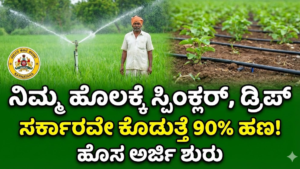
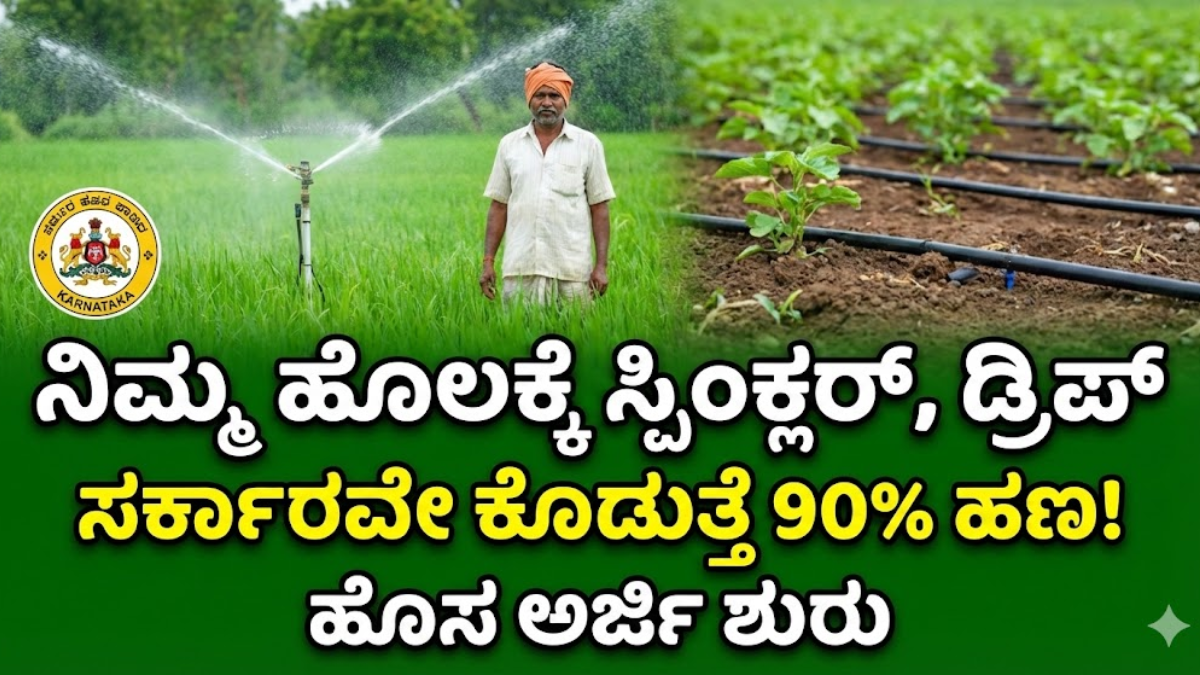
To address this growing crisis, the Central and State Governments are jointly promoting modern micro-irrigation systems such as drip irrigation and sprinklers under the flagship scheme Pradhan Mantri Krishi Sinchayee Yojana (PMKSY). Through this scheme, farmers can receive financial assistance of up to 90% of the total cost of installing drip or sprinkler irrigation systems on their farms.
This initiative aims to encourage farmers to adopt water-efficient technologies, reduce irrigation costs, and improve crop productivity. The slogan of the scheme, “Per Drop, More Crop,” highlights the core idea: use every drop of water wisely to achieve higher yields and sustainable farming.
Why Micro-Irrigation Is Important for Farmers
Traditional irrigation methods such as flooding fields consume a large amount of water, much of which is lost due to evaporation and runoff. In contrast, drip irrigation delivers water directly to the root zone of the crop, while sprinkler systems distribute water evenly across the field. These modern methods offer several benefits:
- Significant water savings (up to 40–60% compared to flood irrigation)
- Higher crop yields due to uniform moisture distribution
- Reduced electricity and diesel costs for pumping water
- Lower weed growth and better soil health
- Improved fertilizer efficiency when used with fertigation
- Suitable for horticulture crops, vegetables, fruit orchards, and even field crops
With water becoming scarcer every year, micro-irrigation is no longer a luxury—it is quickly becoming a necessity for sustainable farming.
Subsidy Details: Who Gets How Much Support?
Under PMKSY, the subsidy percentage varies depending on the farmer’s social category and landholding size. The government has designed the scheme to provide maximum support to vulnerable and small farmers.
1. SC/ST Farmers
Farmers belonging to Scheduled Castes (SC) and Scheduled Tribes (ST) are eligible for the highest level of subsidy—up to 90% of the total cost of the drip or sprinkler system. This means they only need to bear around 10% of the cost from their own pocket.
2. Small and Marginal Farmers
Small and marginal farmers are eligible for a subsidy of up to 55% of the total cost. This category includes farmers with smaller landholdings who often face financial constraints while adopting new technology.
3. Other (General Category) Farmers
Farmers from the general category can receive a subsidy of up to 45% for installing micro-irrigation systems.
Maximum Land Limit for Subsidy
The subsidy is available for landholdings of up to 5 hectares (approximately 12.5 acres). Farmers with larger landholdings can also receive benefits, but the subsidy is capped as per government norms.
Key Updates for the 2025–26 Financial Year
The Horticulture Department and Agriculture Department have introduced a few important updates and clarifications for the current financial year:
1. Seven-Year Rule Relaxation
If a farmer received a subsidy for drip or sprinkler irrigation more than seven years ago, and the old system has become damaged or unusable, the farmer is now allowed to apply again for fresh subsidy support. This provides relief to farmers whose earlier installations have worn out over time.
2. Support for Larger Landholdings
Farmers owning land beyond the basic limit can still receive subsidy support (generally at 45%) for installations up to the permissible area, subject to scheme guidelines and budget availability.
3. First-Come, First-Served Basis
The scheme has limited funds allocated each year. Applications are processed on a first-come, first-served basis, which means farmers are advised to apply as early as possible to avoid missing out on the subsidy.
Documents Required to Apply for the Subsidy
Before applying for the PMKSY micro-irrigation subsidy, farmers should keep the following documents ready:
- Aadhaar Card (identity proof)
- Latest land records / RTC / land ownership document
- Bank passbook copy (for subsidy transfer)
- Caste certificate (mandatory for SC/ST farmers seeking 90% subsidy)
- Passport-size photograph
- Proof of water source availability on the farm (well, borewell, or other irrigation source)
Having these documents ready will make the application process faster and smoother.
How to Apply for Drip and Sprinkler Subsidy
Farmers can apply for the PMKSY micro-irrigation subsidy through two simple methods: online application or direct offline application at local government offices.
Method 1: Online Application
- Visit the official PMKSY website: https://pmksy.nic.in
- Go to the Farmer Registration section.
- Register using your Aadhaar number and mobile number.
- Fill in details such as land survey number, crop type, and irrigation requirement.
- Upload required documents.
- Submit the application and keep a copy of the acknowledgment for reference.
Method 2: Offline Application (Direct Visit – Easier for Many Farmers)
Farmers who are not comfortable with online applications can visit:
- The nearest Raitha Samparka Kendra (RSK), or
- The Taluk Horticulture Department / Agriculture Office
Officials at these centers will provide the application form and guide farmers through the complete process, including document verification and selection of approved equipment suppliers.
Important Advisory for Farmers
Farmers must be careful while purchasing drip and sprinkler equipment. The government subsidy is released only if the equipment is purchased from approved companies that meet quality standards.
- Always buy products with BIS / ISI certification
- Purchase only from government-approved suppliers
- Avoid low-quality local products, as subsidy will not be sanctioned for non-approved equipment
Using certified equipment ensures durability, better performance, and timely release of subsidy amounts.
How the Subsidy Is Paid
In most cases, farmers are required to pay their share of the cost upfront. The government then releases the subsidy amount directly to the farmer’s bank account or to the authorized supplier as per the approved procedure. The exact payment mechanism may vary slightly from state to state.
Long-Term Benefits of Adopting Drip and Sprinkler Irrigation
Switching to micro-irrigation is not just about getting a subsidy—it is an investment in the future of farming. The long-term advantages include:
- Stable yields even during water-scarce seasons
- Reduced dependency on erratic rainfall
- Lower cultivation costs over time
- Better crop quality and market value
- Environmentally sustainable water usage
- Improved resilience against drought conditions
For crops such as vegetables, fruits, sugarcane, cotton, flowers, and plantations, drip irrigation can significantly increase productivity and profitability.
Final Words: A Golden Opportunity for Farmers
The government’s micro-irrigation subsidy under PMKSY is a golden opportunity for farmers to modernize their irrigation systems with minimal financial burden. With support of up to 90%, even small and marginal farmers can adopt advanced technology that was once considered expensive.
The message of the scheme is clear:
Save water, reduce costs, and increase productivity.
Farmers are strongly encouraged to collect their documents, contact their nearest agriculture or horticulture office, and apply at the earliest. With climate uncertainty and water scarcity increasing year by year, adopting efficient irrigation methods today can secure the future of farming tomorrow.