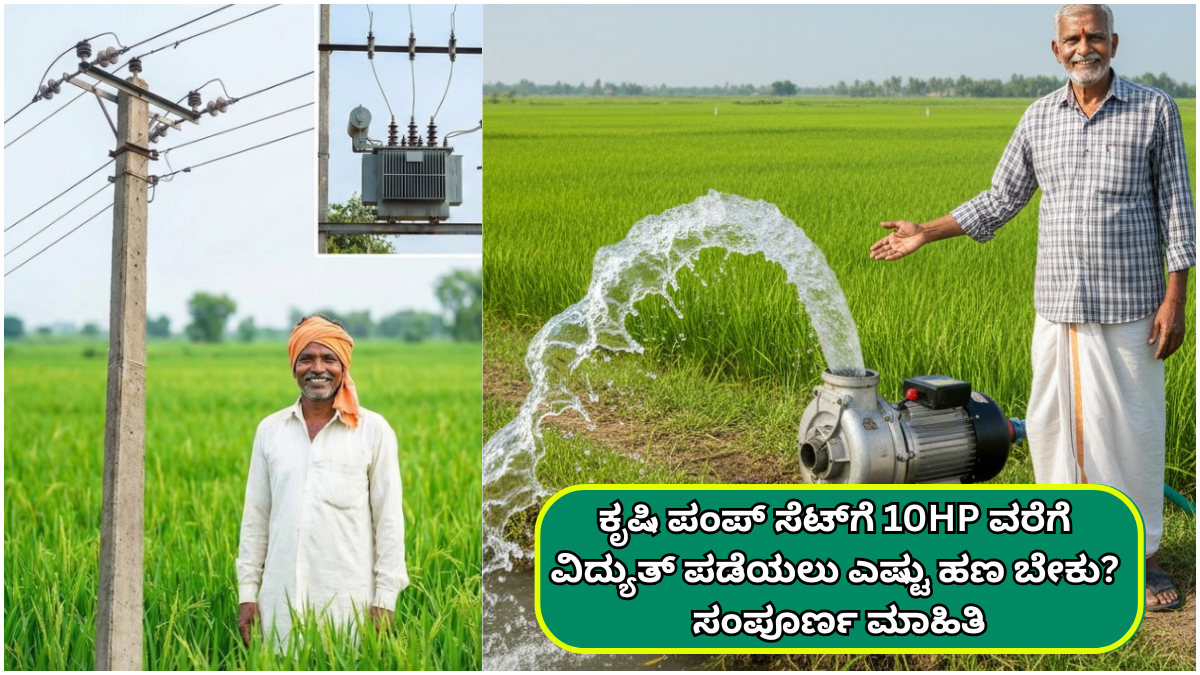
Irrigation is the backbone of Indian agriculture. A reliable water source supported by an efficient electric pump set enables farmers to cultivate crops throughout the year, improve productivity, and reduce dependence on unpredictable rainfall. Recognizing the importance of irrigation infrastructure, the Energy Department and the Government have introduced updated guidelines and simplified procedures to help farmers obtain electricity connections for agricultural pump sets up to 10 HP capacity.
This comprehensive guide explains everything farmers need to know about obtaining an agricultural electricity connection: the approximate charges, application process, required documents, the “Quick Connection Scheme,” and essential safety measures while operating pump sets. The information provided here is designed to help farmers avoid confusion, reduce delays, and ensure safe and lawful use of electricity for irrigation.
Importance of Electricity for Agricultural Pump Sets
Electricity plays a crucial role in modern farming. Whether it is borewell irrigation, open well irrigation, or lift irrigation systems, electric pump sets ensure continuous and reliable water supply. Compared to diesel pump sets, electric motors are more economical in the long run, environmentally friendly, and require less maintenance.
In many states, electricity supply for agricultural use is regulated and subsidized by the government. Farmers must apply through their respective regional electricity supply companies such as:
- Bangalore Electricity Supply Company (BESCOM)
- Hubli Electricity Supply Company (HESCOM)
- Gulbarga Electricity Supply Company (GESCOM)
- Chamundeshwari Electricity Supply Corporation (CESC)
- Mangalore Electricity Supply Company (MESCOM)
Each of these electricity supply companies operates under state electricity board guidelines and follows specific procedures for granting new agricultural connections.
What Is the Quick Connection Scheme?
In the past, farmers often had to wait for several years to receive electricity connections for agricultural pump sets due to limited infrastructure, transformer capacity constraints, and administrative delays.
To address this issue, the government introduced a “Quick Connection Scheme” (also referred to as a priority or fast-track connection system). Under this scheme:
- Farmers can receive electricity connections in a shorter time frame.
- The applicant may need to bear the cost of certain infrastructure components such as additional electric poles, transformers, or line extensions.
- Priority is given to applicants who agree to pay the required infrastructure charges.
This scheme is particularly beneficial for farmers who urgently require irrigation facilities and are willing to invest upfront to avoid long waiting periods.
Electricity Charges for Agricultural Pump Sets up to 10 HP
The cost of obtaining a new electricity connection for an agricultural pump set depends on several factors:
- Horsepower (HP) capacity of the motor
- Distance from the nearest electricity pole or transformer
- Requirement of new poles or transformer installation
- Local electricity supply company regulations
- Applicable government subsidies
Below is an approximate estimate of initial charges (including security deposit and other applicable fees) for agricultural pump sets up to 10 HP:
1. Up to 3 HP Pump Set
Approximate Charges: ₹10,000 to ₹15,000
This category typically includes small borewell or open well motors used by small and marginal farmers. Costs may vary depending on location and infrastructure requirements.
2. Up to 5 HP Pump Set
Approximate Charges: ₹18,000 to ₹25,000
This capacity is common for medium-sized farms. Additional charges may apply if line extension or new poles are required.
3. Up to 10 HP Pump Set
Approximate Charges: ₹40,000 to ₹50,000
This category covers larger agricultural fields requiring higher water output. Costs may increase if a dedicated transformer or long-distance power line is necessary.
Important Note:
The above amounts are approximate estimates. The actual payable amount may vary based on site conditions and departmental revisions. Farmers should verify the exact charges with their local electricity supply office.
Also, farmers covered under specific government schemes such as free electricity programs or irrigation subsidy initiatives may not be required to pay the full amount. Eligibility criteria vary by scheme.
Step-by-Step Application Process for New Agricultural Pump Set Connection
Farmers seeking a new agricultural electricity connection should follow the official procedure outlined below:
Step 1: Prepare Required Documents
Collect all necessary documents (detailed in the next section).
Step 2: Visit the Local Electricity Office
Visit the sub-division office of your regional electricity supply company (such as BESCOM, HESCOM, GESCOM, etc.).
Step 3: Submit Application Form
Obtain and fill out the prescribed application form for a new agricultural pump set connection. Attach all required documents.
Step 4: Site Inspection
After submission, the electricity department will conduct a field inspection to verify:
- Land ownership
- Borewell or irrigation source
- Feasibility of power supply
- Distance from existing line
Step 5: Payment of Charges
Upon approval, the department will issue a demand notice specifying the charges to be paid. The applicant must pay the amount within the stipulated period.
Step 6: Infrastructure Setup
If additional infrastructure such as poles, lines, or transformers is required, the electricity company will arrange installation.
Step 7: Installation and Energization
After completing technical formalities and safety checks, the electricity connection will be activated.
Required Documents for Agricultural Pump Set Electricity Connection
To apply for an agricultural electricity connection, the following documents are generally required:
- Land Ownership Document (RTC / Record of Rights, Tenancy and Crops)
The land document must be in the name of the applicant. - Aadhaar Card Copy
For identity verification. - Recent Passport-Size Photographs
- Borewell Certificate or Well Completion Certificate
Proof of water source, issued by the competent authority. - Power Supply Agreement on Stamp Paper (₹500 denomination)
The applicant must execute an agreement with the electricity department on non-judicial stamp paper. - Completion Report from Licensed Electrical Contractor
The internal wiring and installation must be completed by a licensed electrical contractor. A completion certificate must be submitted.
Depending on regional regulations, additional documents such as caste certificate (for subsidy eligibility), income certificate, or bank account details may also be required.
Factors Affecting the Total Cost
Even though standard charges are specified based on HP capacity, the final payable amount may differ due to:
- Distance from the nearest power line
- Need for new electric poles
- Transformer capacity upgrade
- Soil condition and terrain
- Special category schemes
If the pump location is far from the existing line, the cost of erecting poles and laying conductors can significantly increase the total expense.
Free Electricity and Subsidy Schemes
Many state governments offer free or subsidized electricity for agricultural pump sets. Under such schemes:
- Farmers may be exempted from monthly electricity bills.
- Only initial connection charges may apply.
- Priority may be given to small and marginal farmers.
However, farmers must ensure they meet eligibility criteria and submit the necessary documents to avail themselves of benefits.
Safety Guidelines for Operating Agricultural Pump Sets
Electricity can be dangerous if not handled properly. Farmers must follow strict safety measures to prevent accidents, electrical shocks, or property damage.
1. Use ISI-Certified Starter and Switches
Always install high-quality starter boxes and switches with proper certification. Substandard equipment increases the risk of short circuits and fire.
2. Proper Earthing System
Ensure that the motor and pump set have effective earthing. Proper grounding protects users from electric shock and prevents equipment damage.
3. Avoid Wet Contact
Never touch switches or starter boxes with wet hands. Avoid operating the pump during heavy rain, lightning, or thunderstorms.
4. Regular Wiring Inspection
Inspect wiring periodically to check for:
- Damaged insulation
- Loose connections
- Cut or exposed wires
Do not temporarily fix damaged wires with tape. Replace them with new, high-quality cables.
5. Protect Starter Panel
Install the starter box in a covered area to protect it from rain and moisture.
6. Avoid Overloading
Operate the motor within its rated capacity. Overloading reduces motor life and increases fire risk.
7. Install Circuit Breakers
Use MCB (Miniature Circuit Breaker) or suitable protection devices to prevent overload and short circuit.
Common Mistakes to Avoid
- Submitting incomplete documents
- Installing motor before approval
- Using unauthorized wiring
- Attempting illegal connections
- Ignoring safety norms
Illegal or unauthorized electricity connections can result in heavy penalties and disconnection.
Benefits of Proper Agricultural Electrification
A legal and properly installed electricity connection offers several advantages:
- Reliable irrigation supply
- Improved crop yield
- Reduced dependence on diesel
- Lower operational costs
- Increased farm income
- Government subsidy eligibility
With proper infrastructure, farmers can practice multi-cropping and adopt modern irrigation techniques like drip and sprinkler systems.
Final Thoughts
Obtaining an electricity connection for an agricultural pump set up to 10 HP is now more streamlined and transparent due to updated government guidelines and the introduction of the Quick Connection Scheme. Although the approximate initial investment ranges between ₹10,000 and ₹50,000 depending on motor capacity, actual costs may vary based on infrastructure requirements and regional policies.
Farmers are encouraged to:
- Contact their local electricity supply office for updated charges.
- Submit complete and accurate documentation.
- Follow all safety guidelines during installation and operation.
- Explore government subsidy schemes if eligible.
By following the correct procedure and maintaining electrical safety standards, farmers can ensure uninterrupted irrigation, improve productivity, and strengthen the foundation of their agricultural activities.
Reliable electricity is not just a utility for agriculture—it is a key driver of sustainable farming and rural development.