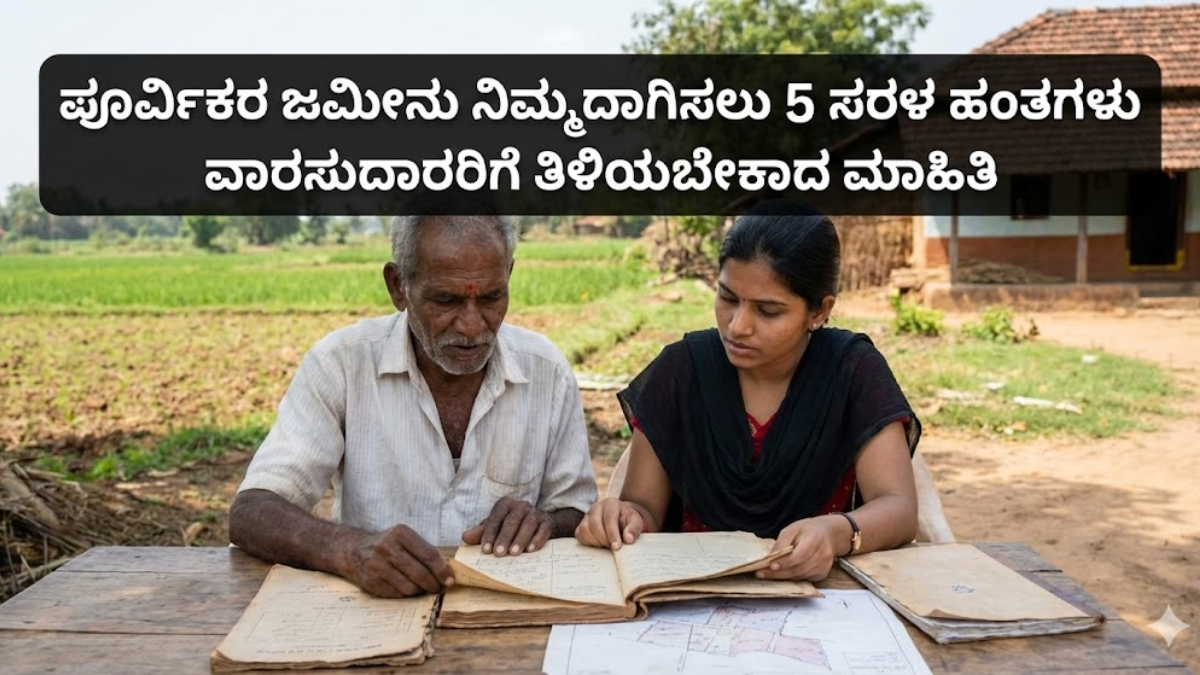
Across Karnataka, thousands of families share a similar concern. They have inherited agricultural land or ancestral property from their father or grandfather, but the official land records still carry the name of the deceased elder. The family continues to cultivate the land and live on it, yet legally the property remains unchanged in government records.
This issue is especially common in rural areas, where updating land records was not considered urgent in earlier times. As long as there were no disputes within the family, most people did not feel the need to transfer ownership formally. However, times have changed. Land records are now digitized, government benefits are linked to official data, and property disputes are increasing. If the RTC (Record of Rights, Tenancy and Crops), also called Pahani, still shows the name of your deceased father or grandfather, it may create serious legal and financial complications in the future.
The good news is that Karnataka law provides clear procedures to transfer ancestral property to legal heirs—even if some original documents are missing. This comprehensive guide explains everything in simple, practical language.
Why Updating Property Records Is Extremely Important
Many families believe that physical possession of land is enough proof of ownership. They think, “We are cultivating the land. Everyone in the village knows it belongs to us.” Unfortunately, in legal terms, possession alone is not sufficient.
Government records determine recognized ownership. If your name does not appear in revenue records, you may face the following problems:
- Difficulty in selling the property
- Problems in obtaining agricultural or bank loans
- Inability to claim crop compensation or government subsidies
- Legal disputes among siblings later
- Objections from distant relatives
- Trouble proving ownership in court
- Complications during land acquisition compensation
Even if you do not plan to sell the land, correcting the records protects your children from future disputes. Updating ownership today prevents costly litigation tomorrow.
Common Problems Families Face
Before starting the process, it is important to understand the typical challenges:
- The original Sale Deed is missing.
- Title documents are lost or damaged.
- The property remains in the name of a grandfather or father who passed away long ago.
- No mutation (Khata transfer) was done after death.
- There are multiple heirs, and records were never updated.
The reassuring fact is this: If old revenue records (RTC/Pahani) show your father’s or grandfather’s name and the property is in your family’s possession, there are legal ways to regularize ownership.
Step 1: Collect Essential Documents
Preparation is key. Before visiting any government office, gather the following documents:
1. Death Certificate
You must obtain the official death certificate of the person whose name appears in the land records. This is mandatory for inheritance-based transfer.
2. Family Tree Certificate (Legal Heir Certificate)
This document establishes who the legal heirs are. It is issued by the Tahsildar or Nadakacheri office. It must list:
- Spouse of the deceased
- All sons
- All daughters
Every legal heir must be included. Omitting a legal heir can lead to objections and delays.
3. Identity Proof
Keep copies of Aadhaar cards, ration cards, or voter IDs of all legal heirs.
4. Affidavit (Self-Declaration)
A notarized affidavit confirming that the listed individuals are the rightful legal heirs.
Having these documents ready reduces delays and prevents repeated visits to offices.
Step 2: Reconstructing Property History Without Original Documents
Many people panic if they do not have original property papers. However, government offices maintain historical records that can help reconstruct ownership details.
A. Encumbrance Certificate (EC)
Visit the Sub-Registrar Office and apply for an Encumbrance Certificate for your survey number. It is advisable to request records for the past 30–50 years.
The EC shows:
- Sale transactions
- Gift deeds
- Mortgage records
- Registered transfers
- Names of previous owners
While inheritance transfers may not always appear unless registered, EC helps establish transaction history.
B. Old RTC / Pahani Records
You can access land records through the Bhoomi portal or by visiting the Taluk office record room.
Pay attention to:
- Column 3 – Owner’s name
- Column 9 – Cultivator’s name
If your grandfather’s or father’s name appears in earlier records, it strengthens your claim.
C. Mutation Register (MR Extract)
The Mutation Register records every ownership change and the reason for it. It includes entries related to:
- Sale
- Gift
- Partition
- Inheritance
The MR Extract is often the most important document in proving ownership continuity.
Step 3: Applying for Inheritance Khata (Pavati Khata)
In Karnataka, the simplest method to transfer ancestral property after the death of an owner is through Inheritance Khata, commonly known as Pavati Khata.
This process updates revenue records in the names of legal heirs.
Application Process:
- Visit a Nadakacheri center or log into the Seva Sindhu portal.
- Select Revenue Department services.
- Choose “Pavati Khata” or “Inheritance Khata.”
- Upload required documents:
- Death Certificate
- Family Tree Certificate
- Identity proofs
- Affidavit
- Pay the prescribed fee (generally ₹25–₹40).
What Happens Next?
- The application is forwarded to the Village Accountant.
- A local inspection may be conducted.
- Notice is issued to all legal heirs.
- If no objections are raised within about 30 days,
- The Tahsildar approves the mutation.
- The property is transferred as Joint Khata in the names of all heirs.
Understanding Joint Khata
Joint Khata means all legal heirs’ names are entered together in revenue records. It confirms collective ownership.
Important: Joint Khata does not divide the land physically. It only records ownership rights jointly.
If heirs want individual shares, they must execute a registered Partition Deed.
Step 4: Dealing with Family Disputes
Scenario 1: One or More Heirs Refuse to Cooperate
If siblings refuse to sign or object to mutation, the process becomes complicated.
Option A: Family Settlement
Conduct a discussion and execute a registered Partition Deed dividing shares amicably.
Option B: Civil Court
File a Partition Suit in Civil Court seeking your lawful share.
Court cases take time and money. Mutual agreement is always better.
Scenario 2: Property in Another Person’s Name – But You Possess It
Sometimes land records show someone else’s name, but your family has been in possession for decades.
In such cases, the doctrine of Adverse Possession may apply.
Basic Legal Rule
If a person has been in continuous, open, and uninterrupted possession of property for more than 12 years, without objection from the original owner, they may claim ownership through court.
Evidence Required:
- Electricity bills for 12+ years
- Land revenue payment receipts
- Property tax receipts
- Aadhaar/Voter ID showing the same address
- Witness statements from neighbors
- Crop cultivation records
Important: Adverse possession must be established through court proceedings. It is complex and requires expert legal assistance.
Government Grievance Programs
The Karnataka government occasionally conducts revenue grievance camps and special outreach programs in villages.
In such camps:
- Citizens can submit property-related applications directly.
- Officers review documents on the spot.
- Some issues are resolved faster.
Attending these camps may reduce delays.
Risks of Delaying Property Transfer
Failing to update records can lead to:
- Future inheritance disputes among children
- Objections during sale
- Delay in bank loan approvals
- Loss of compensation during land acquisition
- Denial of crop insurance benefits
- Increased legal expenses later
Early correction is simpler, cheaper, and safer.
Practical Action Checklist
To simplify the process, follow this order:
- Obtain death certificate.
- Get Family Tree certificate.
- Collect identity documents of all heirs.
- Retrieve old RTC copies.
- Obtain EC and MR Extract if necessary.
- Apply for Pavati Khata.
- Follow up with Village Accountant.
- Verify updated RTC reflects heirs’ names.
Keep certified copies safely.
When You Should Consult a Lawyer
Seek professional legal help if:
- There are disputes among heirs.
- Historical records are unclear.
- Property was transferred multiple times.
- There are third-party claims.
- You are considering adverse possession.
- Property value is high.
A qualified property lawyer can prevent costly errors.
Important Legal Clarifications
- Mutation does not create ownership; it records inheritance.
- Revenue records prove possession and recognition, but title depends on lawful succession and registered documents.
- Always maintain certified copies of important records.
- Never ignore notices issued by revenue authorities.
Final Thoughts
Ancestral land is not just property—it represents your family’s history, identity, and hard work. Failing to update ownership records can create unnecessary hardship for future generations.
Even if original documents are missing, do not assume the situation is hopeless. Karnataka’s legal framework provides structured procedures to transfer ancestral property to rightful heirs.
Take action today:
- Collect documents
- Verify historical records
- Apply for inheritance mutation
- Resolve disputes early
Protecting your elders’ property is your responsibility. By acting now, you safeguard your family’s legal rights and ensure peace of mind for years to come.