Bengaluru: A Historic Welfare Decision for Grassroots Revenue Staff
In a landmark welfare decision, the Government of Karnataka has announced a major financial relief scheme for Grama Sahayakas (Village Assistants) working under the Revenue Department. For decades, Grama Sahayakas have served as the backbone of village administration, yet remained among the most neglected sections of the government workforce in terms of social security and retirement benefits.
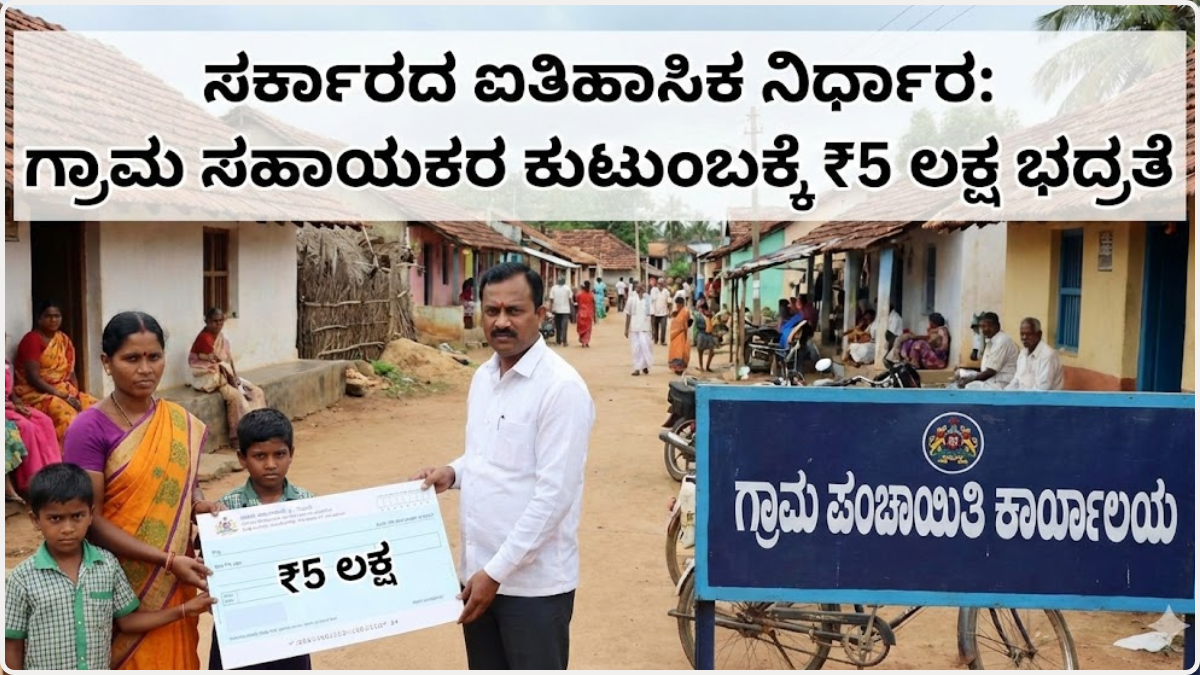
Recognizing their long-standing demands and the hardships they face after retirement or in the event of death during service, the state government has now introduced a one-time lumpsum financial assistance of up to ₹5 lakh. This benefit will be extended either to the retired Grama Sahayaka upon attaining the age of 65 years or to the legal heirs of a Grama Sahayaka who passes away while in service.
The official government order issued on 6 February 2026 marks a significant step towards providing social and financial security to thousands of families dependent on Grama Sahayakas across Karnataka. This article provides a comprehensive overview of the background of the scheme, eligibility conditions, application process, role of officials, financial implications, and the broader significance of this decision for rural governance.
Who Are Grama Sahayakas? Historical Background and Their Role in Karnataka
Evolution of the Grama Sahayaka System
The system of Grama Sahayakas traces its origins to the Karnataka Village Offices Abolition Act, 1961. Before this reform, village administration was handled by hereditary village officers such as Patel and Shanbhog. With the abolition of the old feudal village office system, the state introduced modern administrative mechanisms and created the post of Grama Sahayaka to assist Village Accountants and other revenue officials in grassroots governance.
Over the decades, Grama Sahayakas have become indispensable to rural administration. They act as the first point of contact between villagers and the Revenue Department, playing a crucial role in the implementation of government schemes and delivery of public services at the village level.
Key Responsibilities of Grama Sahayakas
Grama Sahayakas perform a wide range of essential duties, including:
- Assisting in land records and revenue-related documentation
- Supporting village accountants in maintaining pahani (RTC) and mutation records
- Participating in crop surveys and agricultural data collection
- Assisting in election duties and census operations
- Helping in disaster management during floods, droughts, and other emergencies
- Acting as a bridge between rural citizens and government offices
Despite their extensive workload and responsibilities, Grama Sahayakas have historically been treated as honorary workers rather than regular government employees, receiving modest honorariums instead of structured pay scales and service benefits.
Long-Standing Demands and Struggles of Grama Sahayakas
For many years, Grama Sahayaka associations and unions have raised multiple demands before successive state governments. Their primary grievances included:
- Lack of regular government employee status
- Absence of pension or retirement benefits
- No access to provident fund or social security schemes
- Low monthly honorarium compared to workload
- Absence of medical and insurance benefits
Due to the nature of their work, many Grama Sahayakas continue working well into old age, often with no financial backup for their post-retirement life. The lack of a pension system meant that retired Grama Sahayakas had to depend entirely on family support or daily wage labor to survive.
Several rounds of protests, memorandums, and negotiations were held with the government over the years. While some incremental improvements were made in honorarium amounts, comprehensive retirement benefits remained elusive until now.
Highlights of the Government Order Dated 6 February 2026
The Karnataka Government’s official order issued on 6 February 2026 introduces a one-time lumpsum benefit scheme for Grama Sahayakas. The key highlights of the order include:
1. Lumpsum Financial Assistance of ₹5 Lakh
Under the new scheme, eligible beneficiaries will receive a one-time lumpsum amount of up to ₹5,00,000 in the following circumstances:
- When a Grama Sahayaka retires upon attaining the age of 65 years
- In case of the death of a Grama Sahayaka while in service, the lumpsum amount will be paid to the legal heirs
This financial assistance aims to provide basic economic security to retired workers or bereaved families.
2. Coverage of Existing Workforce
According to official estimates, more than 9,900 Grama Sahayakas currently serving in the Revenue Department will be covered under this scheme. This ensures that a significant portion of the grassroots administrative workforce benefits from the decision.
3. Link to Previous Honorarium Revision
The government order also refers to the earlier decision to revise the monthly honorarium of Grama Sahayakas from ₹13,000 to ₹15,000 with effect from 1 April 2024. The introduction of the lumpsum benefit is being presented as a continuation of the government’s efforts to improve the welfare of Grama Sahayakas.
Eligibility Criteria for Receiving the Lumpsum Benefit
The scheme is not universal but subject to specific eligibility conditions laid down by the government. These include:
1. Age-Based Retirement
- The Grama Sahayaka must have completed 65 years of age
- The retirement should be in accordance with official guidelines and with a clean service record
2. Death During Service
- If a Grama Sahayaka dies while still in service, the lumpsum amount will be paid to the legal heirs
- Legal heirs may include spouse, children, or other dependents as recognized by law
3. Service Verification
- The applicant must provide proof of service as a Grama Sahayaka
- Official records maintained by the Revenue Department will be used for verification
4. Compliance with Government Guidelines
- Applicants must fulfill all documentation requirements and adhere to procedural norms specified in the government order
Application Process: Step-by-Step Guide
To ensure transparency and accountability, the government has laid down a structured application and approval process.
Step 1: Submission of Application
Eligible Grama Sahayakas or legal heirs must submit an application in the prescribed format. The application must be accompanied by relevant documents such as:
- Proof of identity
- Service certificate issued by the Revenue Department
- Age proof or retirement order (for retired applicants)
- Death certificate (in case of deceased employees)
- Legal heir certificate and bank account details
Step 2: Verification by Tahsildar
The Tahsildar of the respective taluk will:
- Verify the authenticity of the application and supporting documents
- Cross-check service records
- Confirm eligibility under the scheme
After verification, the Tahsildar will forward the application with recommendations to the District Collector (Deputy Commissioner).
Step 3: Approval by Deputy Commissioner
The Deputy Commissioner (DC) will:
- Conduct a final review of the application
- Ensure compliance with government norms
- Issue the approval order for the release of the lumpsum amount
Step 4: Disbursement of Funds
Upon approval, the sanctioned amount will be credited directly to the beneficiary’s bank account through the government treasury system, ensuring minimal delays and transparency.
Financial and Social Impact of the Scheme
Economic Relief for Retired Workers
For many Grama Sahayakas, the ₹5 lakh lumpsum amount will serve as a crucial financial cushion. The funds can be used for:
- Medical expenses during old age
- Repayment of debts
- Housing repairs or basic living needs
- Supporting children’s education or marriage expenses
Support for Families of Deceased Workers
Families of Grama Sahayakas who die during service often face sudden financial instability. The lumpsum assistance provides immediate relief and helps families cope with funeral expenses, daily living costs, and future uncertainties.
Boost to Morale of Grassroots Workers
The decision is also expected to boost morale among serving Grama Sahayakas. Feeling recognized and valued by the government can improve job satisfaction, motivation, and overall efficiency in delivering public services at the village level.
Broader Significance for Rural Governance in Karnataka
Grama Sahayakas form the foundation of rural governance. Their work ensures the smooth functioning of land administration, welfare scheme implementation, and coordination between citizens and government institutions. By providing them with social security, the government is strengthening the administrative machinery at the grassroots level.
This move also sets a precedent for extending welfare measures to other categories of honorary and contract-based government workers who play critical roles in public service delivery but often lack long-term security.
Political and Administrative Context
The decision to introduce the lumpsum benefit scheme was reportedly discussed and approved in a cabinet meeting held in September 2025. The formal government order issued in February 2026 gives legal and administrative backing to the policy decision.
Senior officials from the Revenue Department and state leadership have described the move as an acknowledgment of the decades of service rendered by Grama Sahayakas under challenging conditions.
Challenges and Implementation Considerations
While the scheme is widely welcomed, certain challenges may arise during implementation:
- Timely processing of applications at taluk and district levels
- Ensuring accurate service records for long-serving Grama Sahayakas
- Avoiding delays in fund disbursement
- Creating awareness among beneficiaries about the application process
To address these issues, the government may need to conduct awareness campaigns, streamline documentation procedures, and leverage digital platforms for faster processing.
Conclusion: A Step Towards Dignity and Social Security
The Karnataka Government’s decision to grant a ₹5 lakh lumpsum benefit to Grama Sahayakas upon retirement or death during service represents a long-overdue recognition of their invaluable contribution to rural administration. While the scheme does not replace a full-fledged pension system, it provides meaningful financial support to workers who have spent their lives serving the state at the grassroots level.
This policy initiative reflects a growing awareness of the need to extend social security measures beyond permanent government employees to include contractual and honorary workers who form the invisible backbone of governance. If implemented efficiently and transparently, the scheme has the potential to transform the post-retirement security landscape for thousands of families across Karnataka.
In the long run, such measures can contribute to a more inclusive and humane public administration system—one that values not just policy outcomes but also the well-being of those who make governance possible at the ground level.