Every year, the arrival of May and June brings not just summer heat but also financial stress for millions of parents across Karnataka. The reopening of schools means fresh admissions, uniforms, shoes, bags, textbooks, notebooks, and various other essentials. For families from poor and middle-income backgrounds, these “back-to-school” expenses often take up a significant portion of their monthly income.

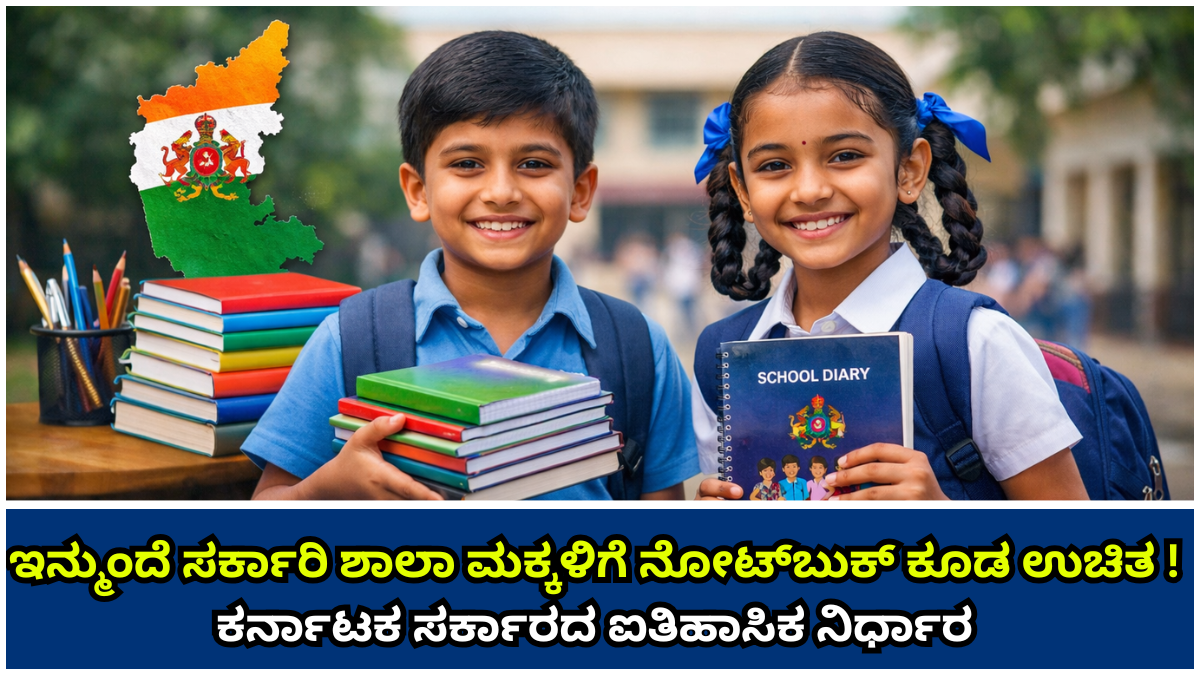
While private schools continue to demand high fees and, in many cases, hefty donations, many parents prefer government schools hoping at least basic education-related expenses will remain affordable. In a landmark and highly welcomed decision, the Government of Karnataka has now announced that from the 2026–27 academic year, students studying in government and aided schools and colleges will receive free notebooks and school diaries along with textbooks.
This historic move is expected to bring massive financial relief to parents and guardians, reduce dropout rates, and strengthen the overall public education system in the state.
The Hidden Cost of Education: Why Notebooks Matter
For many years, the Karnataka government has been providing free textbooks to students studying in government and aided schools under the Department of Education’s welfare initiatives. However, parents were still required to purchase notebooks, workbooks, and other stationery items.
At first glance, notebooks may seem inexpensive. But when broken down annually, the cost becomes significant:
- A student typically studies 6 to 8 subjects per year.
- Most schools require two notebooks per subject – one for classwork and one for homework.
- This alone means 12 to 16 notebooks per child per year.
- Add rough notebooks, drawing books, practical notebooks, and revision books, and the number increases further.
For families with two or three school-going children, notebook expenses alone can run into thousands of rupees annually. For daily wage workers, farmers, and low-income families, this recurring cost becomes a heavy burden.
Recognizing this reality, the Karnataka government has decided to expand its free education kit to include notebooks and school diaries, ensuring that students are not disadvantaged due to lack of basic learning materials.
What Is the New Scheme?
The decision has been taken under the broader framework of the state’s education welfare initiatives, including the Vidya Vikas Yojana. Until now, this scheme focused primarily on distributing free textbooks and basic learning materials. From the academic year 2026–27 onwards, the scheme will be expanded to include:
- Free notebooks
- Free school diaries (daily planners)
- Continued free supply of textbooks and workbooks
This means that students will receive a more complete academic kit at the beginning of the school year, allowing them to focus on learning rather than worrying about resources.
Who Will Benefit from This Scheme?
According to official estimates, nearly 61 lakh (6.1 million) students across Karnataka will benefit from this initiative. The coverage includes:
1. Primary and Secondary School Students (Classes 1 to 10)
All students studying in:
- Government schools
- Government-aided (Aided) schools
from Class 1 to Class 10 will receive free notebooks, textbooks, and diaries.
2. Pre-University Students (PUC)
Students studying in:
- Government Pre-University Colleges (PU Colleges)
including both 1st PUC and 2nd PUC, will also be covered under this scheme.
This wide coverage ensures that students from early childhood education to pre-university level receive equal support.
What Will Be Included in the Free Education Kit?
From 2026–27, the standard education kit provided to eligible students will include:
- Textbooks – Subject-wise prescribed textbooks
- Workbooks – Practice and activity books
- Notebooks – Adequate number based on subjects and grade level
- School Diary – Daily planner for homework, attendance, and communication with parents
This is the first time the Karnataka government is officially including notebooks and diaries as part of the free student kit, making the initiative more comprehensive than ever before.
Focus on Quality: No Compromise on Standards
In the past, government-supplied textbooks and materials were often criticized for:
- Poor paper quality
- Thin pages
- Low-quality printing
- Binding issues
To address these concerns, the Department of Education has issued strict instructions to ensure high quality standards for the newly introduced notebooks and diaries.
Quality Assurance Measures
- Paper Quality (GSM): Notebooks must meet minimum GSM standards to ensure durability.
- Printing Standards: Clear printing, proper ruling, and strong binding will be mandatory.
- Durability: Notebooks should last throughout the academic year without pages tearing easily.
Officials have clearly stated that there will be no compromise on quality, and suppliers will be held accountable for substandard materials.
Timely Distribution: Before the Academic Year Begins
One of the major complaints from parents in previous years was delayed distribution of textbooks, sometimes weeks after schools reopened. To prevent this, the government has directed education authorities to ensure:
- All textbooks, notebooks, and diaries are supplied to schools during the summer vacation itself.
- Students receive the complete kit on the very first day of school in the 2026–27 academic year.
This step will help students start the year on equal footing, without missing out on classwork due to lack of notebooks.
Strict Action Against Corruption and Irregularities
To maintain transparency and accountability, the Karnataka government has announced strict measures against corruption in the procurement and distribution process.
- If officials or suppliers submit false claims, inflate numbers, or compromise on quality, criminal cases will be registered.
- Regular audits and inspections will be conducted to ensure materials reach students without leakage or misuse.
- Schools will be required to maintain records of distribution to prevent duplication and fraud.
This strong stance aims to ensure that the benefits of the scheme reach students directly, without middlemen profiting unfairly.
Budget Allocation for the Scheme
The state government has allocated approximately ₹30.83 crore specifically for the procurement and distribution of notebooks and school diaries under this new initiative. This is in addition to the existing budget for free textbooks and workbooks.
The allocation reflects the government’s growing investment in strengthening public education infrastructure and reducing the financial burden on families.
No Application Required: How Students Will Receive the Benefits
One of the most parent-friendly aspects of this scheme is its simplicity.
- No separate application is required.
- Students who are enrolled in government or aided schools/PU colleges will automatically receive the free education kit.
- Schools will distribute the materials directly to students at the beginning of the academic year.
This removes bureaucratic hurdles and ensures universal coverage among eligible students.
How This Scheme Will Help Parents
The financial impact of this initiative on households will be significant:
- Parents can save thousands of rupees per child per year on notebooks alone.
- The money saved can be redirected towards:
- Better nutrition
- Private tuition if needed
- Digital learning tools
- Healthcare and other family needs
For families with multiple children, the cumulative savings will be even higher, offering meaningful economic relief.
Impact on Students and Education Outcomes
Beyond financial relief, this scheme is expected to have a positive impact on learning outcomes:
- Reduced Dropout Rates
Many students from poor families drop out due to inability to afford basic school supplies. Free notebooks can help prevent such cases. - Improved Classroom Participation
When every child has notebooks, teachers can assign written work more confidently, improving engagement and discipline. - Greater Equality
The scheme ensures that students from disadvantaged backgrounds have the same learning tools as their peers. - Encouragement for Government School Enrollment
As facilities and support improve, more parents may prefer government schools over low-quality private institutions, strengthening the public education system.
Strengthening the Public Education System in Karnataka
This decision aligns with Karnataka’s broader efforts to improve the quality and appeal of government education. Over the years, the state has introduced several initiatives such as:
- Free uniforms and shoes
- Midday meal schemes
- Scholarships and incentives
- Digital classrooms in selected schools
Adding free notebooks to this list signals a shift towards holistic support, addressing not just tuition but also essential learning materials.
Challenges and What to Watch Out For
While the policy announcement is promising, successful implementation will depend on:
- Efficient procurement processes
- Timely printing and distribution
- Transparent monitoring at school and district levels
- Feedback mechanisms for parents and teachers
If these systems work well, the scheme could become a model for other states in India to follow.
Conclusion: A Small Step with a Big Impact
The Karnataka government’s decision to provide free notebooks and school diaries along with textbooks from 2026–27 may appear like a small administrative change. In reality, it represents a powerful step toward making education truly accessible and affordable for millions of families.
By reducing the hidden costs of schooling, the state is sending a clear message: no child should be denied quality education due to lack of basic resources. If implemented effectively, this initiative could transform the schooling experience for lakhs of students and significantly strengthen Karnataka’s public education system in the years to come.