The Government of Karnataka has presented its 2026–27 state budget with a strong focus on agricultural growth, rural development, infrastructure expansion, and social welfare. The budget has been introduced under the theme “Empowerment for All and Expanding Opportunities,” emphasizing inclusive development across sectors.
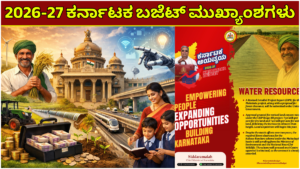
This financial plan aims to strengthen the economy by investing heavily in agriculture, irrigation, infrastructure, education, healthcare, and technology-driven governance. Special attention has been given to enhancing farmers’ income, improving rural livelihoods, modernizing public infrastructure, and promoting sustainable development.
The budget outlines major allocations and policy initiatives across numerous departments, including irrigation, agriculture, transportation, tourism, technology, education, and welfare sectors. It also continues several popular social guarantee schemes while launching new programs to support innovation and employment.
Below is a detailed overview of the key announcements and sector-wise allocations in the Karnataka Budget 2026–27.
Agriculture and Rural Development
Agriculture remains a central pillar of Karnataka’s economy, and the 2026–27 budget prioritizes initiatives aimed at improving productivity, strengthening supply chains, and increasing farmers’ income.
The government has announced a major credit program through the cooperative sector. Around 38 lakh farmers will receive interest-free agricultural loans totaling ₹30,000 crore during the current financial year. This initiative aims to reduce farmers’ financial burden and encourage investment in modern agricultural practices.
Another significant program is the “Chief Minister’s Agricultural Expansion” scheme, which will be implemented over the next three years with an allocation of ₹100 crore. The scheme aims to strengthen post-harvest activities, improve value addition, and increase farmers’ profitability.
To support environmentally sustainable farming practices, the government has introduced the “Vasudhamrutha” initiative, which encourages eco-friendly farming and resource-efficient agricultural methods.
In addition, farmers will receive timely information about pest and disease control through the “Sasya Sanjeevini” program, which will provide guidance on crop protection, biological pest management, and safe agricultural practices.
To improve accessibility to farm inputs, pilot farmer malls will be established in every taluk of Kolar District. These malls will provide seeds, fertilizers, pesticides, and agricultural equipment under one roof.
Irrigation and Water Resource Development
Water management and irrigation projects received significant attention in the 2026–27 budget.
The government has committed to accelerating progress on two major projects:
- Mekedatu Project
- Yettinahole Drinking Water Project
The revised Detailed Project Report (DPR) for the Mekedatu project will soon be prepared and submitted to the central government for necessary approvals, including forest clearance.
Under the second phase of the Yettinahole project, remaining canal works covering 18.73 kilometers will be completed quickly. A balancing reservoir with a storage capacity of 1.2 TMC will also be constructed near Vaderahalli in Koratagere.
The government will also implement 75 irrigation projects across the Krishna, Cauvery, and Godavari river basins with a total investment of approximately ₹8,045 crore.
Additional irrigation projects include new reservoirs, groundwater recharge initiatives, and lake rejuvenation programs in various districts.
Minor Irrigation and Lake Rejuvenation
The state plans to strengthen minor irrigation infrastructure to improve water availability for agriculture and rural communities.
Under the Hebbal–Nagawara Valley Phase III project, a water-filling initiative will supply water from the Amani Lake in Sidlaghatta to 164 lakes across Sidlaghatta and Chintamani taluks. The project will cost approximately ₹237 crore.
Another project will utilize treated wastewater from the HN Valley Project to fill 59 lakes in Sulibele and Nandagudi hoblis of Hoskote taluk.
In addition, a large project worth ₹650 crore will channel treated water from the Vrishabhavathi Valley in Bengaluru to refill 41 lakes across Nelamangala and Doddaballapura taluks.
These initiatives are expected to improve groundwater levels and enhance water security.
Fisheries and Animal Husbandry
The budget also includes measures to support fisheries and livestock farmers.
The value of the free fishing equipment kit provided to fishermen will be increased from ₹10,000 to ₹20,000. A Center of Excellence for fisheries and marine biotechnology will be established at the fisheries college in Mangaluru.
Fish marketing infrastructure will be developed in several districts, including Uttara Kannada, Dakshina Kannada, Udupi, and Bagalkot.
In the animal husbandry sector, 100 new veterinary hospital buildings will be constructed with support from National Bank for Agriculture and Rural Development (NABARD). Fifteen taluk veterinary hospitals will also be upgraded to polyclinic status.
Transportation and Public Infrastructure
The transportation sector has received significant investment to improve mobility and sustainability.
The government will allocate ₹5,300 crore for the Shakti scheme, which provides free bus travel for women in the state.
A major modernization program will include the addition of 1,000 new diesel buses and 4,000 electric buses to public transport fleets. Several electric bus depots will also be developed for state transport corporations and Bangalore Metropolitan Transport Corporation.
New automated driving test tracks will be constructed in Chikkamagaluru and Tumakuru.
The government will also construct new bus stands in Ramdurg, Honnali, and Gadag, along with a bus depot in Tarikere.
Roads, Highways, and Urban Development
Infrastructure development is another key focus area in the budget.
The government plans to invest ₹5,000 crore to upgrade 1,846 kilometers of state highways under the State Highway Development Project Phase V.
Additionally:
- 2,200 km of state highways will be improved
- 3,500 km of district roads will be upgraded
These projects will involve a total investment of approximately ₹5,776 crore.
In urban development, major investments will be made in road infrastructure in Bengaluru, including white-topping of 157 km of roads and upgrades to arterial and sub-arterial roads.
A 450-crore project will develop the Outer Ring Road stretch between Silk Board Junction and KR Puram Metro Station.
Energy and Renewable Power
The energy sector received major allocations to promote renewable power and strengthen electricity supply.
The Gruha Jyothi scheme, which provides free electricity to households within certain limits, will receive ₹10,578 crore.
A new initiative called the Chief Minister Solar Agriculture Scheme will establish 3,000 MW of solar power capacity with an investment of around ₹10,500 crore.
In addition, Battery Energy Storage Systems (BESS) will be installed at substations in Huliyur, Pavagada, and Kushtagi to enhance grid reliability.
The state also plans to set up 1,250 electric vehicle charging stations across public locations.
Tourism Development
Tourism is another sector receiving significant attention in the 2026–27 budget.
The government will implement a Comprehensive Coastal Development Program to promote tourism in Karnataka’s coastal districts.
A major ropeway project will be developed between Mullayanagiri and Seethalayyanagiri in Chikkamagaluru District to boost tourism.
The state will also train 1,000 heritage volunteers, known as “Monument Friends,” to assist in protecting over 844 protected monuments and 1,000 unprotected heritage sites.
Technology and Innovation
The budget emphasizes technology and innovation to position Karnataka as a global tech leader.
An AI and Robotics Technology Park will be established under the guidance of Indian Institute of Science.
In collaboration with Indian Space Research Organisation and KEONICS, a new robotics and artificial intelligence campus named BRAINz (Bengaluru Robotics and AI Innovation Zone) will be developed.
An AI Center of Excellence will also be established at Indian Institute of Information Technology Raichur.
Additionally, a futuristic Science City is planned in Bengaluru after receiving approval from the central government.
Education and Skill Development
Education and skill development remain a major priority.
The government plans to fill 15,000 teaching vacancies across schools and colleges. A total of 800 institutions will be upgraded into Karnataka Public Schools over the next three years with an investment of ₹3,900 crore.
Under the K-QUEST program, the state will invest ₹1,386 crore to improve infrastructure and training quality in Industrial Training Institutes.
Several new government degree colleges will also be established in districts such as Vijayapura, Belagavi Rural, Mysuru, and Raichur.
Health and Social Welfare
Healthcare infrastructure will receive substantial funding.
The government has allocated ₹620 crore for construction of medical colleges and hospitals and ₹220 crore for medical equipment procurement.
The Jayadeva Institute of Cardiovascular Sciences and Research hospital in Mysuru will be upgraded to a 600-bed facility.
Super specialty hospitals will also be built in Karwar and Yadgir.
Children under 18 suffering from Type 1 Diabetes will receive free insulin pens under a new health initiative.
Housing and Urban Welfare
The government aims to complete 3 lakh houses during the current financial year.
Additionally, 50,000 residential plots will be distributed at subsidized rates under the state housing board’s programs.
A large sports infrastructure project called KHB Surya Sports Village will also be developed in Anekal taluk, featuring an 80,000-seat international cricket stadium.
Conclusion
The Karnataka Budget 2026–27 represents a comprehensive roadmap for economic growth, rural development, technological advancement, and social welfare. With substantial investments in agriculture, irrigation, infrastructure, education, healthcare, and renewable energy, the state government aims to build a more inclusive and sustainable future.
By strengthening rural economies, promoting innovation, and improving public infrastructure, the budget seeks to enhance the overall quality of life for citizens while maintaining Karnataka’s position as one of India’s leading states in development and technological progress.